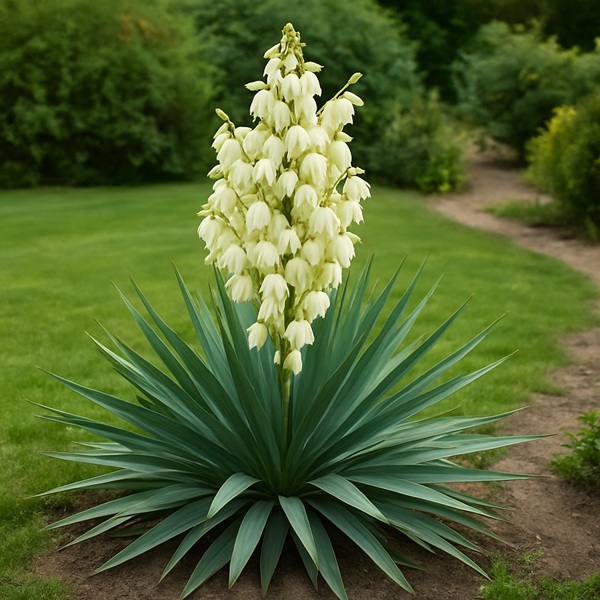
Yucca is a striking ornamental plant with evergreen, sword-shaped leaves that in recent years has been steadily winning over Ukrainian gardens and home plots. Thanks to its exotic appearance, low maintenance needs, and hardiness, it has become popular both among indoor plant lovers and among those who prefer growing plants in open ground. Some species, including threadleaf yucca (Yucca filamentosa), Spanish dagger (Yucca gloriosa), and their hybrids, have adapted well to the conditions of southern and central Ukraine, and with proper winter protection they can also survive winters in more temperate regions.
Yucca comes from the arid regions of North and Central America, so it is perfectly adapted to heat, bright sun, poor soils, and temperature fluctuations. Its characteristic structure is a rosette of long, stiff, pointed leaves growing vertically from the center. In summer, yucca sends up a tall flower stalk (up to 1.5–2 m) densely covered with white, bell-shaped flowers. Flowering usually begins 2–3 years after planting and lasts up to 4 weeks. Yucca fits beautifully into garden compositions — from rock gardens to single accent plants in landscape design.
In Ukraine, yucca is planted both in open ground and in containers. It combines well with xerophytic crops, looks excellent against a lawn or stonework, and makes it possible to create Mediterranean- or desert-style gardens. The main thing is to choose the right species, prepare the soil properly, and follow the basic care requirements. In return, yucca rewards you with many years of stable ornamental appeal and a spectacular appearance.
Yucca is a sun-loving plant, so the main requirement for the site is maximum sunlight exposure. In shade or partial shade, it loses its compact form, becomes stretched, and its leaves grow dull. In addition, it is highly sensitive to standing water, especially during the cold season, so site selection should be taken seriously.
Growing conditions:
Light: direct sunlight for at least 6–8 hours a day. Yucca tolerates heat and overheating well.
Soil: loose, sandy loam or sandy humus-rich soil. The optimal pH is 6.0 to 7.5. In acidic soil, ash or dolomite flour is added.
Drainage: essential. In open ground — a 10–15 cm layer of crushed stone or broken brick; in containers — one-third of the pot volume.
Yucca is most often planted:
on raised sites where meltwater does not accumulate;
on dry southern slopes;
in mixed borders with drought-tolerant grasses and perennials;
as a specimen plant in the middle of a lawn or against a fence.
Container-grown yucca should be placed on southern terraces, balconies, or verandas. The container should be sturdy, wind-resistant, and have good drainage.
Yucca is planted in open ground in spring (April–May), when the soil warms up to +12°C. Autumn planting is also possible (September), but only with winter protection in mind. In containers, planting can be done at any time except during the cold season.
Step-by-step planting:
Dig a hole according to the size of the root system (usually 40–60 cm deep and wide).
Lay in drainage (10–15 cm).
Fill the hole with a mixture of garden soil, sand, and humus (2:1:1).
Set the plant in place without burying the growing point.
Fill with substrate, firm it down, and water (10–12 liters of water).
During the first weeks after planting, direct sun should be limited, especially for plants moved from containers. They can be shaded with agrofabric or temporarily sheltered by a decorative companion plant. The spacing between bushes should be at least 1 m, since over time yucca forms a large rosette.
Container planting:
Pot volume: from 10 liters for young plants, 20–30 liters for mature ones.
Substrate: a special succulent mix or a self-made light, well-drained soil blend.
A must: drainage holes and a movable base or stand.
Yucca is low-maintenance, but basic care should not be neglected, especially in the first year after planting. Successful cultivation depends on properly organized watering, moderate feeding, sanitary pruning, and monitoring the plant’s condition throughout the season.
Watering:
Spring–summer: water once every 10–14 days. The soil should dry out completely between waterings. Water in the morning or evening, at the base.
Autumn: gradually reduce to once every 3–4 weeks.
Winter: do not water at all in open ground. In containers — no more than once a month.
Excess moisture is yucca’s main enemy. In waterlogged soil, the root system rots. It is better to skip a watering than to overwater.
Feeding:
Done 2–3 times a year, from May to August.
Preference is given to mineral fertilizers for succulents or flowering perennials with a high potassium and phosphorus content.
Nitrogen fertilizers should be avoided — they stimulate green growth but reduce winter hardiness.
Pruning:
Flower stalks are cut off after flowering ends.
Dry leaves are removed only when they are completely dry — they protect the trunk.
If needed, rejuvenating pruning is done by cutting off the top of the plant and rooting it separately.
Yucca is easy to propagate even for beginners. The most common methods are division of the clump, separation of side shoots, and rooting the top. This makes it possible not only to renew plantings, but also to create new decorative accents in the garden.
Division of the clump:
Done in spring or autumn.
The plant is dug up and divided into sections with roots and at least one growing point.
Each section is planted separately.
The first watering is done after 5–7 days.
Separating offsets:
Yucca often produces side shoots at the base.
These are cut off with a sharp knife in spring and planted in light soil.
They are kept in partial shade until growth begins.
Top cuttings:
The top of a mature plant is cut off (25–30 cm) and dried for a day or two.
It is rooted in a peat-and-sand mixture or in water.
Once roots appear, it is transplanted into a container.
Yucca also forms impressive “false palms” — one or two trunks with a tuft of leaves on top, ideal for balconies, terraces, or winter gardens.
Yucca is a frost-hardy crop, but under Ukrainian winter conditions it still needs a certain degree of protection. Its root system is sensitive to excess moisture, while the leaves are vulnerable to wind and ice. That is why winter care depends on whether it is grown in open ground or in a container.
In open ground:
Frost-hardy species (filamentosa, gloriosa) overwinter without problems with light protection.
In November, mulch the root zone with pine needles, sawdust, or bark.
Cover the rosette itself with dry leaves or agrofabric, or place a film frame over it as an air shelter.
Ventilation must be ensured, and condensation buildup should be avoided.
Container-grown yuccas:
Bring them indoors in October — to a veranda, balcony, or winter garden.
Storage temperature: +5 to +12°C.
Watering: once every 3–4 weeks.
Light: as much as possible; add artificial light if needed.
Typical problems:
Root rot: caused by overwatering — treated by repotting, cutting off affected roots, and using fungicides.
Pests: scale insects and mealybugs — treated with soapy water or insecticides.
Yellowing leaves: natural aging, reaction to moving, or overwatering.
With these simple care rules in mind, yucca will become a reliable decoration for both a private garden and a city balcony, combining refined ornamental beauty with durability.