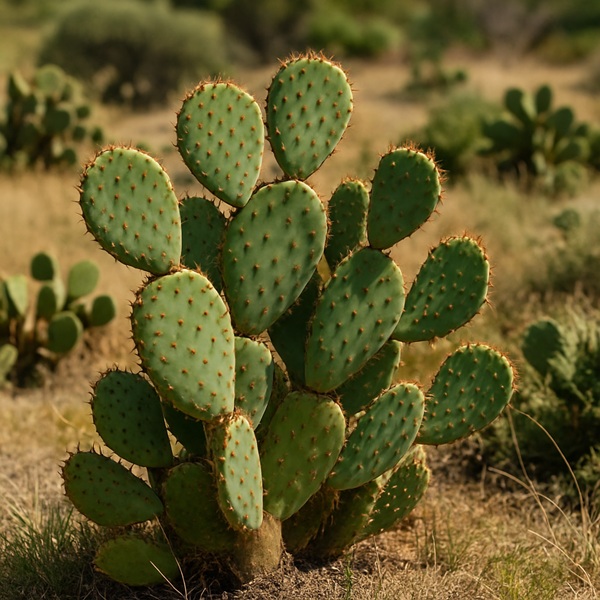
Opuntia is a genus of cacti with flat, oval stems often called “pads.” In nature, there are more than 300 species, most of them native to North and South America, especially Mexico. Thanks to their low maintenance requirements, drought tolerance, decorative appearance, and ability to bear fruit, opuntias are appearing more and more often in gardens and greenhouses across Ukraine. Some species are even capable of overwintering in open ground with proper protection.
Particular attention should be given to frost-hardy opuntia species (Opuntia humifusa, Opuntia fragilis, Opuntia polyacantha), which can tolerate short-term temperature drops to -20°C. This makes them suitable for cultivation in the southern and central regions of Ukraine, both in open ground and in containers. In enclosed spaces such as winter gardens, greenhouses, or glazed balconies, even heat-loving fruiting varieties known as “prickly pears” can be grown successfully.
Despite their spines and stern appearance, opuntias are highly ornamental plants. In spring and summer, they produce large, bright flowers in yellow, orange, or pink, and depending on the species, they may also form fruit — juicy berries up to 10 cm long, covered with tiny glochids. In warm-climate countries, these fruits are widely used in cooking for drinks, jams, and salads. In Ukraine, this is still exotic, but interest in such crops is growing rapidly, especially among supporters of permaculture and xerogardening.
Opuntia needs conditions close to its natural habitat — dry, sunny, well-ventilated, and with as little excess moisture as possible. At the same time, it can adapt to a more humid climate if high-quality drainage and proper care are provided.
What to pay attention to when choosing a site:
Light: a southern or southwestern exposure is ideal. The plant needs at least 6–8 hours of direct sunlight per day.
Soil: light, sandy, or rocky soil with a neutral or slightly alkaline reaction (pH 6.5–7.5). Heavy soils should be lightened with sand, gravel, or perlite.
Drainage: essential. In containers, the drainage layer should make up at least one quarter of the pot’s volume.
Moisture: standing water is the main danger. Excess moisture causes root rot and decay of the lower parts of the stems.
In the southern regions of Ukraine, such as Odesa, Mykolaiv, and Kherson oblasts, frost-hardy opuntia species can be grown in open ground. In the central regions, including Kyiv, Cherkasy, and Vinnytsia, dry winter protection is needed. In the north and in mountainous areas, container growing with winter transfer indoors is the only practical option.
A useful tip: opuntias thrive on slopes, in rockeries, gravel mixborders, and alpine gardens. They are not afraid of overheated soil or sharp temperature swings, as long as ventilation is good and moisture drains away properly.
The best time for planting is spring, once the danger of frost has passed and the temperature remains steadily above +15°C. The most reliable propagation method is rooting cuttings, because they establish quickly and fully preserve the characteristics of the parent plant. Seeds are used less often, mainly for collection or scientific purposes.
Planting from a cutting, step by step:
Cut off a segment, or pad, 10–20 cm long.
Let it dry in the shade for 3–5 days until a dry film forms over the cut surface.
Plant it vertically in a dry mixture of sand and perlite to a depth of 3–5 cm.
Do not water for 7–10 days. After that, begin moistening the substrate gradually.
Substrate: for container growing, the best mix is 40% sand, 30% humus, 20% leaf soil, and 10% fine pebbles or perlite. A ready-made cactus mix can also be used, improved with coarse materials.
Containers: plastic, clay, or ceramic pots with drainage holes are suitable. The volume should be 1.5–2 times larger than the root system, and the depth should be at least 15–20 cm for stability.
After planting, the container should be placed in bright but diffused light for 1–2 weeks. Once active growth begins, the plant can be moved into direct sun. In open-ground conditions, a well-drained planting area with loose soil should be prepared in advance.
Although opuntia is considered a hardy plant, it responds well to regular and balanced care. The main rule is simple: less water, more light. A proper watering schedule, limited but targeted feeding, and respect for the dormant period are the keys to keeping the plant healthy under Ukrainian conditions.
Watering:
Spring–summer: once every 10–14 days; in hot weather, once every 7–10 days. Water in the morning, at the root, without wetting the stems. The soil should dry out completely between waterings.
Autumn: watering is gradually reduced to a minimum.
Winter: watering is either stopped completely or done once every 30 days, depending on the temperature.
Feeding:
Start at the end of April, once every 3–4 weeks.
Use mineral fertilizers for cacti, with very little nitrogen but higher potassium and phosphorus.
Organic fertilizers such as manure or liquid infusions are not recommended, because they may trigger rot.
Additional care includes loosening the top layer of soil once a month, removing weeds in open ground, and spraying with warm water during periods of heat only if the plant is in a protected place such as a balcony or greenhouse. Mature opuntias are repotted once every 3–5 years, while young plants are repotted every 2 years. The best time for this is March to April.
Opuntia is very easy to propagate — even a segment that breaks off by accident may root. Still, for deliberate propagation of decorative plants, it is better to follow proven methods.
By cuttings: this is the simplest and most common method. A 10–15 cm cutting is taken with a disinfected knife, dried for several days, and planted in sand or a light substrate. Roots appear after 3–5 weeks, after which the plant is transplanted into its permanent container.
By seed: this method is used more often for decorative or collector purposes. The seeds are scarified, soaked in warm water, then sown in a light substrate of peat and sand and covered with film. Germination takes 2–6 weeks at +25°C.
By division: this suits older plants with many segments. In spring, during repotting, rooted sections are separated and planted individually. Rooting happens quickly in warm conditions with diffused light.
An interesting note: in southern Ukraine, people are already experimenting with growing opuntias as hedges — they serve not only as fencing, but also as a decorative element in xeriscape design.
Despite its resilience, opuntia may suffer from excess winter moisture or unstable temperatures. Young or recently transplanted plants are the most vulnerable, especially those growing outdoors without cover.
Wintering:
In containers: from October onward, move the plant to a cool, bright place at +5 to +10°C. Watering should be minimal or absent.
In open ground: cover the plant with spruce branches, dry leaves, or agrofabric. The root zone should be mulched with sand or gravel.
Best conditions: a dry winter with moderate frost, around -5 to -10°C. A wet winter with repeated thaws is far more dangerous.
Typical problems:
Root rot: caused by excess moisture. Treatment includes repotting, cutting away damaged parts, and treating the cuts with ash or a fungicide.
Scale insects and mealybugs: controlled with soapy water, alcohol wipes, or insecticides.
Rotting at the base of the segments: the affected part is cut away, and the cut is dusted with ash.
Prevention: monitor watering carefully — underwatering is safer than overwatering. Disinfect tools, and remove fallen or rotting stems, especially in autumn.
Opuntia is not just an exotic decoration. It is a true symbol of resilience and beauty that fits perfectly into modern Ukrainian gardens and balconies, especially in the context of climate change and the growing popularity of drought-tolerant landscaping.