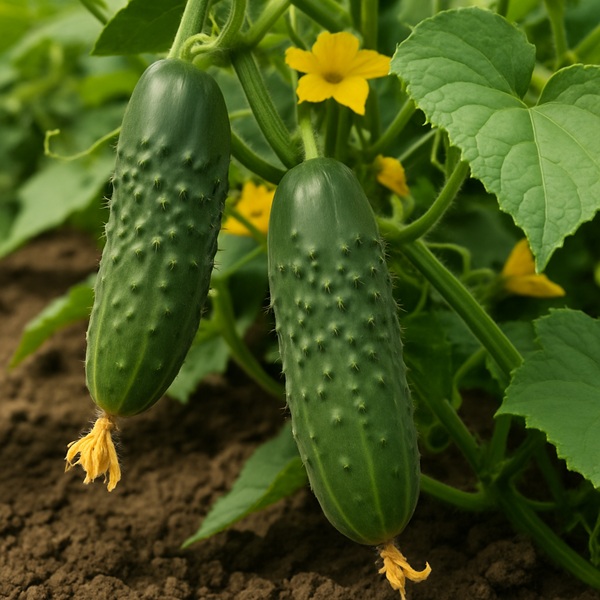
Cucumbers are one of the most popular vegetable crops in Ukraine, grown both in open ground and in greenhouses, hotbeds, tunnels, and even on balconies. Thanks to their short growing season, high productivity, and versatility of use, cucumbers have long held a leading place among crops grown both professionally and in home gardens. Ukraine’s climate is ideal for their active growth: a long warm summer, plenty of sunlight, and moderate nighttime temperatures create optimal conditions for cultivation.
The cucumber belongs to the gourd family and is an annual herbaceous vine with a creeping or climbing stem, large leaves, and a sensitive root system. The fruit is a many-seeded berry, usually cylindrical or oval in shape. In Ukraine, early and mid-early hybrids predominate, capable of producing stable yields even under slight temperature fluctuations. Modern varieties are disease-resistant and suitable both for fresh consumption and for preserving.
Growing cucumbers requires taking a whole range of factors into account, from site selection to systematic watering. The most comfortable temperature for growth is +23 to +28°C. At +15°C, development slows down, and at +10°C, it practically stops. That is why seeds should be sown in open ground only after the soil has fully warmed up. In greenhouses, the first harvest can be obtained as early as late April. The temperature regime is especially important at the stages of germination and ovary formation: even a short cold spell can cause flowers and fruits to drop.
To obtain a stable and abundant harvest, it is important to approach site selection and soil preparation carefully. Cucumbers are very sensitive to growing conditions: the soil must be fertile, loose, and capable of retaining moisture well, but without water stagnation. Light loams or sandy loam soils with a high organic content and neutral acidity (pH 6.5–7.0) are ideal. Overwatered, heavy, or acidic soils cause root rot and disease development.
Bed preparation includes:
Crop rotation. Cucumbers should not be grown in the same place more often than once every 3–4 years. The best preceding crops are cabbage, legumes, potatoes, and onions.
Autumn application of organic matter. Apply 5–7 kg of humus or compost and 200–300 g of wood ash per 1 m².
Spring loosening and bed formation. Seven to ten days before planting, the site is dug over to a depth of 20–25 cm, leveled, and covered with film to warm the soil.
In addition, before planting, the soil can be disinfected with biofungicides or a weak potassium permanganate solution. In areas with a high groundwater level, cucumbers are best planted on raised beds. The root system must have access to oxygen. In greenhouses, drip irrigation and a ventilation system are arranged in advance to prevent overheating and excessive humidity.
Cucumbers can be grown either by direct sowing into the soil or through seedlings. Both methods have their advantages. Direct sowing is suitable for the southern and central regions of Ukraine, where the soil warms up quickly. The seedling method is used more often in northern regions or in greenhouse production to obtain an earlier harvest.
Sowing in open ground:
Timing: late May to the first ten days of June, when the soil temperature reaches +16 to +18°C.
Depth: 2–3 cm in light soils, 3–4 cm in heavy soils.
Spacing: 50–70 cm between rows, 20–30 cm between plants.
Seedling method:
Seeds are sown 20–25 days before transplanting into open ground.
It is better to use separate peat pots or cell trays, as cucumbers do not tolerate pricking out well.
Seedlings are transplanted when the air temperature is no lower than +18°C, and the nighttime temperature is no lower than +12°C.
Before sowing, the seeds can be treated with growth stimulants or micronutrients such as boron, manganese, and zinc to improve germination. It is advisable to cover the beds with agrofabric or film, which helps retain moisture and speeds up emergence. It is important not to let the seedlings overgrow: the stem should be sturdy, and the leaves bright green, without stretching.
Cucumbers are a moisture-loving crop, but at the same time excess moisture is harmful to them. The gardener’s task is to maintain the optimal balance between soil and air humidity while providing the plant with everything it needs for active growth and fruit formation. The basis of care consists of regular watering, timely feeding, and proper training of the vines.
Watering:
The water should be warm (+20°C) and settled.
Frequency: 2–3 times a week in May and June, up to 5 times during hot weather.
Rate: 10–12 liters per m², and up to 15 liters during the fruiting period.
Method: drip irrigation is ideal; hand watering should be done only at the root.
Feeding:
Cucumbers respond well to nutrients:
10–14 days after planting — mullein infusion (1:10) or poultry manure infusion (1:20).
At the budding stage — mineral fertilizers such as nitroammophoska or monopotassium phosphate.
During fruiting — ash solution or a balanced compound fertilizer.
Training:
In a greenhouse and when grown on a trellis, training is essential:
Remove the first 3–4 lower ovaries and side shoots to strengthen the root system.
Pinch the main shoot at a height of 1.5–2 m.
Regularly remove side shoots after the second leaf.
In open ground, training is carried out only partially, but overcrowding should still be avoided to improve ventilation and reduce the risk of fungal infections.
Cucumbers are prone to various diseases, especially under conditions of high humidity or excessive planting density. The most common are powdery mildew, downy mildew, root rot, and bacterial blight. Without preventive measures, these diseases can spread quickly and destroy most of the crop.
Prevention:
Choosing resistant varieties and hybrids.
Following crop rotation.
Controlling humidity.
Ventilating the greenhouse, especially in the morning.
Main diseases:
Powdery mildew — white coating on the leaves, deformation.
Downy mildew — yellow spots on the upper side, grayish mold underneath.
Root rot — blackening of the stem base, wilting.
Bacterial blight — watery spots and leaf wilt.
Protection:
Biological products such as Fitosporin and Trichoderma — in the early stages.
Copper-based products such as Bordeaux mixture and copper oxychloride — at the first signs.
In severe cases — systemic fungicides such as Topaz, Ridomil Gold, and Previcur.
Pests:
Aphids, spider mites, and whiteflies. Biological infusions such as garlic or laundry soap can be used, as well as insecticides such as Aktara and Bi-58.
Always follow the instructions and treat plants in the evening or early morning. Chemical treatments are stopped 7–10 days before harvesting the fruits.
Cucumbers should be harvested regularly, every 1–2 days. Delayed harvesting causes fruits to overgrow, suppresses the plant, and reduces the overall yield. The optimal harvesting size is 9–12 cm for pickling varieties and 13–15 cm for salad types. Cucumbers are cut with secateurs or carefully picked by hand without damaging the vine.
How to prolong the fruiting period:
Maintain stable watering.
Feed with ash or humates.
Remove old yellowing leaves.
Harvest on time to stimulate new ovaries.
Refreshingly prune the vines to reactivate growth.
The “root renewal” method is also effective: the base of the stem is covered with fertile soil and watered generously, which stimulates the formation of additional roots and boosts fruiting. In greenhouses, partial pruning after the first wave of harvest is also practiced — after 10–14 days, the bushes recover and produce a second crop.
In Ukraine, cucumbers can be harvested from late June to early September. To extend the season, growers use winter sowing or very early spring sowing in greenhouses, as well as cultivation in buckets, boxes, or bags on balconies and terraces.