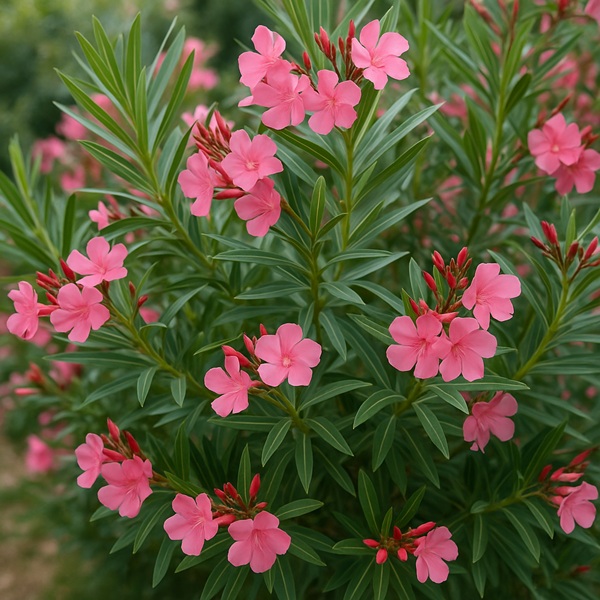
Oleander (Nerium oleander) is an evergreen shrub with luxurious, fragrant flowers that has become widely popular as an ornamental plant for landscaping and container gardening. Visually, it is associated with southern regions — the Mediterranean, the Caucasus, and Turkey — yet with the right approach, it can also be grown successfully in Ukraine. In the southern and coastal regions (Odesa, Mykolaiv, and Kherson oblasts), oleander can overwinter in open ground, while in Central, Eastern, and Western Ukraine it is grown mostly in tubs and moved outdoors only during the warm season.
The plant’s main ornamental value lies in its lush flower clusters, which appear in June and last until September. Depending on the variety, the flowers may be white, pink, red, or yellow, and either double or single. The leaves are stiff, lance-shaped, dark green, and leathery, forming a dense evergreen mass that remains decorative even in winter. In tubs, oleander usually reaches 2–2.5 meters in height, while in open ground, under favorable conditions, it can grow to 3–4 meters.
It is important to remember that oleander is a poisonous plant: the sap from all its parts contains cardiac glycosides that can cause poisoning if ingested. For this reason, gloves should be worn when caring for it, and growing it in places where children or pets are present requires particular caution. Even so, oleander remains popular thanks to its low maintenance needs, drought tolerance, vivid flowering, and ability to adapt quickly to different conditions.
Successful oleander cultivation depends greatly on choosing the right location. This is a sun-loving plant of southern origin that needs as much sunlight as possible. Shade or partial shade negatively affects flowering: the flower clusters become smaller, paler, and shorter-lasting. In open ground, as well as in tubs placed on balconies, windowsills, or terraces, it is best to choose a southern or southeastern exposure where the plant receives at least 6–8 hours of sunlight a day.
Key factors:
Light: intense direct sunlight is essential for abundant flowering.
Wind: undesirable, especially from the north. The plant is heat-loving and sensitive to drafts.
Air humidity: in summer it prefers dry air, but in winter, when heating dries the air indoors, periodic misting is recommended.
Temperature: the optimal summer range is +20 to +30°C. In winter, it should not drop below +5°C indoors.
As for soil, oleander is not overly demanding, but it prefers loose, breathable, nutrient-rich substrates with good drainage. Water stagnation must be avoided, as it leads to root rot. The ideal soil mix for container growing consists of leaf mold, turf soil, sand, and humus (2:2:1:1). For open-ground cultivation in southern Ukraine, compost, sand, and a drainage layer of expanded clay or crushed stone are added.
In Ukraine, oleander is planted either in open ground or in tubs, depending on the climate and the available care conditions.
For containers and pots:
Planting is done in March or April, before active growth begins. Spacious containers are used (10–15 liters), with a 5–7 cm drainage layer placed at the bottom, followed by the prepared substrate. After planting, the plant is watered generously, placed in a sunny spot, and gradually hardened off to outdoor conditions.
For open ground in the south:
Planting is carried out in spring, once the air temperature is consistently above +15°C. The planting hole should be 40–50 cm deep and up to 60 cm wide. Compost, sand, and ash are added. After planting, the soil is mulched and watered, and the plant is shaded for the first few days.
Repotting mature specimens:
This is done every 2–3 years using the transfer method. Large shrubs are repotted in spring, with part of the old root system trimmed back. Very old plants (7+ years) are sometimes not repotted at all; instead, only the top layer of soil is replaced.
Special attention should be paid to container stability: a mature oleander becomes quite heavy, so it is best to choose a sturdy container from the start or place the tub on a wheeled platform for easier moving in winter.
Oleander tolerates drought well, but for abundant flowering and active growth in summer it needs regular watering and feeding. This is especially true for plants grown in tubs, where the soil volume is limited and the root system quickly uses up available moisture and nutrients.
Watering:
Spring–summer: water generously 2–3 times a week. The soil should remain slightly moist, but not waterlogged.
Autumn: gradually reduce watering to once a week.
Winter: water minimally, only when the top layer has completely dried out.
Too much water is dangerous: the roots can rot after only a few days of overwatering. Saucers should be emptied regularly, and a drainage layer is essential.
Feeding:
From April to August: every 10–14 days with mineral fertilizer for flowering plants, with an emphasis on phosphorus and potassium.
In autumn: once a month, using fertilizers with minimal nitrogen.
In winter: no feeding at all.
Foliar feeding with micronutrients such as boron, magnesium, and iron is also effective — it helps keep the foliage healthy and stimulates bud formation.
Oleander grows very quickly, and without regular pruning it loses its decorative appeal: it becomes leggy, thins out, and forms fewer buds. Annual pruning helps maintain its shape, stimulates the development of new flowering shoots, and rejuvenates the shrub.
Main types of pruning:
Formative: in late summer or autumn after flowering. Shoots are shortened by one-third to one-half of their length.
Rejuvenating: in early spring, by removing the oldest branches down to the base.
Sanitary: removing dry, diseased, or damaged branches at any time of year.
Corrective: during summer, by cutting back overly elongated shoots.
Recommendations:
Treat cuts with charcoal or garden sealant.
Flowers are formed on the young shoots of the current year, so regular pruning is the key to flowering.
To create a denser crown, the young tips can be pinched back.
After heavy pruning, flowering is usually delayed for a year. With moderate pruning, the plant continues to bloom every year without interruption.
In the Ukrainian climate, wintering is a critically important stage in growing oleander. In the southern regions with mild winters, it can remain in the ground if temperatures do not fall below -5°C, but in most regions it must be moved indoors.
Preparing for winter:
At the end of September, move the plant to a bright, cool room at +5 to +12°C.
Reduce watering to a minimum.
Stop feeding.
Carry out preventive pest treatment if necessary, using insecticides.
Winter lighting:
A south- or east-facing window, winter garden, or veranda is best. If light is insufficient, some leaf drop may occur, but the shrub usually recovers quickly in spring.
Common problems:
Yellowing leaves: excessive watering, drafts, or sudden temperature changes.
No flowering: lack of light, too much nitrogen, or lack of pruning.
Bud drop: dry air or stress from being moved during the budding stage.
Pests: aphids, spider mites, and scale insects most often appear indoors during winter.
To avoid these problems, the plant needs stable light, ventilation, moderate watering, and periodic misting with warm water to increase humidity.