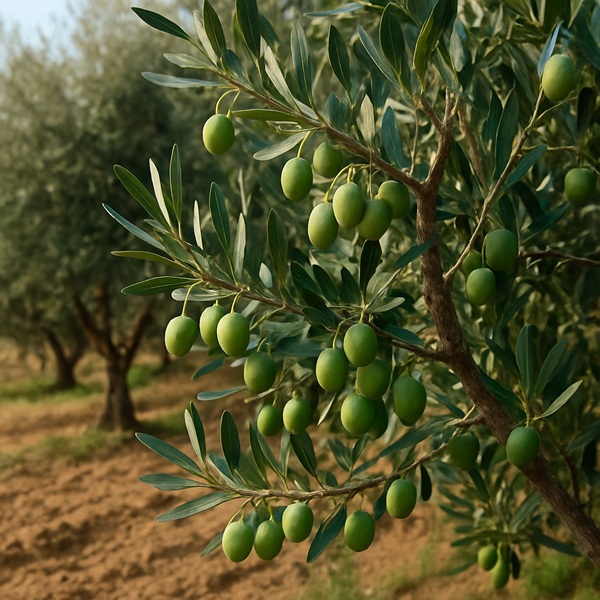
The olive tree, or European olive (Olea europaea), has long been associated with warm Mediterranean landscapes. However, thanks to breeding, changing climate conditions, and growing interest in agritourism and ornamental gardening, this crop has also become accessible to Ukrainian gardeners. With proper cultivation techniques, olives can be grown successfully both in open ground in the southern regions and in containers — on balconies, terraces, and in winter gardens.
The olive is an evergreen tree 2 to 10 meters tall, with narrow silvery leaves and a branched root system. Flowering begins in spring (May–June), the fruits form by October, and full ripening occurs in November–December. It is important to keep in mind that in Ukrainian conditions, especially in areas with frosty winters, olive cultivation is only possible if wintering indoors or under reliable protection is provided. In the southern regions (Odesa, and partly Mykolaiv and Kherson), it can be grown in open ground, provided young saplings are properly protected from freezing temperatures.
Interestingly, the fruits we usually call “green olives” and “black olives” are the same berry, just at different stages of ripeness and after different types of processing. Green olives are unripe, while black olives are ripe or fermented. In Ukraine, olives are valued not only for their taste, but also for their symbolism, longevity, and ornamental appeal. The crown of an olive tree fits harmoniously into the landscape, especially in gardens designed in Provence, Mediterranean, or minimalist styles.
The olive tree is very demanding when it comes to light — this is one of the main requirements of its cultivation. With insufficient sunlight, growth slows down, flowering decreases, and fruiting may not occur at all. That is why, when choosing a site, preference should be given to areas with maximum sun exposure. For container growing, these are south-facing windowsills, glazed loggias, and conservatories. In open ground, the best choice is southern slopes, sheltered from wind and with good drainage.
Basic requirements:
Light: at least 8–10 hours of direct sunlight daily.
Warmth: active growth requires temperatures no lower than +20°C. In winter — no lower than -5°C for cold-hardy varieties.
Wind: especially dangerous for young trees. Drafts and cold air should be avoided.
Soil: light, well-drained, pH 6.5–7.5. Sandy and calcareous soils are suitable.
Before planting, good drainage must be provided. Olives do not tolerate stagnant moisture — it causes root rot. In open ground, saplings are planted on elevated spots or artificial terraces. In containers, a 5–7 cm layer of expanded clay or gravel is essential.
In central and northern Ukraine, olives are grown only in containers. From April to October, they are kept outdoors, and for winter they are moved to a cool room (from +2 to +10°C). This may be an insulated veranda, a basement with a window, a balcony, or a winter garden.
It is best to buy olive saplings from specialized nurseries where they have already been adapted to the climate of Eastern Europe. Usually, plants 2–3 years old are sold in containers, which ensures high survival rates and allows planting during any warm period, although spring — April to May — is preferred.
Step-by-step instructions:
Dig a hole 60–70 cm wide and 50 cm deep.
Place drainage at the bottom (expanded clay or gravel), then fill with a mixture of fertile soil, sand, and humus (2:1:1).
Set the sapling in the center and spread the roots.
Fill with soil without burying the root collar.
Water with 8–10 liters of water and mulch with sawdust, bark, or decorative stone.
For container planting, choose a pot of at least 20–25 liters with drainage holes. During the first 2–3 weeks, the young tree is best kept in partial shade and watered moderately. Under good conditions, it will begin to grow by mid-summer.
Tip: install a support immediately after planting — young trees often have an unstable trunk. In southern Ukraine, open-ground cultivation is possible with mandatory winter protection such as spruce branches, agrofabric, or a mini-greenhouse.
The olive is a crop that can withstand drought, but only in adulthood and with a well-developed root system. Young plants, especially during the first two or three years after planting, need regular moderate watering, particularly in hot periods. In containers, the situation is more demanding: the soil volume is limited, moisture evaporates faster, and nutrients are depleted more intensively.
Watering: seasonal specifics
Spring–summer: 1–2 times a week, when the top 3–4 cm of soil has dried out.
Autumn: gradually reduce the frequency of watering.
Winter: at temperatures below +10°C — water once every 3–4 weeks; during warmer wintering — as needed.
Water should be applied at the root without overwatering. The leaves may be misted from time to time, especially in winter in dry rooms — this helps prevent pests and improves the plant’s condition.
Feeding:
In spring — complex fertilizers with a higher nitrogen content.
During flowering (May–June) — phosphorus-potassium fertilizers.
In autumn — potassium feeding to strengthen the tree before winter.
Container-grown trees need feeding more often — every 2–3 weeks. Organic matter such as humus or herbal infusions and mineral fertilizers are used alternately.
Crown formation:
Spring formative pruning — leave 3–5 main branches.
Sanitary pruning — remove diseased and crossing shoots.
Regular pinching — stimulates the growth of side branches and fruit formation.
With proper light and care, the olive tree begins to flower in the third or fourth year after planting. In Ukraine, the flowering period is May to June. The flowers are small, white, gathered in panicles, and pleasantly fragrant, forming the basis of the future crop.
Fruiting:
In containers — with a self-fertile variety — from the fourth or fifth year.
In open ground in southern Ukraine — from the sixth or seventh year, provided winter protection is ensured.
Olives are pollinated by insects or by hand — for potted plants, gently shaking the flower clusters is recommended.
The fruits set in June–July and ripen by October–November. The harvest is picked either green or dark purple, depending on its purpose: for oil or for preserving.
Important: fresh olives are not eaten without processing. Due to the glycoside oleuropein, the fruits are strongly bitter. For consumption, they are soaked, fermented, or cured in brine.
Despite its southern origin, modern olive varieties show fairly high resistance to stressful conditions. Still, the main threat to the tree in Ukraine remains frost. Temperatures below -7 to -10°C become critical, especially when combined with high soil and air humidity.
Wintering specifics:
Move the tree to a cool room at +2 to +10°C.
Reduce watering.
Carry out sanitary pruning at the end of winter.
Ventilate the room regularly, but avoid drafts.
In open ground in the south, the tree is covered with agrofabric, spruce branches, or straw. The root zone is mulched with sawdust or dry leaves.
Common growing problems:
Yellowing leaves: lack of light or overwatering.
No flowering: the plant is still too young, has not been pruned, or is not getting enough sun.
Fruit drop: sudden temperature fluctuations, dryness, or excess nitrogen.
Pests: aphids, scale insects, and mealybugs — controlled with insecticides or soap/garlic infusions.
With proper care, the olive tree will decorate the site and, after a few years, reward you with its first fruits — a true symbol of the Mediterranean grown on Ukrainian soil.