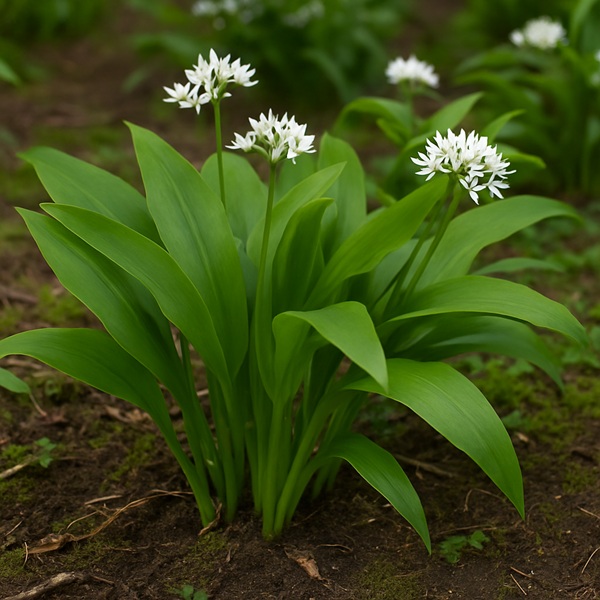
Wild garlic (Allium ursinum), also known as ramsons or bear’s garlic, is a perennial herbaceous plant from the amaryllis family. In nature, wild garlic is widespread in the forests of Europe and Asia, including many regions of Ukraine. Its early spring emergence and rich garlic aroma make it not only a valuable source of vitamins, but also a popular ingredient in cooking and herbal medicine.
Wild garlic grows to 20–40 cm in height. Its long, lance-shaped leaves appear in early spring, when the snow is only just melting from the ground. In May, the plant produces a flower stalk with a small umbel of white flowers, after which seed capsules form by mid-summer. The development cycle of wild garlic is short: by mid-summer, the above-ground part dies back, and the plant enters a dormant phase until the following spring.
Wild garlic has gained particular popularity thanks to its high content of vitamin C, essential oils, phytoncides, and trace elements. It has antiseptic, anti-inflammatory, and tonic properties. In Ukraine, wild garlic is valued as a natural delicacy and medicinal plant, and its cultivation in summer cottages and household plots is becoming increasingly relevant.
Growing wild garlic on a plot requires choosing the right location, since the plant has specific needs determined by its natural origin. In Ukraine, where the climate is diverse, suitable conditions for this crop can be created in almost every region.
Requirements for the site:
Light. Wild garlic prefers semi-shaded or shaded places similar to forest clearings. Direct sun may damage the delicate leaves.
Soil. The ideal soil is loose, rich in organic matter, and slightly acidic. The plant does not tolerate water stagnation or compacted heavy soil.
Moisture. Moderate moisture is important for active spring growth.
Site preparation:
Before planting, the soil is dug to a depth of 25–30 cm, adding compost or humus (5–6 kg per 1 m²), and, if necessary, sand and wood ash to improve structure and neutralize acidity.
Planting material and timing:
Wild garlic can be propagated by seed or by dividing rhizomes.
Seeds are sown in autumn, immediately after harvest, since they require natural stratification to germinate.
Division of clumps is carried out in early spring or late summer.
Proper site preparation and careful site selection allow wild garlic to root quickly and grow actively.
Wild garlic requires minimal but regular care, especially in the first years after planting.
Watering.
In spring, wild garlic grows actively, so it is important to maintain moderate soil moisture. Watering should be done as the top layer of soil dries out, while avoiding stagnant water.
Weeding and loosening.
Young plants are vulnerable to competition from weeds. Regular weeding and light loosening help preserve optimal growing conditions.
Feeding.
In spring, the plants are fed with organic fertilizers or complex mineral blends with a predominance of nitrogen.
In autumn, it is recommended to apply compost or humus to improve soil structure.
Special growing features:
With proper care, wild garlic forms dense, healthy plantings within 3–4 years after planting.
Propagation of wild garlic is a key stage in creating dense and healthy plantings. Under Ukrainian conditions, both seed and vegetative methods are used.
Propagation by seed:
Wild garlic seeds quickly lose viability, so they are sown immediately after harvest, in August–September.
To improve germination, stratification is sometimes used by keeping the seeds in a refrigerator for 2–3 months at +4°C.
The seeds are sown in a loose, moist substrate to a depth of 1–1.5 cm.
Young plants appear in spring, but it takes 2–3 years to form a full planting.
Propagation by division of the clump:
In early spring or late summer, mature plants are carefully dug up and divided into sections, each of which should have a developed root and several growth buds.
The divisions are planted 20–25 cm apart.
After transplanting, the plants are watered well and mulched.
Care of young plants:
During the first two years after transplanting, especially careful care is needed: moderate watering, weeding, and protection from direct sunlight.
Wild garlic is rarely affected by serious diseases or pests, but under unfavorable conditions preventive measures are still worth taking.
Common diseases:
Gray mold. Occurs because of excessive moisture and overcrowding. Prevention includes regular thinning and watering control.
Fusarium. Causes plants to wilt. Control measures include fungicide treatment and reduced soil moisture.
Main pests:
Onion fly. Its larvae damage the roots. Prevention includes mulching with ash or using tobacco dust.
Slugs. They feed on young leaves. Protection includes hand collection, traps, or biological products.
Preventive measures:
Crop rotation.
Keeping the area clean.
Controlling soil moisture.
With proper care, wild garlic remains healthy and resilient for many years.
Wild garlic has a wide range of uses thanks to its culinary, medicinal, and ornamental properties.
Culinary use:
Fresh leaves are added to salads, soups, and pie fillings.
They are used to prepare sauces, seasonings, and marinades.
They are salted and preserved for winter use.
Medicinal properties:
Its high content of vitamin C and phytoncides helps strengthen the immune system.
Infusions of wild garlic improve digestion and help fight vitamin deficiency and colds.
The plant helps cleanse the body of toxins.
Ornamental use:
Wild garlic is planted as a groundcover crop in shady corners of the garden.
Its spring green carpet creates a decorative effect until early summer.
Advantages of growing wild garlic in Ukraine:
Excellent adaptation to different regions.
Minimal care requirements.
High nutritional and medicinal value.
Thus, wild garlic is not only a useful plant, but also a beautiful one for Ukrainian gardens and household plots.