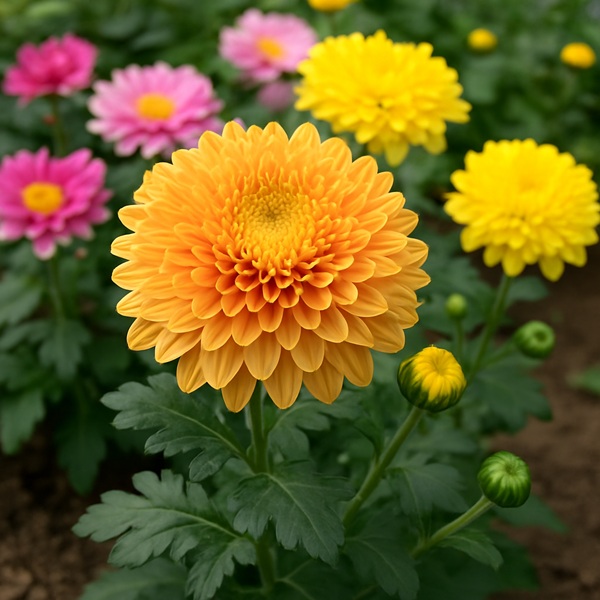
Chrysanthemum (Chrysanthemum) is the queen of the autumn garden, a symbol of refined beauty and resilience. The plant is native to East Asia, but today it is well adapted to temperate climates, including that of Ukraine. Thanks to the diversity of varieties and types, chrysanthemums decorate Ukrainian flower beds, summer cottages, parks, and greenhouses from August until late autumn.
The crop is valued for its long flowering period, variety of forms (bush, standard, and trailing types), and richness of colors — from classic white and yellow to deep violet and burgundy shades. Ukrainian gardeners grow both perennial large-flowered chrysanthemums that overwinter well under cover and dwarf forms for container landscaping. In recent years, Korean varieties have become especially popular, distinguished by high resistance to temperature fluctuations and prolonged blooming.
In Ukraine, chrysanthemums are widely used not only in landscape design but also for commercial purposes. Varieties for cutting are especially in demand, as the need for bouquets and wreaths rises in autumn due to traditional holidays such as Pokrova, Teacher’s Day, and memorial days. Large farms and small flower businesses grow chrysanthemums as a profitable crop capable of generating stable income with minimal care costs.
Success in growing chrysanthemums depends greatly on choosing the right site and following proper planting techniques. Under the Ukrainian climate, it is especially important to provide the plant with optimal conditions for growth and flower bud formation.
Optimal planting conditions:
Light. Chrysanthemums are light-loving plants. In sunny locations, the bushes produce strong shoots and set the maximum number of buds. In shade, the plants become stretched, weaker, and bloom poorly.
Soil. Light loam rich in organic matter, with a neutral or slightly acidic reaction (pH 6.0–6.5), is ideal. Heavy clay soils are improved with sand and compost.
Moisture. The soil should be moderately moist and well drained. Stagnant water is destructive to the chrysanthemum root system.
Soil preparation and planting:
The site is dug to a depth of at least 30–40 cm, and humus (4–5 kg per m²) along with phosphorus-potassium fertilizers is added. A few days before planting, the soil is loosened and beds 10–15 cm high are formed for better drainage. Planting holes are dug 30–35 cm deep. The distance between bushes depends on the variety: for low-growing ones, 30–40 cm; for tall ones, 50–70 cm.
When planting, it is important not to bury the root collar, leaving it at soil level. After planting, the plants are watered generously and mulched with humus or straw to preserve moisture and protect against overheating.
Planting time:
In Ukraine, the optimal time for planting chrysanthemums is spring (late April to May) or late summer (August). Spring planting allows the plants to root well and prepare for winter. With autumn planting, it should be done 30–40 days before the first frosts so the bushes can establish themselves.
Chrysanthemums are quite hardy, but without proper care they cannot fully reveal their potential. The main care measures include regular watering, timely feeding, and proper shaping of the bushes.
Watering.
This is especially important during rooting, active growth, and bud formation. Plants are watered at the root, avoiding overwatering and water on the leaves. In hot periods, watering is done 2–3 times a week, using 10–15 liters of water per bush.
Feeding.
Plant nutrition is organized in several stages:
In spring — nitrogen fertilizers to stimulate vegetative growth.
During bud formation — phosphorus-potassium mixtures to encourage abundant blooming.
In autumn (September) — only potassium feeding to strengthen plant tissues before wintering.
It is important to alternate mineral fertilizers with organic ones (mullein infusion or poultry manure solution) to support active soil microflora.
Bush formation.
Pinching is an essential practice in chrysanthemum growing:
The first pinching is done when the shoots reach 10–15 cm in height.
After 2–3 weeks, pinching is repeated to form a lush crown.
Late pinching is avoided so as not to delay the start of flowering.
In addition, faded inflorescences and weakened shoots are removed in autumn to stimulate the development of new flower buds.
Chrysanthemum propagation is an important stage for renewing plantings, increasing the number of plants, and preserving varietal characteristics. In Ukrainian conditions, it is best to use vegetative methods: division of the bush, cuttings, and more rarely seed sowing.
Division of the bush.
This is the simplest and most popular method among Ukrainian gardeners. In spring, when the plants begin to grow, a mature bush is carefully dug up and divided into several parts. Each division should have 3–5 shoots and a developed root system. The new plants are set into prepared holes, watered generously, and the soil is mulched.
Cuttings.
The best time for taking cuttings is spring or early summer. Young shoots 10–15 cm long are cut, the lower leaves are removed, and they are rooted in a light substrate (sand + peat) under film or in a greenhouse. Rooting stimulants are used for better establishment. After 3–4 weeks, the rooted cuttings are transplanted into open ground.
Growing from seed.
This is used rarely, mainly for breeding new varieties. Seed-grown plants often do not retain the varietal characteristics of the parent. Sowing is done in March in greenhouses or for seedlings, and the young plants are set out into open ground in May.
To ensure full flowering and preserve the characteristics of varieties, vegetative propagation is recommended in Ukraine in most cases.
Despite their general hardiness, chrysanthemums may suffer from a number of diseases and pests, especially in wet years or under unstable weather conditions typical of the Ukrainian autumn.
Main diseases:
Powdery mildew. Appears as a white coating on the leaves. For prevention, the plants are treated with fungicides such as Topaz or Horus, and overcrowded plantings are avoided.
Gray mold. Caused by fungi under excessive moisture. The affected parts are removed, and the rest of the plant is treated with fungicides.
Rust. Orange spots on the leaves. Treatment involves Bordeaux mixture or copper-based products.
Main pests:
Aphids. They weaken plants by sucking out sap. Control is carried out with soap solutions or systemic insecticides such as Aktara or Confidor.
Spider mites. They attack leaves in hot weather. Acaricides are used, and humidity is increased.
Thrips. They deform flowers. Broad-spectrum insecticides are applied.
Preventive measures:
Regular soil loosening and moisture control.
Thinning of bushes to improve ventilation.
Sanitary pruning of old and affected plant parts.
Preventive treatments in spring and summer.
Thanks to careful maintenance, chrysanthemums in Ukrainian gardens can delight with lush and vivid flowering for a long time.
Chrysanthemums play an important role both in the landscaping of private gardens and in Ukraine’s flower business economy. Their popularity is explained not only by their ornamental value but also by their practical advantages.
Decorative use:
Decorating autumn flower beds and mixed borders.
Creating borders along garden paths.
Growing in containers to decorate balconies and terraces.
Floristry:
Chrysanthemums are indispensable in autumn bouquets and arrangements. Thanks to their excellent vase life (up to 2–3 weeks), they are widely used in wedding, festive, and memorial floristry. Large-flowered varieties and compact bushes for baskets and festive arrangements are especially popular.
Commercial cultivation:
Ukrainian farms are increasingly growing chrysanthemums for cutting and for sale on the domestic market. Flowers are especially in demand in October–November, before Memorial Day, Teacher’s Day, and All Saints’ Day.
Advantages of growing chrysanthemums in Ukraine:
Adaptability to the country’s different climatic conditions.
High profitability with relatively low costs.
Stable demand among buyers.
Thus, chrysanthemum remains one of the most versatile and profitable crops for Ukrainian gardeners and flower growers.