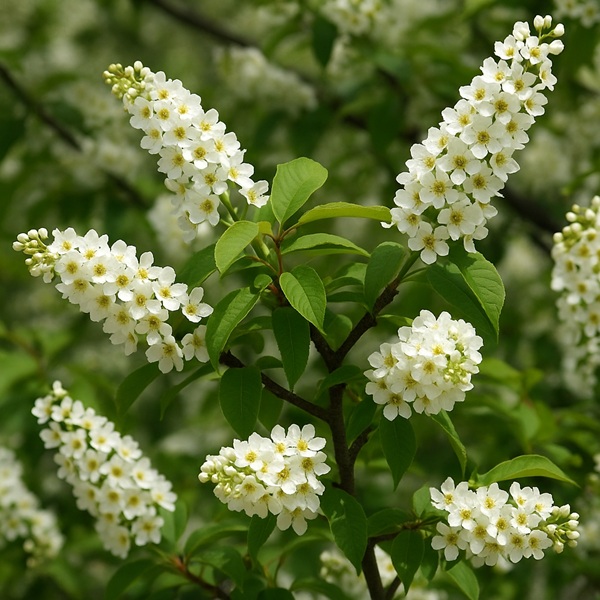
Bird cherry (Prunus padus) is one of the most recognizable and beloved woody plants in folk tradition, symbolizing the beginning of spring and the awakening of nature. In Ukraine, bird cherry grows both in the wild, decorating forests, river floodplains, and ravines, and in home gardens, where it is valued for its ornamental beauty, fragrant flowering, and the healing properties of its fruit.
The plant is a deciduous tree or large shrub reaching from 3 to 10 meters in height, with a dense crown. In spring, bird cherry is covered with abundant clusters of white flowers that release a delicate, rich fragrance, filling the air over long distances. Its flowering period is one of the most picturesque sights in nature, and its ornamental appeal lasts until late autumn thanks to its beautiful dark green foliage, which turns golden yellow in fall.
Bird cherry is not only pleasing to the eye, but also useful: its fruits — small black drupes — are used in cooking and folk medicine. The fruits are made into jam, fruit leather, flour for baking, tinctures, and decoctions. The bark and leaves have phytoncidal properties, purifying the air and protecting the area from harmful insects. In Ukraine, bird cherry is actively planted in gardens, parks, along roads, and near bodies of water as part of landscape design and for strengthening riverbanks.
Choosing the right planting site and following proper planting techniques are the keys to successful growth and abundant flowering of bird cherry. Despite its hardiness, the plant develops better under certain conditions, especially considering the climatic specifics of Ukraine.
Site requirements:
Light. Bird cherry prefers sunny or lightly shaded sites. It also grows well in partial shade, but flowering will be less abundant.
Soil. The best soils are moist, fertile, slightly acidic or neutral loams. Bird cherry does not tolerate saline, dry, or stony soils well.
Moisture. The plant likes moderately moist places, so it is ideal for planting near bodies of water or in low-lying areas where moisture is naturally retained.
Site preparation and planting technique:
2–3 weeks before planting, the site is dug over, cleared of weeds, and enriched with organic fertilizers (well-rotted manure or compost — 5–6 kg per 1 m²).
A planting hole measuring 60×60×60 cm is dug.
A drainage layer (crushed stone, sand) is placed at the bottom of the hole, which is then filled with a fertile mixture of garden soil, humus, and wood ash.
The seedling is placed vertically, with the roots carefully spread out. The root collar should remain at soil level.
After planting, the plant is watered generously (up to 20 liters of water) and mulched with peat or humus.
Optimal planting times:
In Ukraine, bird cherry is best planted in spring (April) or autumn (September–October), avoiding periods of severe frost and soil drying.
Bird cherry does not require complicated care, but regular basic maintenance helps preserve its ornamental quality and prolong the period of active growth and flowering.
Watering.
During dry periods, especially in the first year after planting, bird cherry is watered once every 7–10 days, using 20–30 liters of water per tree. In rainy weather, watering is stopped to avoid stagnant moisture around the roots.
Feeding.
To stimulate growth and flowering, the following feedings are recommended:
In spring — nitrogen fertilizers (urea, ammonium nitrate) for active shoot and leaf growth.
During bud formation — phosphorus-potassium fertilizers to increase the number of flowers.
In autumn — humus or compost to enrich the soil with organic matter.
Pruning.
Annual spring sanitary pruning is necessary to remove dry, damaged, and overcrowded branches:
Formative pruning is carried out to create a beautiful crown and improve air circulation.
Old trees are rejuvenated by pruning back to the scaffold branches to stimulate the growth of new shoots.
In addition, root suckers should be removed, since bird cherry produces them abundantly and they can thicken the planting.
Propagating bird cherry is simple and accessible to any gardener. In Ukraine, several main methods are used: sowing seeds, using root suckers, cuttings, and dividing the bush.
Sowing seeds.
This is the most natural propagation method:
Freshly collected bird cherry seeds are sown in autumn directly into prepared beds. No prior stratification is needed, since winter frosts provide natural hardening.
The seeds are planted 2–3 cm deep in loose, moist soil.
Seedlings appear in spring of the following year, but the first flowering occurs 3–5 years after sowing.
Propagation by root suckers.
Bird cherry produces abundant root suckers, especially in fertile, moist soils. Young shoots are carefully separated from the mother plant in spring or autumn and transplanted to a new location.
Cuttings and division of the bush.
Green cuttings are taken in summer and rooted in greenhouses or under plastic cover.
Division of the bush is carried out in early spring when mature plants are being transplanted, while preserving the main root system.
When choosing a propagation method, gardeners in Ukraine usually consider the age of the plant, the availability of plant material, and the desired timeframe for obtaining new specimens.
Despite its strong natural resistance, bird cherry may still be affected by diseases and pests, especially in unfavorable weather conditions. Timely prevention and proper care significantly reduce the risk of problems.
Common diseases:
Moniliosis (fruit rot). Affects flowers, leaves, and shoots. Prevention includes spring pruning and fungicide treatment.
Rust. Appears as orange spots on the leaves. Copper-based products are used for treatment.
Shot-hole disease (clasterosporiosis). Affects leaves and young shoots. The affected parts should be removed and the plant treated with fungicides.
Main pests:
Bird cherry moth. The caterpillars damage the leaves by rolling them into tubes. Control measures include manual removal of damaged leaves and insecticide treatments.
Aphids. They settle on young shoots and leaves. Ash infusions, tobacco solution, or insecticides such as Aktara and Inta-Vir are used.
Silkworm caterpillars. In cases of mass infestation, they can strip the leaves completely. Biological products such as Lepidocide and Bitoxibacillin are used, or chemical treatments in severe cases.
Preventive measures:
Spring sanitary pruning and burning of plant debris.
Whitewashing the trunks with a lime solution.
Regular loosening and mulching of the trunk circles.
These measures help keep bird cherry healthy and ornamental for many years.
Bird cherry is valued in Ukraine not only for its ornamental qualities, but also for its practical usefulness in cooking, medicine, and landscaping.
Decorative uses:
Landscaping gardens, parks, and avenues.
Creating hedges and shelterbelts.
Planting along bodies of water to strengthen the banks.
Culinary uses:
The fruits are used to make jam, compotes, and fruit leather.
Bird cherry flour is used in baking gingerbread, pies, and cookies.
Infusions and decoctions are used to enrich desserts and drinks.
Medicinal properties:
The fruits have anti-inflammatory, astringent, and antiseptic properties.
The bark and leaves are used in infusions for colds.
Bird cherry is included in many traditional remedies for strengthening the immune system.
Ecological role:
Bird cherry improves the microclimate by purifying the air of harmful impurities.
Thanks to the phytoncides it releases, it suppresses the development of pathogenic microorganisms.
Bird cherry remains a versatile and indispensable plant for Ukrainian gardeners and nature conservationists.