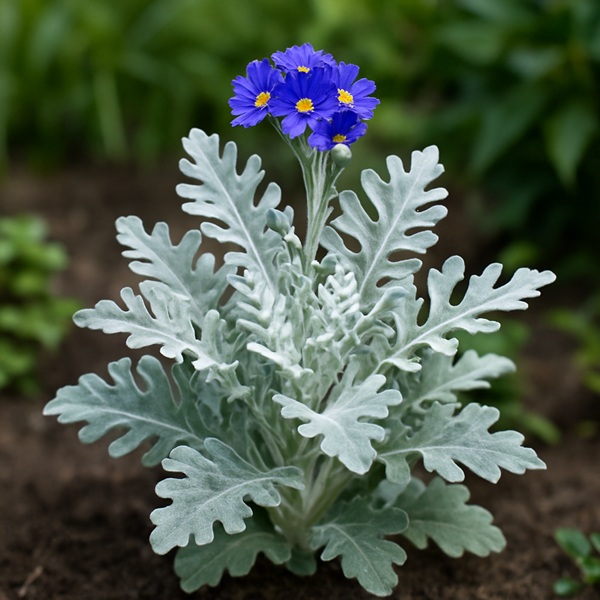
Cineraria (Cineraria) is a uniquely beautiful ornamental plant that is appearing more and more often in Ukrainian gardens, parks, and urban squares. It is valued for its striking appearance, variety of forms and colors, and relative ease of care. Two types of cineraria are especially popular: flowering forms (grown indoors or in greenhouses) and ornamental foliage forms, such as dusty miller, which is widely used in open ground.
The best-known type in Ukraine is dusty miller (Senecio cineraria), distinguished by its silvery-gray foliage that creates an excellent backdrop for bright garden flowers. Thanks to its decorative qualities, it is used as a border plant, for edging flower beds, alpine slides, and mixed borders. At the same time, cineraria keeps its attractive appearance throughout the season, from spring until late autumn.
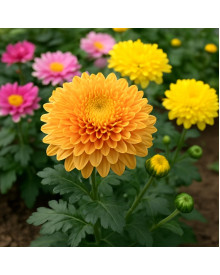
Flowering cinerarias are most often hybrid varieties (Cineraria hybrida), usually grown in greenhouses or as houseplants. They form lush caps of bright inflorescences in a wide range of shades: blue, violet, pink, and white. In Ukraine’s open-ground conditions, such cinerarias are grown less often, since they are more demanding in regard to temperature and air humidity.
To get a striking plant, you need to choose the right place and provide suitable planting conditions. In the Ukrainian climate, cineraria feels quite comfortable as long as a few basic cultivation rules are followed.
Planting site requirements:
Light. Cineraria prefers well-lit areas with light shade at midday. Direct sun may cause leaf scorch, especially in ornamental foliage varieties.
Soil. Light, well-drained soil with a neutral or slightly acidic reaction (pH 6.0–6.5) is ideal. Heavy clay soils are improved by adding sand and humus.
Wind protection. Cineraria does not like strong wind, so it is best planted near buildings or shrubs.
Soil preparation:
Before planting, the site is deeply dug over, compost or humus is added (4–5 kg per m²), along with mineral fertilizers higher in phosphorus and potassium. If needed, the soil structure is improved with sand and loosening agents.
Planting technique:
Cineraria seedlings are planted in open ground in May, once the threat of frost has passed.
The spacing between plants is 20–30 cm for compact border forms and up to 40 cm for larger bushes.
After planting, the plants are watered generously and mulched to preserve moisture.
Cineraria is sensitive to excess moisture in the soil, so good drainage is essential, and sites with stagnant water should be avoided.
Cineraria is considered a fairly low-maintenance plant, but to achieve maximum ornamental effect it needs regular and proper care, especially under Ukraine’s changeable climate.
Watering.
The plant needs moderate watering. The soil should remain slightly moist at all times, but never waterlogged. During dry periods, watering is done up to twice a week, especially when grown in full sun. Water in the morning or evening, avoiding wetting the leaves.
Feeding.
To support active growth and vivid coloring, cineraria is fertilized as follows:
The first feeding is carried out two weeks after planting, using a complex mineral fertilizer.
Throughout the season, the plants are fed every 2–3 weeks with weak fertilizer solutions containing a low nitrogen level for ornamental foliage forms, or with formulas higher in potassium and phosphorus for flowering types.
By late summer, the number of feedings is reduced so the plant can gradually adapt to falling temperatures.
Maintaining the shape of the bush.
To preserve an attractive appearance, wilted leaves and faded flower heads are removed regularly in flowering cineraria. In ornamental foliage types, occasional thinning improves air circulation and helps prevent fungal diseases.
In Ukrainian conditions, cineraria can be propagated either by seed or vegetatively, by cuttings. The method depends on the plant type and the purpose of growing it — ornamental foliage forms are more often propagated by cuttings, while flowering forms are usually grown from seed.
Seed propagation.
This is the most common method for flowering types. Sowing is done in February–March:
The seeds are sown on the surface, without being covered with soil, only lightly pressed into the moist substrate.
The containers are covered with glass or film to create a greenhouse effect and placed in a bright, warm location (temperature +18 to +22°C).
Seedlings appear in 10–14 days. After two true leaves form, the seedlings are pricked out into separate pots.
In Ukraine, the seedlings are planted into open ground in May, once the soil has warmed well.
Propagation by cuttings.
For ornamental foliage varieties, cuttings are used:
In late summer, tip cuttings 8–10 cm long are taken.
They are rooted in a light substrate (sand + peat) under film or in a greenhouse.
After rooting, the young plants are transplanted into separate pots for further growing.
This method makes it possible to preserve varietal traits and quickly obtain healthy plants for the next season.
Cineraria is quite resistant to most diseases, but under unfavorable conditions it may suffer from fungal infections and pests. Timely prevention and regular care help reduce the risk of problems to a minimum.
Main diseases:
Powdery mildew. A white coating on the leaves. It is controlled with fungicides such as Topaz or Skor, and by thinning the planting to improve ventilation.
Gray mold. Appears in humid conditions. Affected parts are removed, and the plants are treated with copper-based fungicides.
Damping-off. Often affects young seedlings when moisture is excessive. Prevention includes controlling watering and using mild fungicides.
Main pests:
Aphids. They damage young leaves by sucking out the sap. Systemic insecticides such as Aktara or Inta-Vir are used.
Whitefly. Small white insects that multiply actively in greenhouses and overly dense plantings. Sticky traps and biological products are effective.
Spider mite. Damages plants in hot weather. Acaricides are used, and humidity around the plants is increased.
Prevention:
Regular inspection of the plants for signs of damage.
Timely loosening of the soil and moisture control.
Ensuring sufficient ventilation around the planting.
An integrated protective approach helps keep cineraria healthy and decorative throughout the season.
Cineraria plays an important role in greening Ukrainian gardens and public spaces thanks to its versatility and expressiveness. Different types of cineraria allow it to be used both in mass plantings and in individual compositions.
Flower beds and borders:
Dusty miller is ideal for creating borders along pathways and lawns.
Combined with bright flowers such as petunias, begonias, and marigolds, its silvery foliage creates elegant contrasts and accent zones.
It is used for decorating rabatkas, alpine gardens, and rockeries.
Combination with other plants:
Thanks to its neutral silvery coloring, cineraria blends harmoniously with any bright flowers, serving either as a background or as an independent decorative element.
Container growing:
To decorate terraces, balconies, and entrances, cineraria is excellent for container growing. Compact ornamental foliage forms tolerate transplanting and shaping well.
Advantages of growing cineraria in Ukraine:
High decorative value throughout the whole season.
Resistance to heat and drought.
Versatility for both open ground and pots.
Cineraria can become a true ornament of any Ukrainian garden, giving it elegance and a carefully tended appearance even in hot or rainy weather.