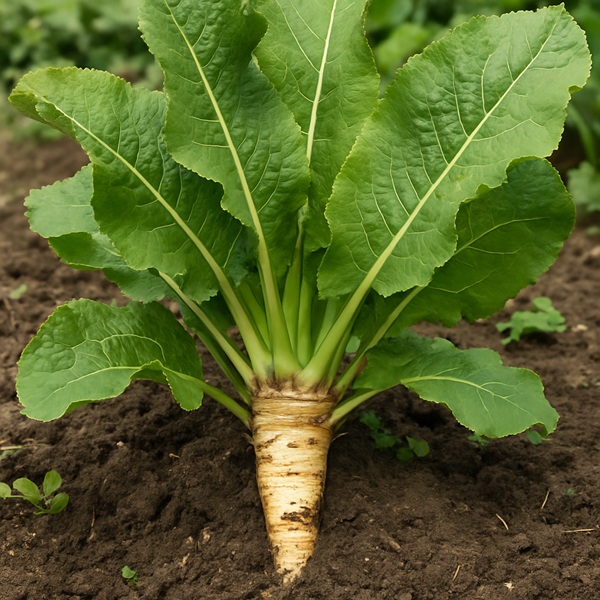
Horseradish (Armoracia rusticana) is a perennial herbaceous plant known for its sharp taste and pronounced aroma. In Ukraine, horseradish is widely used both in cooking and in folk medicine. Its roots are a source of vitamins, phytoncides, and essential oils, while the leaves are used for preserving vegetables. Thanks to its hardiness and ability to grow in almost any soil, horseradish has become one of the traditional crops in Ukrainian kitchen gardens.
The plant has a powerful root system that can penetrate the soil to a depth of up to 2 meters. Several shoots with large, elongated leaves develop from one root. Horseradish blooms in late spring to early summer with small white flowers gathered in raceme-like inflorescences, but in practical cultivation the flower stalks are usually removed so they do not exhaust the root system and so the concentration of nutrients in the roots is preserved.
Horseradish is highly winter-hardy, easily tolerates drought, and develops well in different climatic zones of Ukraine. At the same time, its aggressive growth requires careful control: without restriction, it can quickly take over a large part of the plot. That is why growing horseradish requires certain cultivation techniques that make it possible to obtain high-quality, large roots and prevent the crop from spreading beyond the allotted area.
Planting horseradish is a fairly simple process, but to obtain a good harvest several important aspects of soil preparation and planting material should be taken into account.
Choosing the site:
Light. Horseradish prefers sunny or partially shaded areas. With insufficient light, the leaves develop poorly, and the roots lose juiciness and aroma.
Soil. Horseradish grows best in light or medium loams with good drainage. The best option is loose, fertile soil with a neutral or slightly acidic reaction (pH 6.0–7.0).
Site preparation. In autumn before planting, the soil is deeply dug (30–40 cm), adding well-rotted manure or compost at 5–6 kg per 1 m², along with mineral fertilizers such as superphosphate and potassium salt.
Choosing and preparing the planting material:
Root cuttings 20–30 cm long and about 1 cm thick are used for planting. The best results come from cuttings prepared in autumn and stored in a cool room until spring. Before planting, the cuttings are trimmed in a special way: the upper cut is made straight, while the lower cut is made diagonally, which makes correct placement in the soil easier.
Planting technology:
Furrows 10–15 cm deep are made on the plot, spaced 40–50 cm apart.
The cuttings are planted at a 45° angle, burying the top end 3–5 cm below the soil surface.
They are covered with soil and lightly firmed.
After planting, the site is watered and mulched with peat or humus to retain moisture.
The best time for planting horseradish in Ukraine is early spring, when the soil has already warmed but still retains enough moisture.
Horseradish is a crop that does not require excessive care, but regular cultivation practices help produce large, juicy, and aromatic roots.
Watering.
Horseradish is fairly drought-tolerant, but for the formation of quality roots it needs regular watering, especially during active growth (May–June) and root formation (August). It is watered once every 7–10 days, using 10–15 liters of water per 1 m². If moisture is lacking, the roots become hard and fibrous.
Weeding and loosening.
Horseradish is sensitive to competition from weeds, especially in the early stages of development. Regular weeding is essential, as is loosening the soil after each watering or rain to a depth of 5–7 cm to improve air access to the roots.
Root formation.
To obtain large and even roots, the method of removing side buds is used:
In June, when the plant reaches 15–20 cm in height, the root is carefully uncovered.
All side branches and extra shoots are removed.
The root is covered with soil again and watered.
This procedure helps direct nutrients into the main root, making it larger and better in quality. In regions of Ukraine with a short summer, this shaping is especially important for timely harvesting.
Horseradish is propagated exclusively vegetatively, since the seed method is practically not used in gardening. The most common method is the use of root cuttings.
Preparing the cuttings.
The best time to prepare planting material is autumn, after harvesting. Sections 0.8–1.5 cm thick and 20–30 cm long are selected from healthy, strong roots. It is important to orient the cuttings correctly: the upper cut is made straight, the lower cut diagonal. The cuttings are stored in sand at 0 to +3°C until spring.
Spring propagation:
Before planting, the cuttings are inspected and damaged or dried-out pieces are discarded.
For better establishment, they may be soaked for a day in a growth stimulator.
They are planted using the standard method: at a 45° angle to stimulate vertical root growth.
Summer propagation:
If necessary, rooted side offshoots that form around the main plant can be used. However, the yield in the first year with this method will be somewhat lower.
Thanks to the simplicity of vegetative propagation, horseradish is easy to maintain on a plot, but it is important to control its spread in time.
Horseradish is considered a fairly resilient crop, but under unfavorable conditions it can still be affected by diseases and pests. Timely prevention and proper care help avoid serious problems.
Main diseases:
Bacterial root cancer. Appears as growths on the roots. Affected plants are destroyed, and the soil is disinfected.
White rot. Caused by fungi and appears as a white coating on the roots. The main prevention is avoiding water stagnation and proper watering.
Sclerotinia. A fungal disease that affects leaves and roots. Treatment involves removing affected parts and treating with fungicides.
Main pests:
Crucifer flea beetles. Damage young leaves. Wood ash, tobacco dust, or insecticides are used for control.
Cabbage moth. Damages horseradish leaves. Treatment with infusions of wormwood, yarrow, or biological products is effective.
Nematodes. Cause root deformation and stunted growth. Prevention includes crop rotation and soil disinfection.
Preventive measures:
Follow crop rotation rules and avoid planting horseradish after cruciferous crops.
Inspect plants regularly and remove affected ones in time.
Maintain the proper watering regime and sufficient spacing in the planting.
Horseradish is not only a spicy seasoning, but also an important part of Ukrainian folk culture with many uses.
Culinary use:
Horseradish roots are used to prepare spicy sauces served with meat dishes, aspic, and fish.
The leaves are actively used for preserving cucumbers, tomatoes, and other vegetables thanks to their antiseptic properties.
Horseradish is part of traditional Ukrainian dishes such as borshch, appetizers, and tinctures.
Medicinal properties:
Horseradish root has antiseptic, expectorant, and diuretic effects.
Folk medicine uses infusions and compresses made from horseradish to treat colds, rheumatism, and skin conditions.
Fresh grated horseradish stimulates appetite and improves digestion.
Decorative value:
Although horseradish is rarely grown as an ornamental plant, its large carved leaves can be used for greening utility plots and creating striking accents.
Advantages of growing horseradish in Ukraine:
Hardiness and high productivity.
Long-term cultivation in one place without loss of quality.
Wide use in cooking, medicine, and everyday life.
Horseradish remains an indispensable crop in Ukrainian kitchen gardens, combining ease of cultivation with multifunctional usefulness.