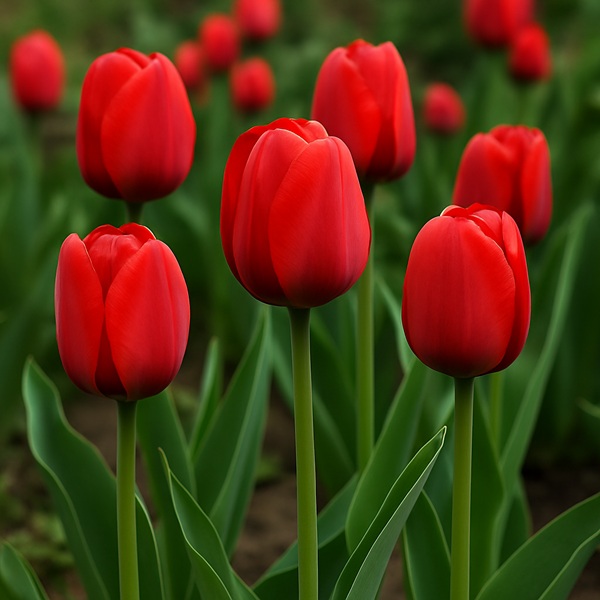
The tulip (Tulipa) is one of the most beloved spring flowers, a symbol of elegance, joy, and renewal. It is grown not only for beauty, but also for cut flowers, landscape design, and forcing for March 8. In Ukraine, tulips have adapted well in all climate zones — from Zakarpattia to Kherson region. They grow equally successfully in private gardens and in urban flower beds. Thanks to hundreds of varieties and forms, the tulip remains a universal crop chosen by both beginners and experienced flower growers.
From a botanical point of view, the tulip is a bulbous plant from the lily family. Its life cycle is clearly defined: vegetation begins in spring, and after just a few weeks the above-ground part dies back, while the bulb enters a dormant state. During this period, it is important to store the planting material properly so that it does not dry out, rot, or lose its ability to grow. Tulips are divided into 15 classes: single early, double, Darwin hybrids, fringed, viridiflora, parrot, and others. Each has its own flowering period, flower shape, and cultivation features.
Ukraine’s climate — with a pronounced winter and a warm spring — is ideal for the classic tulip development cycle. Winter temperatures ensure proper rooting, while spring warmth promotes active growth and flowering. At the same time, regional differences should be taken into account: in the south, planting is best done earlier to avoid overheating, while in the west, later planting is preferable to prevent rotting caused by excessive moisture. The success of tulip cultivation depends greatly on choosing the right variety and planting site — both for a flower bed in a home garden and for a farmer’s field.
Planting is a critical stage in tulip cultivation. The planting material must be high quality: firm bulbs, free of spots, damage, and rot. The optimal size is at least 3 cm in diameter, with an intact dry outer skin. Small bulbs usually do not bloom in the first year or produce weak flowering. They should be bought from trusted suppliers or taken from your own stock after summer storage.
The best planting time in Ukraine is from late September to mid-October. The bulb should have time to root for 3–4 weeks before frost, but not begin active growth. Early planting may cause premature sprouting, while late planting increases the risk of freezing. The planting depth should be 2.5–3 times the bulb’s height, on average 10–15 cm. In heavy soils, the depth is reduced slightly; in light soils, it is increased.
The planting layout depends on the purpose. For a decorative flower bed, bulbs are placed densely — 8–10 cm apart. In rows or borders, 12–15 cm is suitable. The soil should be loose, fertile, and well drained. Before planting, compost, wood ash, and superphosphate are added. Fresh manure is strictly unsuitable, as it promotes rot. After planting, the area is mulched with dry leaves, sawdust, or humus for frost protection.
Tulips are sensitive to moisture conditions. Watering is especially important in spring, during leaf growth and bud formation. In regions of Ukraine with a rainy spring, extra watering is not needed. But in a dry spring, the flowers are watered 1–2 times a week, while avoiding stagnant water. Watering is done at the base, not over the leaves, and drip irrigation is ideal.
Feeding is carried out three times:
– in spring, after shoots appear — nitrogen fertilizers;
– at the bud stage — balanced fertilizers with phosphorus and potassium;
– after flowering — to form a high-quality bulb.
Fertilizers are applied only to moist soil to avoid burns.
Care also includes weeding, mulching, and loosening. Weeds are especially harmful in the first weeks, since they compete for moisture and nutrients. After flowering, the above-ground part should not be cut immediately — the leaves continue feeding the bulb. They are removed only after they have turned completely yellow. This is critically important for the formation of next season’s flower.
Under Ukrainian climatic conditions, tulips may suffer from a number of diseases, especially in cases of excessive moisture, dense planting, or improper bulb storage. The most common problems are gray mold (botrytis), fusarium, penicillium rot, tulip breaking virus, and bacterial rots. The first signs include spots on the leaves, deformed buds, rotting at the stem base, or a complete lack of flowering.
The most effective method of control is prevention:
– follow crop rotation and do not plant tulips in the same place more often than once every 3–4 years;
– disinfect bulbs before planting with potassium permanganate solutions or fungicides;
– remove diseased plants and never compost them;
– loosen and aerate the soil, and control moisture levels.
Among pests, the most dangerous are tulip nematodes, mole crickets, wireworms, aphids, and thrips. Control includes soil treatment before planting, mechanical traps, and biological insecticides. Special attention should be paid to storage: it is during the dormant period that most infections occur. Ideal conditions are a temperature of about +17 °C, humidity no higher than 65%, and good ventilation.
After vegetation ends, tulips should not be left unattended. Even if they are grown purely for garden decoration, annual lifting ensures rejuvenation of the planting, improves flowering quality, and preserves varietal traits. The best period for digging is late June to early July, when the leaves have completely yellowed and dried.
The bulbs are carefully lifted in dry weather, cleaned of soil, sorted by size, and dried in the shade for 2–3 weeks. After that, they are stored in wooden or plastic crates in 1–2 layers in a well-ventilated room. During drying, it is important to inspect the material regularly and remove any damaged or moldy bulbs. This greatly reduces the risk of losses and makes it possible to form a full stock for the next season.
The planting material should be checked once a month. Large bulbs are planted the following season for flowering, while small ones are grown on. It is essential to label containers, store varieties separately, and prevent mixing. Following these simple rules ensures synchronized, even flowering and preserves the health of the planting.
The tulip is not only a decorative crop, but also a commercially profitable one. It is widely used for forcing for March 8, grown for cut flowers, and sold in pots. In Ukraine, forcing begins in October: the bulbs are placed in cold storage for 10–12 weeks at +5 °C, after which they are moved into a warm room for growth. This process requires precision, but with the right technique it provides a stable profit.
In landscape design, tulips combine well with muscari, daffodils, crocuses, and squills. They are planted in “waves,” in mixes of 3–5 varieties, or in large drifts of one color. They also look excellent in rock gardens, borders, and containers. They are especially striking in monochrome compositions or with pastel-colored perennials. It is important to take flowering times into account: early varieties open spring, while late ones prolong it into June.
For farmers, the tulip is a niche but promising product. Demand for fresh flowers in February–March is stable, so forcing can become an alternative to vegetable production. Growing them outdoors for cut flowers is also a profitable option. With the right approach, even a few hundred square meters can generate a substantial income — it only takes knowledge of the basics of cultivation and the ability to analyze the market.