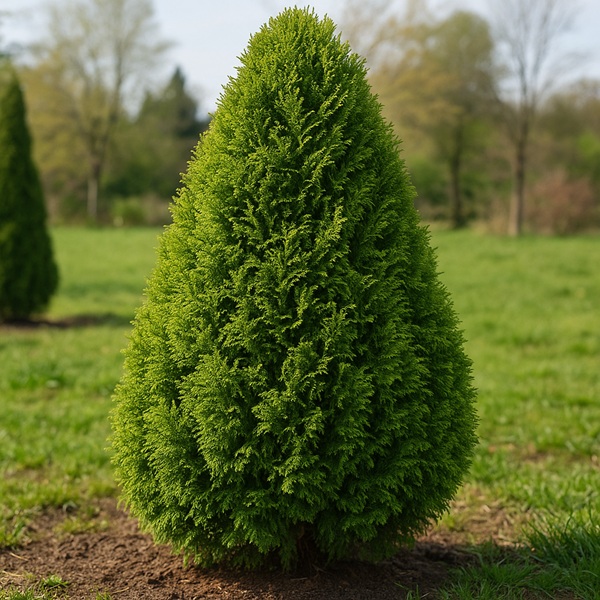
Thuja (Thuja) is an evergreen conifer from the cypress family that has gained popularity worldwide thanks to its ornamental value, hardiness, and versatility. In Ukraine, thuja is widely used both in private gardens and in urban landscaping — from hedges to specimen accents in rock gardens. Unlike many other conifers, thuja does not require especially specific conditions for normal growth and adapts well to most regions of the country.
Several thuja species are suitable for growing in Ukraine. The most common is western thuja (Thuja occidentalis), which tolerates frost well and is represented by many cultivars: from dwarf rounded forms to tall columnar ones. In urban landscaping, the varieties ‘Smaragd,’ ‘Brabant,’ ‘Danica,’ and ‘Globoza’ are often used, each with its own shape and growth rate. Folded thuja and Korean thuja are less common. Despite its soft foliage, thuja is resistant to air pollution and can help cleanse the air of dust and harmful substances.
Thanks to its dense crown and thick foliage, thuja serves not only a decorative role but also creates wind-protective and noise-reducing barriers. It grows fairly well in partial shade, but achieves its best ornamental effect in sunny or lightly shaded locations. In addition, thuja tolerates formative pruning well, so it is often used for topiary shapes, hedges, and geometric compositions. Its root system is shallow and branched, which requires a special approach to planting and watering — especially in the first years after planting.
Before planting thuja, it is important to choose the right place. Although this plant is quite adaptable, there are basic conditions that ensure full development. The site should be protected from strong winds — this is especially important in winter, when frosty air can dry out the foliage. It is also undesirable to plant thuja in lowlands or on waterlogged soils: despite its preference for moderate moisture, the plant does not tolerate overwatering or stagnant water well.
The optimal soil for thuja is light loam with a neutral or slightly acidic reaction (pH 5.5–7.0), well drained and moderately fertile. If the soil is too heavy, sand and peat should be added; if it is poor, compost or humus can be used. It is important not to overdo the organic matter: too much encourages overly vigorous green growth at the expense of crown density. Two to three weeks before planting, the soil should ideally be dug over, weeds removed, and phosphorus-potassium fertilizers applied — this creates a favorable starting environment.
Planting holes are dug to a depth of 60–80 cm and a width of 70–90 cm, depending on the size of the sapling. A drainage layer — crushed stone, expanded clay, or broken brick — is placed at the bottom, followed by a layer of fertile substrate. The root collar should remain at ground level: burying it may cause rot. The distance between plants for specimen planting is 1–2 m; for hedges, 60–80 cm. After planting, the thuja is watered generously, and the trunk area is mulched with bark, sawdust, or compost.
Thuja likes moisture, but not in excess. Young plants are especially sensitive to drought, so in the first two years they should be watered regularly, especially during hot periods. The optimal schedule is 1–2 times a week, 10–15 liters per plant. If moisture is lacking, the foliage turns yellow and begins to shed; if there is too much, the roots start to rot. Sprinkling the crown is also beneficial — it not only moistens the foliage, but also washes off dust, improves photosynthesis, and reduces the risk of drying out.
As for fertilizers, thuja does not need frequent feeding, but periodic mineral nutrition promotes better growth and richer foliage color. In spring, a balanced fertilizer with a higher nitrogen content is applied, and in August, a phosphorus-potassium fertilizer is used to prepare the plant for winter. Too much fertilizer is harmful: it causes an overly soft, loose crown that tolerates frost poorly.
Other care measures include weeding around the trunk, mulching, and careful loosening. Sanitary pruning should be carried out — removing dry, broken, or frost-damaged branches. Formative pruning is done in spring or early summer, avoiding late trimming in August–September, since new shoots will not have time to harden before frost. It is important to remember that thuja forms its crown slowly, so every intervention should be measured.
Despite its frost resistance, thuja in Ukraine does need some preparation for winter. The main danger is not so much frost itself as the drying of the foliage under the influence of wind and bright sun in February–March. When the soil is still frozen but evaporation has already begun, the plant loses moisture faster than it can absorb it — the foliage turns brown, dries out, and falls.
How to prepare thuja for winter:
– In autumn, during September–October, carry out deep moisture-charging watering — up to 20–30 liters per plant.
– Mulch the trunk circle with a layer of peat, bark, or compost up to 10 cm thick.
– Young plants should preferably be covered with breathable agrofabric or mesh.
– Do not use polyethylene — it does not breathe and encourages rot.
– Columnar cultivars should be tied with twine to prevent branch breakage under snow.
In spring, coverings are removed gradually — in cloudy weather or in the evening — to avoid sunburn. Fertilizers are applied only after temperatures stabilize. If the plant has suffered frost damage, pruning is done after growth begins, once the live and dead parts can be assessed. Thuja is capable of slow but steady recovery — the main thing is not to intervene too aggressively.
The easiest way to propagate thuja in a private garden is by cuttings. In June–July, cuttings 10–15 cm long are taken from one-year-old shoots. The lower part is cleared of foliage, dipped in a rooting stimulant, and planted in a light substrate of sand and peat in a greenhouse or cold frame. It is important to maintain high air humidity and good ventilation. Rooting takes 4–8 weeks, after which the young plants are grown on for another season and planted outdoors in spring.
Shaping thuja is a long-term process that depends on the chosen purpose. For hedges, trimming begins in the second year, gradually giving the plants the desired height and width. If thuja grows as a specimen plant, pruning is done only as needed — to remove damaged branches or make minor shape corrections. Thuja responds well to regular trimming, but it does not tolerate radical cutting back to bare wood. It is important to preserve the green part — foliage will not regrow from a bare trunk.
Fast-growing varieties such as ‘Brabant’ are best for hedges, while compact, dense ones such as ‘Smaragd’ and ‘Columna’ are better for shaped forms. The main principle is to trim often but lightly. Annual trimming by 10–15 cm is far better than radical cutting once every few years.
Although thuja is a hardy plant, it can still be affected by diseases and pests. The most common problems are thuja aphids, false scale insects, bark beetles, and fungal diseases. The first symptoms are yellowing foliage, curling shoots, sticky residue, and cracks in the bark. It is important to inspect the plant regularly, especially in spring, in order to detect and remove problems in time.
How to respond:
– Aphids and scale insects. Spray with insecticides such as Aktara or Actellic, or wash with a soap solution.
– Fungal diseases such as phytophthora and shütte. Treat with fungicides such as Topsin or Fundazol in spring and autumn.
– Frost damage and burn. Use winter covering and sanitary pruning in spring.
– Root rot. Replant into well-drained soil and control watering.
Prevention includes balanced watering, mulching, ventilation, and regular pruning. In the southern regions of Ukraine, it is also important to consider the risk of overheating — in open places, the foliage may burn. In such cases, partial midday shading and mulching, which stabilize soil moisture and temperature, are helpful.