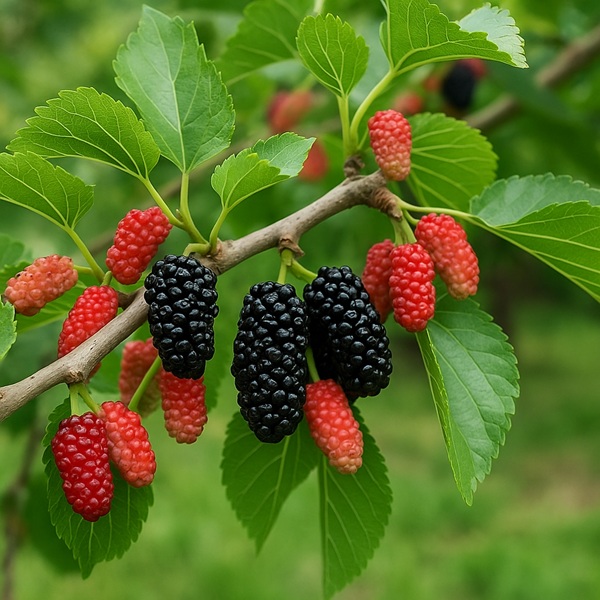
Mulberry (Morus) is a tree with a long history, traditionally grown in gardens and yards throughout Ukraine. It is valued not only for its sweet berries, but also for its resilience: mulberry is able to grow where other crops fail because of heat or lack of water. It can be seen both in rural households and in urban plantings — near roads, schools, and parks. In recent years, interest in growing mulberry has increased noticeably: it is becoming relevant both for private use and for commercial orcharding.
The two most widespread species in Ukraine are Morus alba (white mulberry) and Morus nigra (black mulberry). White mulberry grows faster and is less demanding in terms of soil and climate, but its berries are less intense in flavor. Black mulberry, by contrast, develops more slowly, yet its fruits are much more aromatic, fleshier, and richer in beneficial substances. There are also hybrid forms that combine the advantages of both species, as well as standard and dwarf varieties suitable for decorative use or for gardens with limited space.
Mulberry is an underrated source of benefits. Its berries contain glucose, fructose, vitamins C and B-group vitamins, organic acids, iron, potassium, and magnesium. They support digestion, improve blood formation, and strengthen the immune system. The leaves of white mulberry are used as feed for silkworms and also in herbal medicine. Its wood is valuable as well — strong, dense, and beautifully textured, ideal for joinery. This makes mulberry a highly versatile crop, suitable for growing in a garden, on a household plot, or even on a farm scale.
To grow a healthy tree and obtain a good harvest, it is important to choose the site correctly. Mulberry is a light-loving crop: in shade it becomes stretched, grows more slowly, and produces fewer berries. The best locations are south- or southeast-facing sites protected from northern winds. It is important to keep in mind that a mature tree may reach 10–15 meters in height, so it should not be planted close to buildings or other trees.
Mulberry is undemanding in regard to soil, but it grows best in fertile, loose loams with a neutral or slightly alkaline reaction (pH 6.5–7.5). The main thing is to avoid areas with standing water. If the soil is heavy or acidic, sand and humus should be added, and liming should be carried out. Planting is done in spring (March–April) or autumn (September–October). Spring planting allows the tree to establish before winter, while autumn planting provides a reserve of moisture for spring growth.
The planting hole is dug to a depth of 60–80 cm and a width of up to 70 cm. A drainage layer (gravel, crushed stone) is placed at the bottom, followed by a mixture of soil, humus, and ash. The root collar should remain level with the surface. The planting scheme depends on the purpose: for a single tree, at least 4–5 m from other plantings; in a row, 3–4 m between plants. After planting, the plant is watered generously (20–30 l), and the trunk circle is mulched. In windy locations, it is advisable to tie the young tree to a support.
Mulberry is one of the least demanding garden crops, but in its first years it still needs attention. It is especially important to ensure regular watering during hot periods and while the fruit is forming. In the first two years after planting, it is watered 1–2 times a week, using 10–15 l of water each time. A lack of moisture during this period may negatively affect root development and future productivity.
Mulberry has a shallow root system, so regular weeding and loosening of the soil are important. Mulching with straw, grass, or bark is very effective — it preserves moisture, reduces weed growth, and improves soil structure. From the third or fourth year of the tree’s life, the first formative pruning is carried out: weak shoots and inward-growing branches are removed, the height is adjusted, and crown ventilation is improved.
Crown formation is important not only for appearance, but also for productivity: a well-lit tree produces more berries, and they are easier to harvest. In spring, before bud break, sanitary pruning is done — removing frost-damaged and dried branches. Once every 5–6 years, rejuvenating pruning is advisable, shortening the main scaffold branches. This encourages active growth of new shoots and increases yield.
Mulberry in Ukraine begins to bear fruit in the 3rd–5th year after planting, depending on the variety and growing conditions. One mature tree can produce from 30 to 100 kg of berries. Fruiting lasts from late May to mid-July. Black mulberry ripens later than white mulberry, but it has denser flesh and a richer taste. It is best to harvest the berries by hand, in the morning or evening, to avoid overheating the fruit and loss of aroma.
There is also the practice of shaking the fruit onto a spread cloth or plastic sheet — effective for mass harvesting, though the downside is uneven ripening. The berries are very delicate and can be stored in the refrigerator for only 2–3 days, so they are best processed quickly. The best methods are:
– jams and preserves (the berries gel well without additives);
– drying (in the sun or in a dehydrator);
– freezing (for compotes, smoothies, and baking);
– making tinctures, liqueurs, or wine.
Mulberry juice is also beneficial — it is used for anemia, weakness, and gastrointestinal problems. Processing helps avoid losses, preserves the value of the berries, and greatly expands the ways they can be consumed.
Although mulberry is considered a fairly resilient crop, it may sometimes be affected by diseases and pests. The most common problems are powdery mildew, leaf spot diseases, aphids, scale insects, and whitefly. These usually appear in overcrowded plantings or with excessive nitrogen fertilization. Heat and high humidity, especially in June, also promote disease development.
The main preventive measures are:
– forming a proper, open crown;
– preventing moisture stagnation around the root collar;
– removing affected branches and leaves;
– autumn cleanup of fallen leaves and mulching.
For treatment, it is best to use natural remedies: infusions of garlic, wormwood, or calendula. In more serious cases, biological products based on Bacillus subtilis or pyrethrin can be used. Mulberry usually resists pests well if care is systematic and the soil is healthy. In the southern regions, it is important to protect young trees from sunscald and overheating — mulch and evening watering are helpful here. It is also recommended to wrap the trunks with plastic mesh to prevent rodent damage.
Mulberry can be propagated by seed, cuttings, layering, and grafting. The seed method is used mainly in breeding, since seedlings do not retain varietal traits. Vegetative methods are more practical. Green cuttings are taken in June–July, treated with a rooting stimulant, and rooted in a moist substrate. Roots appear after 4–5 weeks, and the young plants are grown on until the following season.
Grafting is used to propagate valuable varieties. The rootstock is usually a 1–2-year-old white mulberry seedling. Grafting is carried out in spring by copulation or budding. Root suckers and air layering are also common. These methods make it possible to preserve varietal traits and speed up fruiting.
The variety should be chosen with the climate, taste preferences, and disease resistance in mind. Early white mulberry varieties are well suited to the southern regions, while mid- or late-ripening, frost-hardy varieties are better for central and western Ukraine. Among the popular ones are ‘Ukrainska Chorna,’ ‘Nadiya,’ ‘Shelly No. 150,’ ‘Staromiska,’ and ‘Rumuńska Velykoplidna.’ With proper care and a correctly chosen variety, mulberry can become a true leader among fruit and berry crops in the Ukrainian garden.