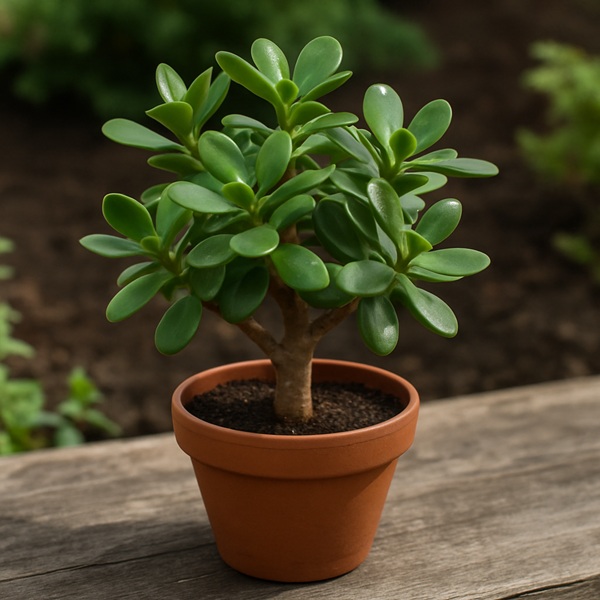
Crassula (Crassula), often called the “money tree,” is one of the best-known houseplants. It combines ornamental appeal, hardiness, and popular beliefs about its ability to attract prosperity. This succulent comes from South Africa and adapts very well to indoor conditions, especially in the climate of Ukraine, with its contrasting seasons and changing indoor humidity. It is believed that a healthy, lush “money tree” brings financial stability and harmony into the home.
From a botanical point of view, crassula is a genus that includes more than 300 species, most of which have fleshy leaves that store moisture. The most common in floriculture is Crassula ovata — an evergreen plant with glossy oval leaves and a thickened stem. Under favorable conditions, it can grow from 30 cm to 1.5 m tall. If given proper care, it may bloom with small white or pink flowers gathered in clusters. However, this happens rarely indoors, and its main decorative value comes from the foliage and the overall silhouette of the plant.
Crassula is an ideal choice for both beginners and experienced growers. It is hardy, does not require daily watering, and tolerates drought easily. This makes it especially suitable for Ukrainian conditions, where winters often bring a lack of light and humidity, while summers are hot and dry. In addition, crassula fits beautifully into interiors — it is grown in homes, offices, and coworking spaces. It purifies the air, creates a cozy atmosphere, and adds a natural sense of harmony. Its slow but steady growth also allows it to be shaped into a tree or even a miniature bonsai.
Despite crassula’s hardiness, the correct choice of soil and container matters a great deal. Its roots are shallow, so a deep pot is unnecessary. However, because of the heavy top growth, the plant may be unstable in lightweight plastic pots. Wide, shallow ceramic or clay pots are best, as they are both stable and breathable. Each repotting should involve increasing the pot diameter by 2–3 cm.
Drainage is just as important. A 2–3 cm layer of expanded clay, gravel, or broken brick should always be placed at the bottom. The soil mix should be light, well-draining, and neutral or slightly alkaline. The simplest option is to mix 2 parts leaf soil, 1 part river sand, and 1 part humus. It is also useful to add a little charcoal plus perlite or vermiculite for looseness. Ready-made succulent and cactus substrates are also suitable, as long as they do not contain an excess of peat, which holds too much moisture.
The ideal place for crassula is a windowsill on the south, southeast, or southwest side. It is light-loving and needs at least 4–6 hours of direct sun a day. With too little light, the plant stretches, the leaves become smaller, and the color loses its richness. In summer, especially in intense heat, it is worth shading it at midday to avoid burns. In winter, when daylight is short, supplemental lighting with a grow lamp is recommended. A comfortable temperature is +18 to +25 °C in the warm season and +10 to +15 °C in winter with restrained watering.
Crassula is not repotted often — mature plants once every 2–3 years, young ones every year in spring. The best method is transfer: the plant is carefully removed from the pot while preserving the root ball, excess old substrate is removed without damaging the roots, and it is moved into a new container with drainage and prepared soil mix. It should not be watered for 2–3 days after repotting — this reduces the risk of root rot.
In the case of initial planting, for example after buying it in a store, the condition of the root system should be checked. Plants are often sold in peat-based soil, which either dries out too fast or, on the contrary, retains too much water. It is better to replace such a substrate, gently rinsing the roots in water. The newly planted specimen should be kept in partial shade for 5–7 days — this helps it adapt more easily. Watering during this period should be very moderate.
Crassula is usually propagated by cuttings. A shoot 7–10 cm long is chosen, cut with a disinfected tool, dried in the shade for 2–3 days, and then planted in a light substrate of sand and leaf soil. It can also be rooted in water, although there is a risk of rotting. Roots appear within 1–3 weeks. Rooted cuttings are planted into small pots and cared for in the same way as mature plants, but with extra caution regarding watering.
Crassula does not require complicated care, but it does have its own nuances. The main rule is not to overdo anything. This is especially true of watering. As a typical succulent, crassula stores moisture in its leaves and does not tolerate overwatering well. This is one of the most common reasons the plant dies, especially in winter.
Key care points:
– Spring–summer:
• Water once every 7–10 days, depending on air temperature;
• Wipe dust off the leaves to improve respiration;
• Optional evening misting;
• Feed once a month with fertilizer for succulents.
– Autumn–winter:
• Water once every 3–4 weeks if the temperature is below +15 °C;
• Stop feeding;
• It is desirable to provide cool conditions (up to +12 °C) and plenty of light;
• If natural light is insufficient, use supplemental lighting.
It is worth remembering: if the leaves are soft and limp, the plant lacks moisture. But if they are dropping, this is a sign of overwatering or root rot.
Even though it is undemanding, crassula can lose its decorative appeal or die. The most common problems are:
Excess watering.
Signs include soft leaves, dark spots on the stem, and an unpleasant smell. The solution is repotting, cutting away the affected roots, and treating with fungicides.
Lack of light.
The plant stretches, the leaves become smaller, and the shoots lean. The solution is to move it to a brighter place or use grow lamps.
An unsuitable pot.
If it is too large, water stagnates; if it is too tight, growth slows. Balance is needed.
Sunburn.
In hot weather, brown spots appear on the leaves. Shading is needed in the second half of the day.
Pests are also possible — scale insects, spider mites, and mealybugs. Their appearance is most often caused by dry air and a weakened plant. Regular inspection and gentle washing are the best prevention.
Crassula is easy not only to propagate, but also to shape into a beautiful “money tree.” This allows you not only to control its size, but also to give the plant the form you want.
How to propagate it:
– By cuttings. The most common method. After drying, plant in moist sand or a light substrate.
– By leaf. Less reliable, but possible. A dried leaf is simply placed on the substrate, where it will later produce a shoot.
– By offshoots. If young shoots appear at the base, they can be carefully separated and replanted.
Shaping is done by pinching. The central shoot is left, while the side ones are removed. When the plant reaches the desired height, the top is pinched too — this stimulates the growth of side branches, and a crown begins to form. The tree can be shaped into a rounded, bushy, or bonsai-like form.
Tip: shaping is best done in spring or early summer. Heavy pruning in winter or during the dormant period can harm the plant. After shaping, it is important to repot the plant in time, about once every 2 years — this stimulates the root system and improves its appearance.