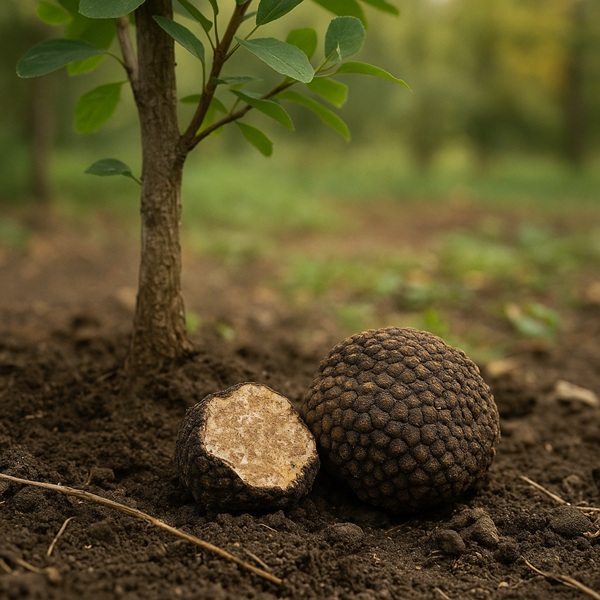
Truffle is not just a mushroom — it is a symbol of culinary refinement and of a difficult, yet promising, agricultural process. Although its popularity is growing worldwide, truffle cultivation remains a little-studied and labor-intensive field. In Ukraine, however, recent years have seen steady interest in establishing truffle plantations. And while the process is far from simple, truffle growing is no longer merely exotic here — it is gradually becoming a real branch of farming and agribusiness.
Truffles belong to the genus of tuberous fungi (Tuber), which form underground fruiting bodies in symbiosis with the roots of certain trees. The most expensive are the black Périgord truffle and the white Piedmont truffle, but other species adapt successfully in Ukraine, including the summer black truffle (Tuber aestivum), winter black truffle (Tuber brumale), and Burgundy truffle (Tuber uncinatum). They are suited to Ukraine’s temperate climate, especially in the western, central, and southern regions, where the soil and moisture levels are appropriate.
The key feature of truffles is that they are not grown like ordinary mushrooms — they require a symbiotic relationship with host trees. Most often, these are oak, hornbeam, beech, hazel, and pine. It is essential that the tree be inoculated with truffle mycorrhiza. A truffle plantation begins to bear fruit only 5–8 years after planting. But with proper care, it can remain productive for 20–30 years, bringing stable income and yielding a delicacy valued all over the world.
The success of a truffle farm begins with choosing the site. And although it may seem that truffles can grow anywhere, in reality even small deviations from natural conditions can ruin the harvest for years. Dozens of factors must be considered: soil type, acidity, humus depth, groundwater level, and microclimate.
Optimal conditions for growing truffles in Ukraine:
– well-drained calcareous soils with a pH of 7.5–8.3;
– carbonate content of at least 10%;
– a humus layer of at least 30 cm;
– a low groundwater level (not closer than 80–100 cm);
– no standing water, waterlogging, or excessive flooding.
South-facing and southwest-facing slopes with good light exposure and air movement are considered the best. Before planting, a soil analysis is essential — laboratory testing should determine pH, calcium, magnesium, and humus content. If needed, liming and compost application should be carried out. Site preparation takes from six months to two years, especially if agricultural chemicals were previously used there. Truffles are extremely sensitive to soil composition and microbiota, so the soil must be biologically balanced.
If the soil is acidic or depleted, planting will fail. In that case, it is better either to change the site or postpone the project for several years. It is also important to avoid places at risk of spring frosts or strong winter winds — these can damage young trees and disrupt the mycorrhizal bond with the fungus.
Planting truffles is, above all, planting a tree with mycorrhiza. The main thing is not the tree itself, but its roots, into which the fungal mycelium has been integrated. In Ukraine, certified saplings are already available — oak, hornbeam, and hazel grown under sterile conditions and inoculated with truffle spores. The reliability of the supplier is critical here: poor-quality inoculation means losing 5–10 years.
Planting is done in autumn or spring, in holes 30–40 cm deep and up to 60 cm wide. The spacing between trees is 3–5 meters. A little limestone and compost are added to the bottom, and sometimes forest soil with natural microflora as well. The sapling is placed carefully, covered with light soil, and watered. Phosphorus and nitrogen fertilizers must not be used — they destroy the fungus.
After planting, the surface around the tree is mulched with pine chips or bark. This helps retain moisture and suppress weeds. During the first two years, minimal but careful maintenance is needed: protection from frost, rodents, and mechanical damage. The soil is not dug — only shallow loosening is allowed. The symbiosis between fungus and tree forms gradually over several seasons. And it is this period that determines whether there will be truffles in five years.
The first years after planting are the most important for establishing a stable symbiotic system between the tree and the fungus. This period determines the fate of the future harvest. If everything goes well, the first truffles may appear by the fifth year. If major mistakes are made, there may be no result at all.
It is recommended to:
– inspect the trees periodically, every 2–3 weeks: signs of wilting, leaf discoloration, or poor growth are warning signals;
– maintain moderate moisture, ideally with drip irrigation, especially in summer;
– prevent weeds from appearing, but never use herbicides;
– carry out light sanitary pruning of the trees every spring;
– monitor pests such as cockchafer larvae, ants, and rodents.
Starting from the third or fourth year, a “bare zone” often appears around the tree — an area without grass. This is a positive sign: the mycelium is actively developing and pushing out other plants. By the fifth year, this zone should expand — an indirect sign that underground fruiting may already be possible. Interestingly, in Europe, natural mycorrhiza collected from forests is sometimes introduced into plantations. In Ukraine, forest litter from oak or beech stands can also be used to support soil microflora.
Truffles ripen underground at a depth of 5–20 cm. Harvesting takes place from mid-September to late November, depending on the variety and climate. The main challenge is finding the exact place where the fungus is growing, since it gives almost no visible signs above ground.
Search methods:
Trained animals.
The best truffle hunters are specially trained dogs, such as Lagotto Romagnolo, Labradors, or Spaniels. Unlike pigs, they do not eat the mushrooms and do not damage the mycelium.
Observing the soil.
In places where truffles are ripening, cracks in the soil, slight lifting of the ground, or a lack of vegetation can sometimes be noticed.
Careful probing.
The soil in the bare zone is gently probed with wooden or plastic sticks. Shovels are prohibited — they can destroy the mycelium.
Harvested truffles are cleaned of soil, but not washed, and stored at +2 to +4 °C for no more than 7–10 days. The best sales option is to sell them fresh to restaurants or for export. It is also possible to produce truffle paste, oil, dried products, or freeze-dried products — this extends shelf life and opens access to new markets.
Growing truffles is a long-term investment project that requires patience, knowledge, and financial resources. It is not quick profit, but an investment in a premium product with high added value.
Advantages in Ukraine:
– the presence of suitable soils, especially in Zakarpattia, Prykarpattia, and Podillia;
– affordable land lease and relatively low labor costs;
– growing demand in the HoReCa market and private segment;
– the possibility of fruiting in one place for more than 25 years.
Main risks:
– very high sensitivity to soil quality;
– lack of state support or clear standards;
– a shortage of specialists and certified saplings;
– difficulties in protecting the harvest, since truffles may be dug up by other people or by wild animals.
Despite all this, the first Ukrainian plantations are already producing results, and the experience of farmers in Lviv region, Bukovyna, and Odesa region proves that truffles in Ukraine are not a myth. They are a promising reality that requires time, knowledge, and the right strategy. Over the next 5–10 years, this crop has every chance of becoming part of the country’s niche agricultural landscape.