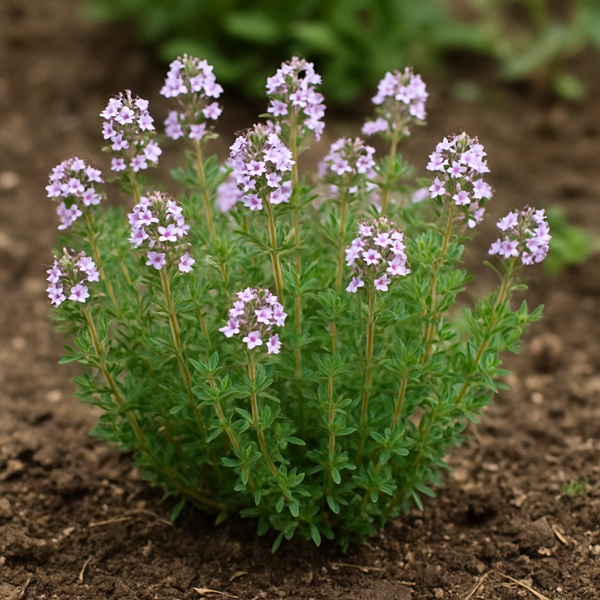
Thyme (Thymus vulgaris), also known as common thyme or mother-of-thyme, is one of the oldest culinary and medicinal plants, used as far back as Ancient Egypt, Rome, and Greece. Thanks to its strong aroma, essential oil content, and rich chemical composition, thyme has earned an honored place not only in the world’s cuisines, but also in herbal medicine. In Ukraine, it grows both in the wild (for example, creeping thyme) and is cultivated in home gardens. It is especially popular in the southern and central regions, where dry soils and a warm climate support its active growth. However, thanks to its high adaptability, thyme is also successfully grown in the north of the country, provided it receives proper care and is protected from excessive moisture.
This crop is valued for its compact habit, hardiness, and ability to grow even on poor soils. A perennial shrub up to 30 cm tall forms dense carpets of aromatic foliage. In summer, thyme blooms abundantly with small flowers, attracting bees and other pollinators. It is often grown not only as a seasoning, but also as an ornamental plant for alpine slides, borders, and containers. In the first year after sowing, development is slow, but by the second season the bushes become strong and capable of producing regular harvests of greenery.
Thyme is rich in carvacrol, thymol, ursolic acid, B vitamins, and flavonoids — this is what makes it indispensable in folk medicine. It is used for colds, coughs, gastrointestinal disorders, and as an external antiseptic. In cooking, thyme perfectly complements meat dishes, roasted potatoes, vegetable side dishes, and marinades. The plant can be dried, frozen, added fresh, and used to flavor vinegar, oil, drinks, and even baked goods.
A properly chosen location is the key to success. Thyme loves sun and well-ventilated areas. Even light shade leads to stretched growth, reduced aroma, and a higher risk of disease. South-facing slopes and open sites protected from strong winds are best. It is very important that the soil not be waterlogged, because thyme is a Mediterranean crop that does not tolerate stagnant water. In lowlands or on heavy clay soils, raised beds should be made.
The ideal substrate is light, loose, well drained, with a neutral or slightly alkaline reaction (pH 6.5–7.5). Thyme does not need humus-rich soil — on the contrary, in overly fertile conditions the concentration of essential oils decreases. Before planting, the soil should be dug to a depth of 20–25 cm, all perennial weeds removed, sand or fine gravel added to improve drainage, and ash or lime incorporated to normalize acidity. Per 1 m², it is enough to add 1–2 kg of sand and half a kilogram of ash. Organic fertilizers such as compost may be used in small amounts only if the soil is poor.
Thyme can be grown from seed or through seedlings. Under Ukrainian conditions, especially in the northern regions, the seedling method is often preferred. The seeds are very small, so they are not covered with soil, but only lightly pressed into a moist substrate and covered with film or glass. Germination takes place in the light at temperatures from +20 °C. Sowing is done in late March to early April, and seedlings are pricked out when the second true leaf appears. The seedlings are planted in open ground in mid-May, after temperatures have stabilized. In the southern regions, direct sowing in open ground is possible from late April.
At the early stage of development, thyme seedlings need special attention. First of all, they must receive enough light. Too little sun leads to stretched shoots, weakened plants, and loss of aroma. Another critical factor is watering. Although mature thyme is drought-tolerant, young plants need regular moisture. At the same time, excess water is dangerous, since it easily provokes root rot. Ideally, water in small amounts, judging by the drying of the topsoil.
After emergence, it is important to loosen the spaces between the rows regularly and remove weeds. Since thyme has a shallow root system, this should be done very carefully, without digging deeply. To encourage branching and increase aroma, it is worth pinching the shoot tips. In the first season, a small trial harvest of greenery can be taken as early as 3 months after sowing, but the main harvest comes in the second year, once the plant has reached full strength.
Feeding during active growth should be done cautiously. Nitrogen fertilizers are used very sparingly so they do not trigger vigorous growth at the expense of aroma. Ash infusion, a weak compost solution, or compound fertilizers with low nitrogen content are best. If thyme is growing in poor or sandy soil, feeding twice per season is possible — in June and August. It is important to remember that stagnant water and compacted soil can destroy the crop even when it is fully mature.
Although thyme can be grown from seed, in practice vegetative propagation is used more often. It allows mature plants to be obtained more quickly while preserving all varietal characteristics. One of the most effective methods is dividing the bush. This is done in spring, before active growth begins, or in autumn, in September. A healthy mother plant is carefully dug up, divided into 3–4 parts with roots attached, and replanted in a new place. Each part is planted at the same depth as before, watered thoroughly, and mulched.
Another popular method is rooting layers. In June–July, a strong shoot is chosen, bent to the ground, pinned with a staple or a stone, and covered with moist soil. In 3–4 weeks, roots form, after which the shoot is separated and replanted. The advantage of this method is that it causes minimal trauma to the main plant. Cuttings 8–10 cm long can also be taken and rooted in a moist light mix — in 2–3 weeks roots appear, and the young plant is transplanted into open ground.
With age, after 4–5 years, thyme bushes become bare in the center, and their productivity and aroma decline. To avoid this, the planting should be rejuvenated every few years — divide older plants, replace part of the bushes, or move the bed to a different place. Growing thyme in one place for more than 5–6 years is not recommended, because pests and diseases accumulate in the soil and the ground becomes exhausted. Good previous crops for thyme are legumes, cucurbits, or root vegetables.
Thyme is fairly resistant to diseases and pests, but under unfavorable conditions — excessive moisture, crowded planting, long rains — fungal infections may develop. The most common are gray mold, rust, and powdery mildew. Symptoms include yellowing and drying leaves, coating on the stems, and loss of aroma. For prevention, avoid dense planting, prune old shoots in time, and follow crop rotation. If the plant becomes infected, cut away the affected parts and spray with biofungicides, for example those based on Trichoderma or Fitosporin.
Among pests, thyme may be attacked by aphids, spider mites, and whiteflies, especially in greenhouses or when planted too densely. Folk remedies such as garlic infusion, onion peel infusion, or soap solution are effective. In severe cases, bioinsecticides are used.
Preparing thyme for winter is an important step, especially in the northern and eastern regions of Ukraine. Although the plant is frost-hardy, in winters with little snow or deep freezing its above-ground parts may be damaged. In September–October, it is cut back to a height of 5–7 cm, after which the bed is mulched with dry leaves, straw, or spruce branches. In the southern regions, such cover is usually unnecessary. In spring, the mulch is removed, the soil is loosened, and the plants are checked before further row shaping.
Thyme is cut 2–3 times per season, beginning in June. The most aromatic greenery is harvested in the morning after the dew has dried, in warm, dry weather. Young shoots up to 10–15 cm long are cut, avoiding woody parts. A second harvest is made after 4–5 weeks. The final cutting should be completed no later than early September so the plant has time to recover before winter. From one square meter, up to 300–400 g of dried raw material can be obtained.
For drying, thyme is spread in a thin layer in a shaded, well-ventilated place or hung in bunches. When the leaves become brittle, they are stripped from the stems and stored in glass jars or metal containers for up to 12 months. The crop can also be frozen — chopped or in whole sprigs in ice-cube trays with water or oil, which is very convenient for cooking.
In cooking, thyme has countless uses. It is added to meat, fish, vegetables, sauces, soups, and casseroles. The herb pairs especially well with potatoes, tomatoes, eggs, and cheese. It is used to make flavored oil, vinegar, and homemade marinades. Thyme is also used in tea, herbal blends, and even in honey-based baked goods. Because it withstands heat well, it retains its aroma during roasting and boiling, which makes it an essential spice in any Ukrainian household.