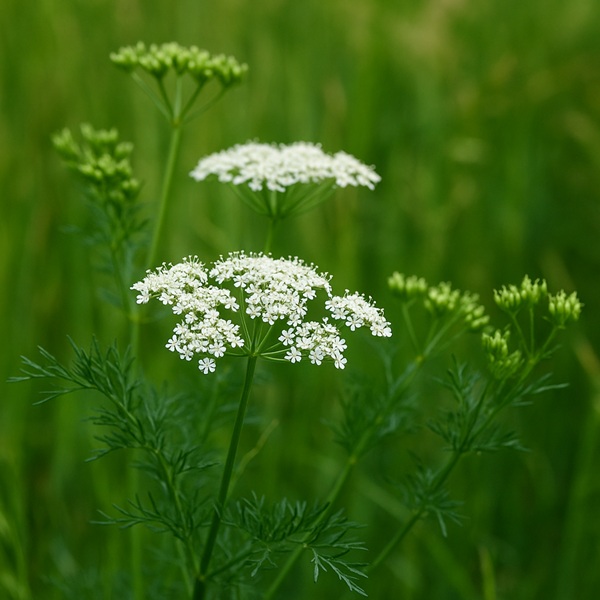
Caraway (Carum carvi) is a biennial plant from the Apiaceae family, cultivated as a spice, aromatic, and medicinal crop. Its characteristic feature is the warm, slightly sweet aroma typical of its mature fruits. These fruits, often referred to as seeds, are used in cooking, baking, confectionery, medicine, and even cosmetology. In Ukraine, caraway has long been well known: it was added to borscht, bread, pickles, and tinctures, and was also used as a remedy to improve digestion and reduce spasms.
From a botanical point of view, caraway is a plant with a strong taproot, an upright grooved stem up to 70 cm tall, and finely divided bipinnate leaves. It blooms in the second year after sowing, in June–July, forming umbel inflorescences pollinated by insects. After flowering, fruits develop — elongated schizocarps with characteristic ribs. In the first year, the plant forms only a leaf rosette and root system; in the second, it flowers and bears fruit, after which it dies. Because of this feature, caraway cultivation requires two-year planning.
Caraway is well adapted to a temperate climate and grows very well under Ukrainian conditions. It tolerates spring frosts down to -7 °C, prefers sunny sites, but can also grow in light partial shade. It develops best on light or medium loamy soils with good drainage. It should be taken into account that caraway does not like excessive moisture or acidic soils — the optimal pH level is 6.5–7.2. The crop also does not tolerate dense planting well: under such conditions, yields decrease, the risk of disease rises, and seed quality worsens.
For successful caraway cultivation, it is necessary to choose the right site. This crop prefers well-lit areas protected from northern winds. South-facing plots or raised beds are ideal, especially in regions with higher humidity. Caraway can be grown after cereals, potatoes, or legumes. It is not recommended to sow it after other umbelliferous crops such as dill, parsley, or coriander, because shared diseases and pests may be carried over. The crop rotation interval should be at least 3–4 years.
In autumn, before sowing, the site should be prepared thoroughly: dig the soil to a depth of 25–30 cm, remove perennial weeds and rhizomes, and apply organic matter — humus or compost (up to 4 kg/m²). Phosphorus-potassium fertilizers such as superphosphate and potassium salt should also be added. In spring, 2–3 weeks before sowing, the soil is loosened and harrowed to achieve a fine crumb structure. It is important that by sowing time the soil has had time to settle: in soil that is too loose, the small seeds may sink too deeply and fail to emerge.
Caraway is sown early in spring, in late March or early April depending on the region. Winter sowing is also possible in October. The sowing rate is 1.5–2 g/m². The seeds are covered to a depth of 1.5–2 cm, with row spacing of 35–45 cm. After sowing, the soil is firmed with a roller or the back of a rake. Seedlings appear in 2–3 weeks. During this period, it is very important to control moisture: drying of the soil during germination significantly reduces germination rates. Throughout the first year of cultivation, caraway needs regular loosening and weed control — at the early stage, the crop competes poorly with aggressive plants.
Caraway is undemanding in care, but it does require systematic attention, especially in the first year. The main agronomic practices are loosening between the rows, weeding, and maintaining soil moisture. Watering is done during prolonged drought, mainly in the period of active leaf growth. At the same time, it is important to avoid water stagnation: excess moisture encourages rot. Mulching is a good solution — it reduces moisture evaporation and suppresses weed growth.
In the second year, in spring, the plants begin growing rapidly and form flowering shoots. During this period, it is advisable to feed the crop with a balanced mineral fertilizer with a greater proportion of potassium and phosphorus, which helps form full-value seed. Excess nitrogen is undesirable, because it stimulates excessive leaf growth at the expense of flowering. During budding and flowering, preventive spraying against aphids and caterpillars may be carried out. Although caraway is fairly resistant, it may be affected by the umbel moth, carrot fly, powdery mildew, and phoma.
After flowering ends, the seed-filling stage begins. When the umbels turn brown and the seeds begin to shatter, it is time to harvest. The umbels are cut when partly browned and dried in a ventilated room. After full ripening, the seeds are threshed by hand or mechanically, cleaned, and sorted. Caraway should be stored in airtight containers in a dry place at a temperature not exceeding 18 °C. Under such conditions, its aroma and properties are preserved for up to three years.
Although caraway is a biennial crop, repeated cultivation in the same place is not recommended more often than once every 4–5 years. This is due to soil depletion, the buildup of pests and pathogens, and increased weed pressure. That is why it is important to follow crop rotation and choose preceding crops correctly. In practice, caraway is often alternated with cereals, maize, beet, peas, or beans. Growing it after other umbelliferous crops is strongly discouraged because of the risk of shared diseases and pests.
Caraway is propagated exclusively by seed. To ensure good sowing material, fully mature, healthy seed with high germination should be selected. The best germination comes from fresh seeds up to two years old. On farms, the most vigorous second-year plants are left for seed production, making it possible to obtain strong offspring. In home gardens, seed can be collected independently, provided no other umbelliferous crops are growing nearby — this helps preserve varietal qualities without cross-pollination.
Sometimes caraway is left into a third year if some plants did not manage to flower or if second-year conditions turned out to be unfavorable. In that case, a harvest is possible, but it will be less abundant. Caraway may be returned to the old site only after the soil has been fully restored, with organic matter added and acidic soils limed. It is important to remember: caraway performs best on loose, clean, and well-structured soils, so regular loosening and inter-row cultivation remain relevant in any year of cultivation.
Despite its general resistance to pests, caraway grown in open ground in Ukraine may be affected by a number of diseases and insects. The most dangerous are the carrot fly, black aphid, umbel moth, as well as phoma and powdery mildew. Affected plants lose their vigor, form seed poorly, and may die prematurely. Weed control is highly important: weeds not only take nutrients away, but also serve as centers for the spread of pathogens. For that reason, systematic weeding is one of the main protective measures.
At the first signs of disease, natural remedies should be used: garlic infusion, wood ash solution, or biological products based on Bacillus subtilis or Trichoderma. In the case of mass pest infestation, bioinsecticides may be used, but treatments should be carried out before the flowering stage. During bud formation and flowering, the use of any chemical agents is undesirable so as not to harm pollinators. Preventive measures also include planting repellent crops nearby — onions, garlic, and marigolds.
An effective method of protection is mulching and crop rotation. Mulch made from straw, cut grass, or peat helps preserve moisture, slows weed growth, and reduces soil overheating. In addition, after harvest all plant residues should обязательно be removed, the soil dug to a depth of 25–30 cm, and allowed to rest. Such agronomic techniques are especially valuable in organic farming, where pesticides are not used but the goal is still to obtain a healthy and safe harvest.
Caraway is harvested when the seeds reach technical maturity — they take on a gray or brown shade, separate easily from the umbels, but have not yet started active shattering. Harvesting falls in August, although the exact timing depends on the region. The umbels are cut by hand or mechanically, tied into bundles, and hung in a shaded, well-ventilated place for drying. After complete drying, the fruits are threshed, sifted, and stored in airtight paper or glass containers in a dry place.
Caraway is widely used in Ukrainian cuisine. It is added to bread, sauerkraut, meat, marinades, and homemade sausages. It gives dishes a distinctive aroma and improves digestion. In folk medicine, caraway is used as an anti-inflammatory, antispasmodic, and expectorant remedy. Infusions and decoctions help with flatulence, bronchitis, colic, and digestive disorders. Caraway essential oil is used in cosmetology, aromatherapy, and also as a natural immune stimulant.
So, caraway is not just a spice, but a valuable agricultural crop with a wide range of uses. With proper growing techniques, it is easy to cultivate even on small household plots throughout Ukraine. The harvest can be used in everyday life, cooking, and treatment — and it will certainly become a useful addition to any gardener’s household.