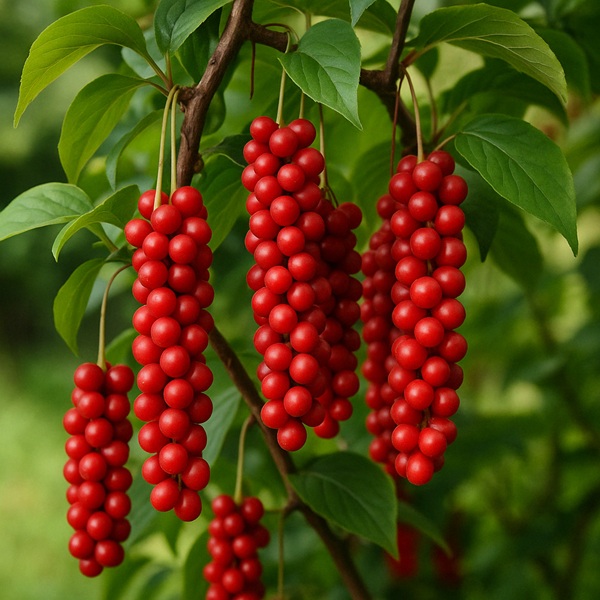
Schisandra, most commonly referring to Chinese magnolia vine (Schisandra chinensis), is a perennial woody vine valued not only for its ornamental qualities but also for its healing properties. Its berries are rich in organic acids, vitamins — especially vitamin C — and essential oils, which makes them desirable in both folk and conventional medicine. In Ukraine, schisandra can be grown successfully in most regions, especially in the central and western parts, where the climate is moderate and winters are not too severe. In the south, overheating of the root system in summer is possible, so additional protection is needed there. In the northern regions, it is important to provide winter cover, especially for young plants.
For cultivation in Ukraine, Chinese magnolia vine is the best choice, as it is distinguished by high winter hardiness, disease resistance, and vigorous growth. The plant develops as a vine reaching 10–15 meters in length and requires mandatory support. Without it, the shoots trail along the ground, which negatively affects both yield and the general condition of the plant. When choosing a planting site, it is important to keep in mind that schisandra likes bright locations but does not tolerate direct midday sun. Partial shade or diffused light is ideal, for example along fences, house walls, or near gazebos.
Schisandra begins to bear fruit in its fourth to sixth year of life. Moreover, berry formation requires both male and female flowers, as this is a dioecious crop. Some plants may be functionally unisexual, especially under unfavorable conditions when part of the flowers does not develop fully. For this reason, it is recommended to plant 2–3 schisandra specimens close to one another. This ensures good pollination and a more abundant harvest. Bees and other insects pollinate the flowers well, but to increase yields on cloudy spring days, manual pollination may sometimes be needed.
In Ukraine, schisandra is most often planted in spring — in April or early May — when the soil has already warmed up but still retains moisture after snowmelt. Autumn planting, in September, is possible in the southern regions, where winter comes later and the ground does not freeze until November. At the same time, it is very important that the plant has at least a month and a half to root before frosts arrive. The planting site is prepared in advance, preferably in autumn: it is dug over, organic fertilizers are added, and weeds are removed. Schisandra has a shallow root system, so it needs loose, fertile soil with good drainage.
Light loams and sandy loams rich in humus are best for planting. If the soil is clayey, it is improved by adding sand and compost. The acidity should be neutral or slightly acidic, with a pH of 5.5–6.5. It is advisable to plant schisandra along fences or trellises on the eastern or western side, so the plant receives soft light in the morning or evening. Planting holes are dug 35–40 cm deep and 50 cm wide. A drainage layer of broken brick or expanded clay is placed at the bottom, then filled with a nutritious mixture of humus, sod soil, ash, and superphosphate.
When planting, it is important that the root collar remains at soil level or slightly above it, since planting too deeply leads to rotting. After planting, the plant is watered abundantly and mulched with humus or wood shavings. This prevents rapid moisture loss and protects the roots from overheating. If several plants are being planted, leave at least 1 meter between them. At first, schisandra grows slowly, so during the first two years it is necessary to remove weeds regularly, loosen the soil, and ensure sufficient watering, especially during dry periods.
Since schisandra is a climbing plant, without support it develops improperly: the shoots lie on the ground, rot, and produce few fruiting branches. As early as the second year after planting, sturdy vertical trellises should be installed or wire stretched between posts. The support may reach 2–2.5 meters in height. The shoots are directed upward and fixed in the desired position. This ensures even lighting, improves ventilation, and makes harvesting easier. It is important to make sure the support does not damage the stems or interfere with the plant’s development.
Formative pruning is carried out in autumn, after leaf fall, or in spring before sap flow begins. Weak, dry, and damaged shoots are removed, and excessively long, unproductive branches are shortened. Three to six of the strongest shoots are left, forming a fan-shaped bush of sorts. With age, the plant begins to thicken, and to maintain productivity, rejuvenating pruning is done every 5–6 years by cutting old skeletal branches back to the base. New, more productive vines quickly form in their place.
In summer, sanitary pruning is carried out: side shoots, inward-growing shoots, and weak or thickening branches are removed. This is especially important in rainy and foggy seasons, when high humidity promotes fungal diseases. Thanks to proper shaping and annual pruning, schisandra not only bears fruit well but also keeps a neat appearance, making it excellent for vertical greening of walls, gazebos, and arches. Sound cultivation practices that take its growth habit into account are the key to abundant harvests and a long-lived plant.
Schisandra is very sensitive to moisture management, especially during the period of active growth. Most of its roots are located in the upper soil layer, up to 10–15 cm deep, so drying out causes slower development and leaf drop. In Ukraine, especially in the central and southern regions, regular watering from early spring to late summer is essential. Watering should be abundant but without water stagnation: ideally once or twice a week depending on weather conditions. In hot weather, more often; in rainy periods, less often. The most critical period is ovary formation and berry filling.
Schisandra is fed three times per season. In spring, as soon as the snow melts and shoot growth begins, nitrogen fertilizers are applied, for example a solution of ammonium nitrate or urea. These stimulate the growth of green mass. During budding and flowering, complex mineral fertilizers with phosphorus and potassium are used. After harvest, the plant is fed with a phosphorus-potassium mixture, such as ash and superphosphate, to strengthen the roots before winter. Organic matter — humus or compost — is best applied once every two years in autumn during digging.
Mulching is an important cultivation technique in schisandra care. Organic mulch such as peat, cut grass, straw, or rotted leaves retains moisture, suppresses weeds, and protects the roots from overheating in summer and freezing in winter. The optimal mulch thickness is 5–7 cm. In spring, the mulch is renewed or replaced. After each watering or feeding, it is recommended to loosen the soil in the root zone carefully to a depth of 3–5 cm to improve air access to the roots and prevent the formation of a soil crust.
Schisandra blooms in May or June depending on the region. The flowers are white or cream-colored, up to 2 cm in diameter, and gathered in clusters of 3–6. The flowering period lasts about two weeks and falls during warm weather, which favors pollination. As already mentioned, schisandra is a dioecious plant: male and female flowers form on different bushes. Although partial self-pollination is possible, stable yields require cross-pollination. The main pollinators are bees, bumblebees, and other insects. On cloudy spring days, manual pollination with a soft brush is used to increase the number of ovaries.
Schisandra fruits are bright red berries gathered in elongated clusters of 10–30. They ripen in September–October. The yield of one mature bush may reach 3–5 kg with proper care. Harvesting is done by hand, carefully cutting the clusters with pruning shears. The berries are very juicy and delicate and bruise easily, so they should be placed in soft containers. Fresh, they keep for no more than 2–3 days in the refrigerator. For long-term storage, drying, freezing, or processing into juices, jams, and tinctures is used. Before drying, the fruits are first wilted in the sun, then dried in a dryer at temperatures up to 60°C.
The healing properties of schisandra are well known: the berries and seeds contain schisandrin, a natural stimulant that increases tone, strengthens the immune system, and improves liver and heart function. Because of this, the plant is actively used in herbal medicine, sports nutrition, and restorative nutrition. In folk medicine, decoctions and infusions of the fruits are used for fatigue, nervous disorders, and low blood pressure. However, schisandra should be used with caution: because of its strong stimulating effect, it is contraindicated in hypertension, insomnia, and heart disease.
Schisandra is quite a resilient crop, but if cultivation practices are нарушені or conditions are unfavorable, it may be affected by diseases. The most common are powdery mildew, gray mold, and leaf spots. The main causes are overwatering, overcrowded planting, and excess nitrogen. For prevention, spraying with biofungicides is used, and at the first signs of disease, treatment with Bordeaux mixture or copper-based preparations is recommended. Affected leaves must be removed and destroyed, and the soil mulched. After harvest, it is advisable to treat the bushes with a weak solution of potassium permanganate or soda.
Among pests, aphids, spider mites, and scale insects are the ones most often found on schisandra. Aphids suck the juices from young shoots, slowing development. Spider mites cause yellowing and curling of the leaves. Effective control measures include biological products such as Fitoverm and Akarin, and in cases of severe infestation, insecticides. Pest prevention includes proper crop rotation, removal of fallen leaves and plant debris, and avoiding stagnant moisture. Planting calendula, marigolds, or garlic near schisandra also gives a good effect, as they repel insects.
Preparing for winter is especially important in the first years of the plant’s life. Young vines are removed from the supports for winter, carefully laid on the ground, mulched with peat or humus, and covered on top with spruce branches, agrofibre, or another insulating material. Mature bushes in regions with a mild climate may overwinter without protection, but in the north of Ukraine even older plants are best protected. With proper care, schisandra can bear fruit in one place for 30–50 years, remaining healthy and productive. This makes it not only a valuable medicinal crop, but also a long-lasting ornament for any garden.