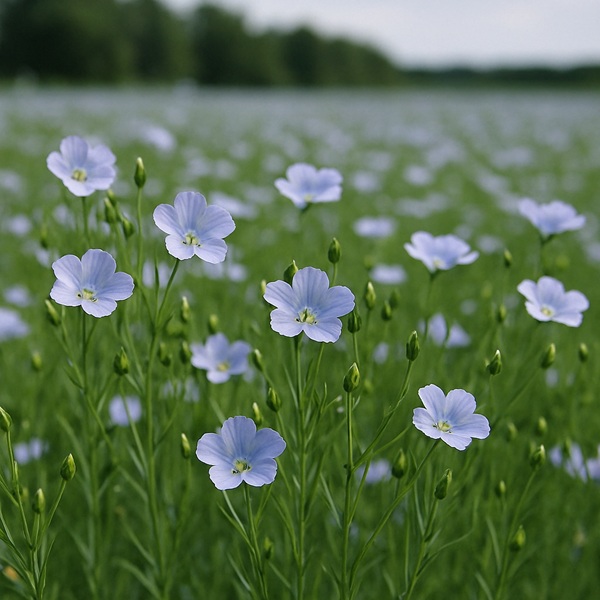
Flax (Linum usitatissimum) is one of the oldest cultivated plants and has been grown in Ukraine for many centuries. Its uniqueness lies in its multifunctionality: it provides strong fiber, valuable oil, seeds with medicinal properties, and can also be used as a green manure crop. Flax is widely used in the textile industry, medicine, cosmetology, and the food sector. Thanks to its moderate climate, fertile soils, and deep agricultural traditions, Ukraine is one of the most favorable places for growing this crop. Flax thrives especially well in the northern and central regions, where there is no excessive heat and moisture is sufficient.
There are two main types of flax: fiber flax and oilseed flax. The first is used to obtain long fiber for textile production, while the second is grown for oil and feed production. The choice of variety depends on the purpose of cultivation. For textile raw material, it is advisable to use thin-stemmed varieties with minimal branching, while for oil production, more branched plants with larger seeds are preferred. With proper cultivation practices, flax is capable of producing high yields even on relatively poor soils, which makes it an attractive crop for farmers interested in sustainable agriculture.
Modern Ukrainian farmers are increasingly returning to flax cultivation, especially against the backdrop of growing demand for natural materials and environmentally friendly products. Thanks to state support and the development of agricultural exports, the area under flax cultivation in Ukraine is gradually increasing. At the same time, the plant stands out for its high ecological resilience: it does not exhaust the soil, improves soil health, reduces pest populations in crop rotation, and can be grown without the use of aggressive chemicals. All this makes flax a valuable crop not only in economic terms, but also in an environmental sense.
Successful flax cultivation in Ukraine begins with proper soil preparation and compliance with agronomic standards. Flax grows best on light loamy or sandy loam soils with a neutral or slightly acidic reaction (pH 5.5–6.5). It does not tolerate waterlogging or salinity, so it is important to choose sites with good drainage, and in low-lying areas to provide measures for removing excess moisture. It is also advisable to avoid planting flax after crops from the brassica family (rapeseed, mustard) or the nightshade family (potatoes, tomatoes), as they contribute to the accumulation of pathogens in the soil.
The best preceding crops for flax are cereals (wheat, barley), legumes (peas, soybeans), and corn. Two to three weeks before sowing, the site is dug over or deeply loosened, the surface is leveled, and weeds are removed. A few days before sowing, it is advisable to firm the soil with a roller to ensure uniform sowing depth. It is also recommended to apply phosphorus-potassium fertilizers, especially if the soil is poor in nutrients. Fresh manure is not applied before flax, as it may encourage the development of diseases.
Flax is sown in early spring — in Ukraine this is usually from late March to mid-April, when the soil warms to +6 to +8°C. Delaying sowing may lead to poorer germination and an increased risk of pest damage. The seeds are sown in rows with 10–15 cm spacing, at a depth of 2–3 cm. The seeding rate depends on the type of flax: for fiber flax, 18–22 kg/ha; for oilseed flax, 25–30 kg/ha. After sowing, the soil is rolled to ensure close contact between the seeds and the ground. The first seedlings appear in about 6–8 days, depending on temperature and moisture.
Proper care of flax throughout the growing season is the key to a high-quality harvest. The main measures include weed control, soil loosening, protection from diseases and pests, and, if necessary, irrigation. It is especially important to control weeds in the early growth stages, since young flax seedlings develop slowly and are easily suppressed by competitors. To control weeds, both agronomic methods and modern herbicides approved for use in flax fields are applied.
Pre-emergence harrowing, carried out 3–4 days after sowing, is done with light harrows across the rows to break the soil crust and destroy the first wave of weeds. After seedlings emerge, harrowing is no longer carried out, in order not to damage the thin stems. During dry periods, especially in the southern regions of Ukraine, one or two irrigations may be needed during the critical phases of budding and seed filling. In general, however, flax is a fairly drought-tolerant crop and under normal weather conditions does not require additional watering.
Among the most common diseases are fusarium, anthracnose, and rust. For prevention, it is important to observe crop rotation, carry out pre-sowing seed treatment with fungicides, and, if necessary, spray the crops during vegetation. Among the pests, flax flea beetle, wireworms, and aphids are dangerous. Effective protection is provided by insecticides, as well as mechanical measures such as removing plant residues, autumn plowing, and weed control. Competent agronomic practice helps preserve not only yield, but also product quality — which is especially important when growing flax for oil or fiber.
The timing of flax harvesting in Ukraine depends on its type and the weather conditions of the season. Fiber flax is harvested at the stage of technical ripeness, when the stems begin to yellow, the capsules turn brownish, and the lower leaves start to fall. This is approximately 80–90 days after sowing. Oilseed flax is harvested later — at full ripeness, when the capsules are fully mature, dry, and begin to crack open. Delayed harvesting leads to seed loss, lower oil quality, and poorer fiber quality. The optimal harvest window may be as short as 5–7 days, especially in hot years.
Fiber flax is harvested manually in small farms or with specialized flax-harvesting machines that carefully pull the plants up by the roots rather than cutting them, which is important for preserving fiber length. After pulling, the stems are laid out in windrows in the field for 2–3 weeks for natural retting — the enzymatic breakdown of pectic substances that bind the fiber to the woody core. Air humidity and temperature are critical during this period: under excessive moisture, rot develops, while under dry conditions the process slows down. Oilseed flax, unlike fiber flax, can be harvested with a conventional grain combine.
After retting, the flax is collected into rolls, transported to processing plants, or processed on-site: the fiber is separated from the woody part, followed by scutching, combing, and pressing. The seeds are threshed, dried, and cleaned. At this stage, it is important to observe proper storage technology, especially for oilseed varieties, as the seeds oxidize quickly if humidity or temperature are incorrect. Finished flax fiber is used to make fabrics, technical products, and insulation materials, while the seeds are used for oil production or in the food industry. Thus, harvesting and primary processing require precision and strict timing.
Flax is a unique crop with an almost waste-free processing cycle. Ukraine has traditionally had a developed textile industry that uses flax fiber to produce fabrics, yarn, rope, thread, and even composite materials. Natural linen fabrics are valued for their strength, breathability, and hygienic properties. Eco-friendly clothing, underwear, and bed linen made from flax are especially popular. In recent years, interest has also grown in processing flax fiber for eco-insulation, packaging materials, and even furniture boards, which makes flax relevant in the construction sector as well.
Flaxseed is a valuable raw material for the oil and fat industry. Flaxseed oil contains a high concentration of omega-3 fatty acids, vitamin E, and B vitamins, and is therefore actively used in dietetics, medicine, and cosmetology. The by-product after pressing, known as oil cake, is used as animal feed, as an additive to compound feed, and even in flour production. In addition, flax is used to make meal, dietary supplements, scrubs, masks, soap, and creams. It has also found application in pharmaceuticals: flaxseed extracts are included in products for digestion and cholesterol reduction.
Ukrainian processing enterprises are gradually modernizing, introducing European quality and environmental standards. Demand for flax products is high not only within the country, but also abroad — especially in the EU and Asia, where natural and environmentally friendly raw materials are highly valued. This opens up prospects for the development of cooperatives, small-scale production, and farming enterprises specializing in flax. State grants, international support programs, and interest from eco-brands make flax processing a promising direction for Ukrainian business.
One of flax’s main advantages is its environmental value. It is widely used in crop rotations as a crop that improves soil structure, suppresses weeds, and restores fertility. After flax, the soil becomes looser, while its root system promotes aeration and moisture retention. This is especially important for the central and northern regions of Ukraine, where fields are intensively cultivated. In addition, flax does not require large doses of pesticides and fertilizers, which makes it suitable for organic farming.
Under conditions of global warming and climate change, flax’s resistance to temperature fluctuations and drought makes it a strategic crop for Ukraine. It tolerates moderate drought well, especially in the early growth stages, and adapts to different soil types. Thanks to its short vegetation period of 80–120 days, flax fits easily into crop rotation and can even be used as an intermediate crop. This is especially important for farmers working under no-till or minimum tillage systems, where every week of the season matters.
Flax also contributes to reducing carbon emissions, since it actively absorbs CO₂ during vegetation, while its fiber and seeds are used in green industry. It is easily biodegradable, which reduces the environmental burden. For Ukraine, which is striving toward sustainable agricultural production, flax is not only a traditional crop, but also a symbol of a modern ecological approach. Its cultivation and processing can become the foundation of new agro-industrial clusters focused on export while remaining resilient to the challenges of the time.