Lilies are refined flowers distinguished not only by their beauty but also by their wide varietal diversity. In Ukraine, where the climate ranges from moderately continental in the west and north to a warmer steppe climate in the south and east, choosing the right variety is extremely important. The most popular are Asiatic hybrids, which overwinter well and offer a rich color palette. Oriental hybrids are more demanding, but they stand out for their large, fragrant flowers. For regions with mild winters, trumpet lilies and LA hybrids are suitable, as they are resistant to most diseases and bloom abundantly.
Before planting, it is important to pay attention to the quality and structure of the soil. Lilies prefer loose, well-drained soils rich in organic matter. Clay soils require the addition of sand or peat to improve air permeability. The acidity should be neutral or slightly acidic, with a pH of 6.0–6.5. In waterlogged areas where moisture stagnates, the bulbs may rot. In such cases, it is recommended to make raised beds or plant lilies on elevated spots.
Preparing the site for lilies begins in autumn or early spring. Digging the soil to a depth of at least 30 cm and adding humus, compost, or well-rotted manure is the key to successful growth. Fresh manure must not be used, as it causes burns and encourages fungal diseases. It is also advisable to add wood ash or superphosphate to enrich the soil with phosphorus and potassium. These elements promote the development of a strong root system and the formation of large buds. If the soil is poor, it is additionally fertilized with mineral mixes 1–2 weeks before planting.
Lilies can be planted both in spring and in autumn. Each period has its own advantages. Autumn planting, from late September to mid-October, is preferable for the southern and central regions of Ukraine. At this time, the bulbs have enough time to root before the cold sets in, but they do not start growing, which results in earlier and more abundant flowering. Spring planting, in April to early May, is suitable for northern and cooler regions. However, in spring the soil should be sufficiently warmed, to at least +10°C, in order to avoid rotting and growth arrest.
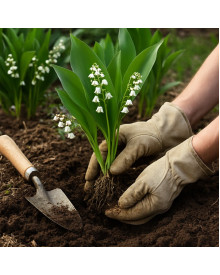
Before planting, the bulbs are carefully inspected, and dry scales and damaged areas are removed. If the bulbs have dried out slightly, they can be soaked for several hours in warm water with a growth stimulant or a weak potassium permanganate solution. This protects them from fungal infections and activates root development. The planting depth depends on the size of the bulb: as a rule, it should be three times the bulb’s height. Small varieties are planted at a depth of 10–12 cm, medium-sized ones up to 15 cm, and large ones up to 20 cm.
The spacing between bulbs should be 20 to 30 cm depending on the variety. After planting, the soil is gently firmed and watered with warm water. In spring, the bed is additionally mulched with peat or humus to retain moisture and protect the shoots from possible frosts. In autumn, especially in regions with cold winters, the site is covered with spruce branches or agrofibre. This helps protect the bulbs from freezing and prevents the upper soil layer from hard freezing. With proper planting, lilies do not need transplanting for 4–5 years, and their flowering becomes more luxuriant with each passing year.
Lilies are moisture-loving plants, especially during active growth and budding. However, standing water is destructive for them. Watering should be moderate but regular. It is important that the water penetrates the soil to a depth of 15–20 cm, reaching the roots. During hot summer months, watering is done early in the morning or in the evening, avoiding water on the leaves and buds to prevent sunburn and fungal infections. If the summer is especially dry, drip irrigation is acceptable, as it provides even moisture and reduces the risk of overwatering.
For abundant and long-lasting flowering, lilies need systematic feeding. The first is carried out in early spring — nitrogen fertilizers stimulate shoot growth. The second is during bud formation, when complex mineral blends with phosphorus and potassium are appropriate. The final feeding is done after flowering ends. It helps the bulbs store strength for the next season, so potassium fertilizers are preferred. It is important not to overuse nitrogen in summer, as it causes excessive leafy growth at the expense of flowers and makes the plants more vulnerable to disease.
One of the main conditions for successful cultivation is keeping the area clean. Weeds not only take nutrients away from lilies, but also create a favorable environment for pests. Weeding is done regularly, especially at the beginning of the season. Mulching with straw, pine needles, or sawdust has proven effective: it suppresses weed growth, preserves moisture, and improves soil structure. It should also be remembered that the root system of lilies lies close to the surface, so loosening should be done carefully and shallowly, in order not to damage the shoots.
The flowering period of lilies in Ukraine begins in late May and may last until the end of August, depending on the variety. Asiatic hybrids bloom first, followed by trumpet lilies, while Oriental lilies bloom the latest. To extend flowering on the site as much as possible, experienced gardeners recommend planting different varieties with different budding times. This makes it possible to enjoy bright flowers throughout the summer. It is important to remove faded buds in time so the plant does not waste energy on seed formation. Such pruning stimulates the appearance of new buds and improves the overall condition of the plant.
After flowering ends, the above-ground part of the plant should not be removed immediately. The green stems continue to take part in photosynthesis and nourish the bulb. The stem is removed completely only when it has fully yellowed and started to dry out. This usually happens in September. Pruning is done with sharp secateurs at a height of 5–7 cm above the soil surface. In autumn, it is also advisable to remove all plant debris to avoid overwintering of pathogens and pests.
To improve the decorative effect of the flower bed, supports are often used for tall varieties, especially in regions with strong winds. Under the weight of large buds, the stems may break, so tying them to supports helps maintain their shape and avoid damage. It is also useful to combine lilies with other perennials such as hostas, irises, and phlox. This not only improves the look of the flower bed, but also helps protect the bulbs from overheating and the soil from drying out during hot months.
Lilies do not need frequent transplanting, but after 4–5 years they should be rejuvenated and divided. Over time, several bulbs form in one nest and begin to compete for nutrients, which weakens flowering. The best time for transplanting is August or early September, after flowering has ended, when the bulbs have already strengthened sufficiently. For the procedure, choose a dry sunny day, dig up the clumps with a ball of soil, carefully clean the bulbs, and separate the daughter bulbs.
During division, it is important not to damage the roots and scales. Small bulbs formed near the base of the mother bulb can be planted immediately for growing on. They will need 1–2 years before full flowering. If storage until spring is planned, the planting material is dried, dusted with wood ash or packed with moss, and placed in a cool location with a temperature of +2 to +5°C. Propagation by scales is also possible: the outer scales are removed from the mother bulb, treated with a fungicide, and rooted in a light substrate. After 2–3 months, miniature bulbs appear.
A quick and safe way to increase planting material is propagation by bulbils, which sometimes form in the leaf axils. They are collected after flowering ends, dried, and planted in autumn or spring. Such lilies usually bloom in the second or third year. Proper propagation not only saves money on buying new plants, but also helps preserve especially successful or rare varieties adapted to the conditions of your site.
Despite their outward hardiness, lilies are susceptible to a number of diseases, especially in conditions of excessive moisture. The most common problem is gray mold. Its signs are brown spots on the leaves, stems, and buds. This fungal infection spreads quickly and may lead to the death of the plant. For prevention, fungicide sprays are used at the beginning of the season and at the first signs of disease. It is also important to observe the correct watering regime and avoid overcrowded planting, since good air circulation reduces the risk of infection.
Among pests, the most dangerous are the lily fly and aphids. Lily fly larvae bore into leaves and buds, leaving a brown mass inside. Affected parts should be removed, and the plants treated with insecticides. Aphids feed on plant sap and carry viral diseases. They can be controlled both with chemical means and with biological methods, such as planting calendula, garlic, or lavender nearby to repel insects.
Wintering of lilies in Ukraine depends on the region. In the southern and central regions, lilies usually overwinter in open ground without cover, especially if autumn was dry and the soil is well-drained. In the northern and eastern regions, where winters may be severe, it is recommended to insulate the planting with a layer of mulch up to 10 cm thick made of humus, peat, or sawdust. Oriental and trumpet hybrids require special attention: for winter, they are better covered with spruce branches or agrofibre. In spring, the cover is removed gradually to avoid stress from sharp temperature changes. If all the rules are followed, lilies will reward you with reliable flowering year after year.