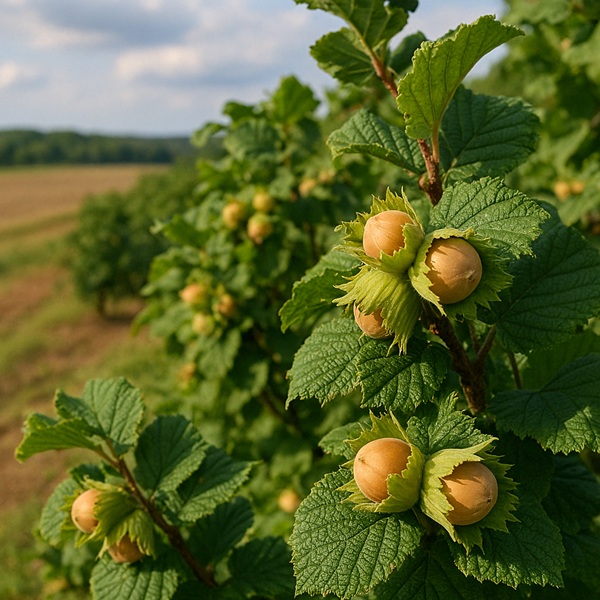
Hazelnut, or common hazel (Corylus avellana), is a perennial shrub grown for its tasty and nutritious fruits — hazelnuts. This crop is widespread in the wild in Ukraine, especially in the forests of Polissia, the Carpathians, and Podillia. However, in recent decades hazel has also been actively cultivated both in home gardens and on an industrial scale. Thanks to its mild climate, fertile soils, and sufficient rainfall, Ukraine is a favorable country for growing hazelnuts. Fruiting begins as early as the third or fourth year after planting and continues for decades, while with proper cultivation practices yields can reach 3–5 kg of nuts per bush.
Hazel is valued not only for its tasty nuts, rich in oils, proteins, vitamins, and minerals, but also for its resistance to diseases, drought, and pests. Unlike many fruit trees, hazelnut is undemanding when it comes to soil and can grow both on loamy and sandy loam sites. Another advantage is frost resistance: mature plants can withstand temperatures down to –30°C, which is especially important for the northern and central regions of Ukraine. In addition, hazel adapts well to different light conditions and can grow both in open places and in partial shade.
Hazelnut is a promising export crop. Ukraine has the potential to occupy its own niche on the international market, especially against the backdrop of growing demand for natural nuts and healthy food products. In particular, the southern regions of the country — Odesa, Mykolaiv, and Kherson regions — show good results in industrial hazelnut cultivation. There, drip irrigation, formative pruning, and modern plant protection systems are used, ensuring stable and high yields. However, even in home gardens, hazel can produce excellent results provided it is planted and cared for correctly.
The success of growing hazel largely depends on choosing the right site. Despite the plant’s unpretentious nature, it is important to create favorable conditions in order to obtain a stable and high-quality harvest. Hazel prefers sunny places protected from northern winds. In shaded areas, growth will be slower and fruiting unstable. A southern or south-western slope protected by a shelterbelt or building is considered ideal. It is also important to take groundwater depth into account — at least 1.5 m — since the root system of hazel penetrates fairly deeply.
The soil for planting should be loose, well-drained, and neutral or slightly acidic (pH 6–7). Before planting, the site is cleared of weeds, dug to a depth of 30–40 cm, and, if necessary, enriched with humus or compost (5–6 kg per 1 m²), as well as phosphorus-potassium fertilizers. Nitrogen fertilizers are applied in moderation, since an excess may cause overly dense green growth at the expense of fruiting. If the soil is heavy, it is advisable to add sand and ash. Well-prepared soil helps the seedlings establish themselves and gives them an active start in their first years of life.
The optimal time for planting hazel is early spring (March–April) or autumn (mid-October to early November). With autumn planting, it is important to finish the work 3–4 weeks before frost so the seedling has time to root. For planting, holes 50–60 cm in diameter and 50 cm deep are dug. A nutrient mix — humus, ash, and superphosphate — is placed at the bottom and covered with a layer of soil. The seedling is positioned so that the root collar remains at ground level. After planting, abundant watering is carried out (up to 20 liters of water per bush), followed by mulching with peat or humus, which protects against drying out and promotes root development.
In the first year after planting, hazel care is focused on rooting and shaping the bush. Young seedlings need regular watering, especially during periods of drought. On average, watering is carried out once every 10–14 days, using 10–15 liters per plant. In the second and third years, the number of waterings is reduced according to rainfall. It is also important to loosen the soil around the bush after every rain or watering to ensure air reaches the roots and to prevent crust formation.
Feeding begins in the second year. In spring, before bud break, nitrogen fertilizers such as ammonium nitrate or urea are applied to stimulate shoot growth. In summer, it is advisable to feed the plant with organic matter: mullein infusion or poultry manure diluted with water. In autumn, phosphorus-potassium fertilizers are applied to strengthen the root system and improve winter hardiness. Fertilizers are applied to moist soil in the root zone, followed by loosening and mulching — this helps retain moisture and nutrients.
Pruning is one of the key care procedures. It may be sanitary or formative. Sanitary pruning is carried out annually in early spring, before sap flow begins: dry, damaged, and overcrowding branches are removed. Formative pruning begins in the second year: usually 6–8 skeletal shoots are left, evenly spaced around the center of the bush, while the rest are removed. Later, every 5–6 years, the bush is rejuvenated by cutting out old branches and replacing them with new basal shoots. Proper pruning promotes good fruiting and improves ventilation and light penetration in the crown.
Hazel is a cross-pollinated plant, so for stable fruiting it is necessary to plant at least two or three varieties that are compatible in flowering time. It blooms very early — already in March, and sometimes even in February, when the snow has not yet melted. The male inflorescences (catkins) open first, while the female flowers are inconspicuous — small buds with red stigmas. Since pollination occurs by wind, weather conditions are very important: rainfall, humidity, and strong winds may interfere with pollen transfer. That is why planting several varieties close together greatly increases the likelihood of a good harvest.
The first fruits appear in the third or fourth year after planting. Hazel reaches peak productivity in the eighth to tenth year of life, after which, with proper care, it remains productive for 30–40 years. Nuts form in clusters of 2–5, more rarely singly. Ripening occurs in August–September: the shell darkens, the husk dries and cracks, and the nuts then fall. The harvest must be gathered in time to avoid losses. Most often, it is collected by hand — the nuts are shaken down or picked up from the ground, then dried for 2–3 weeks in the shade, being turned regularly for even ventilation.
Hazelnuts are best stored in a dry, well-ventilated room at a temperature of +10 to +15°C. Under such conditions, the nuts retain their flavor and nutritional value for 1–2 years. In the shell, they keep longer, while shelled nuts are less resistant to moisture and oxidation. The crop can be eaten fresh, roasted, processed into oil or paste, or added to baked goods and confectionery. In addition, hazelnuts are widely used in cosmetology and folk medicine thanks to their high content of vitamin E, B vitamins, magnesium, and beneficial fatty acids. Thus, hazel is not only an ornamental shrub, but also a valuable source of food and income.
Despite its overall hardiness, hazel may be affected by a number of diseases and pests. Among the most common diseases are powdery mildew, brown leaf spot, bacterial blight, and gray mold. The appearance of symptoms is often associated with excessive humidity, crown overcrowding, or poor ventilation. For prevention, it is important to follow proper cultivation practices: prune in time, control planting density, and avoid overusing nitrogen fertilizers. If signs of disease appear, fungicides such as Bordeaux mixture, Topaz, or Horus are used according to the instructions.
Among pests, the most common are the hazelnut weevil, aphids, caterpillars, and scale insects. The hazelnut weevil is especially dangerous during ovary formation: its larvae eat the kernels, leading to the loss of part or all of the crop. For protection, spring spraying with insecticides such as Actellic, Fufanon, or Decis is carried out; trapping belts, ash, and infusions of tobacco and wormwood are also used. In autumn, it is essential to collect and destroy fallen leaves and damaged nuts in order to break the pest life cycle.
Another important measure is regular inspection of plants throughout the season. Timely detection of problems makes it possible to intervene quickly and prevent their spread. When establishing new plantings, it is recommended to choose resistant varieties adapted to the climate of the specific region of Ukraine. A crop rotation strategy is also effective: hazel should not be planted on sites where massive outbreaks of diseases or pests were previously observed. A comprehensive protection approach ensures stable and environmentally clean production, especially under organic farming conditions.
In addition to its practical value, hazel has strong decorative potential. In spring, the shrub is adorned with catkins and delicate foliage; in summer, with dense green mass; and in autumn, with bright yellow-red coloring. This makes hazel an attractive element of hedges, a way to screen utility buildings, or a feature for marking plot boundaries. It can be combined with ornamental shrubs such as barberry and ninebark, conifers, and perennials. Hazel does not require complex care, quickly builds up greenery, and is easy to shape, which makes it convenient for landscape design.
Hazel is especially important in nature-oriented ecosystems. It provides shelter and a food source for birds and small animals, stabilizes the microclimate, strengthens the soil, and prevents erosion. Thanks to its deep root system, hazel improves soil structure and can be used on slopes, in ravines, and in areas at risk of landslides. In agricultural landscapes, hazel can serve not only as a fruit crop but also as part of a shelterbelt, a buffer zone between fields, or an element of mixed orchards and agroforestry systems.
Hazel also performs well in organic and permaculture farming. It rarely requires chemical treatment, is resistant to pests, and its produce is in high demand. More and more Ukrainian farmers are introducing hazel into eco-gardens and agri-park systems. In addition, there is interest from the processing industry: hazelnuts are used in chocolate, oil production, and cosmetics, while hazel wood is used in crafts and decorative work. So, hazel is a versatile, profitable, and ecologically valuable crop that fits harmoniously into Ukraine’s agricultural future.