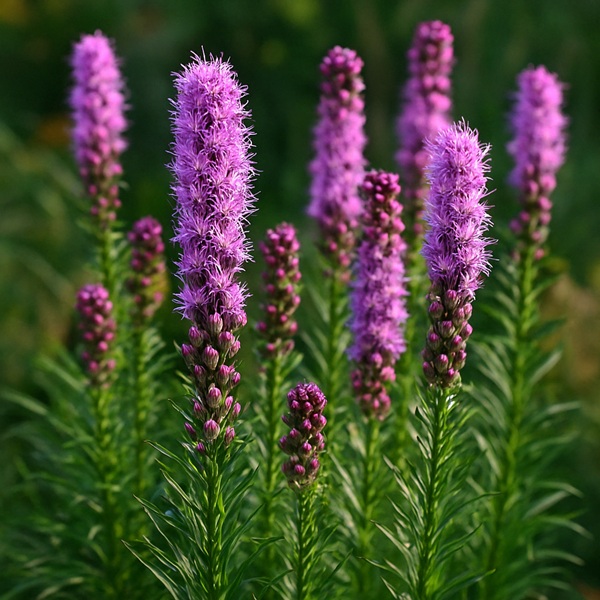
Liatris is a striking perennial from the aster family that is becoming increasingly popular among Ukrainian gardeners year by year. Its tall flower spikes covered with bright, fluffy blooms not only decorate the site, but also attract many beneficial insects — especially bees and butterflies. Liatris blooms from early July to late August, and some flower spikes remain decorative even into September. It is especially valued for its unusual blooming order — from top to bottom — which sets it apart from other perennials. Breeders have developed many varieties with white, lilac, pink, and deep purple inflorescences, making it possible to create original flower arrangements.
In Ukraine’s climate, liatris feels very much at home. The plant prefers sunny, open locations and tolerates both heat and short periods of drought well. Thanks to its strong root system with tuberous thickening, liatris can store moisture and endure prolonged dryness. At the same time, it is winter-hardy and does not require special covering, except in the northernmost regions of Ukraine where temperatures may drop below –25°C. Even if the above-ground part freezes, the tuber remains viable and produces new shoots in spring. This makes liatris not only beautiful, but also a reliable element of the landscape.
Liatris is also known by names such as “blazing star” or “prairie feather” because of its bright vertical inflorescences that resemble tongues of flame. It looks wonderful both in single and group plantings and combines well with ornamental grasses, echinacea, rudbeckia, sage, and lavender. Thanks to its texture and height, ranging from 40 to 120 cm, liatris is used in mixborders, along fences, in rabatkas, and as a background plant in flower beds. Its inflorescences last well as cut flowers, which also makes liatris popular in floristry. All of this makes it a versatile choice for ornamental landscaping in any region of Ukraine.
Choosing the right place to plant liatris is an important step that affects both the plant’s health and its decorative value. This crop prefers sunny, well-lit areas with well-drained soil. It can also grow in partial shade, but the inflorescences lose some of their richness and the flowering period becomes shorter. It does not tolerate standing water, so lowlands and poorly drained places are completely unsuitable. Loose, fertile loams or sandy loam soils with a neutral or slightly alkaline reaction are considered best. On acidic soils, it is advisable to reduce acidity with dolomite flour or wood ash.
Before planting, the plot is dug to a depth of 25–30 cm, weed roots are removed, humus or compost is added at up to 5 kg per square meter, and, if necessary, sand is incorporated to improve the structure. A few days before planting, the soil can be watered with a weak potassium permanganate solution or a biofungicide-based preparation to prevent fungal infections. Liatris tubers are planted in open ground in April to early May, once the threat of return frosts has passed. The tuber is planted 6–8 cm deep, with the growth bud facing upward. The spacing between plants is 20–40 cm depending on the variety.
After planting, the tubers are watered with warm water, and the soil is mulched with peat, dry grass, or straw. Mulch helps retain moisture, prevents weed growth, and provides additional insulation in case of cold weather. It is important that the mulch does not touch the growth point, as this may cause rotting. In a cold spring, the bed is temporarily covered with agrofibre or film stretched over hoops to speed up sprouting. Under favorable conditions, the first shoots appear 2–3 weeks after planting. Young liatris sprouts are quite strong, tolerate temperature fluctuations well, and develop quickly.
Liatris is a plant that does not require daily care, but for lush and long-lasting flowering, the basic horticultural practices should still be followed. Watering should be moderate: the plant does not like overwatering, yet during dry periods, especially in June and July, stable soil moisture should be maintained. Water at the root, avoiding moisture on the leaves and flower stems. The optimal frequency is once or twice a week depending on the weather. After watering, the soil is loosened, weeds are removed, and the mulch layer is renewed when needed.
Feeding is carried out three times during the season. In spring, at the beginning of the growing season, nitrogen fertilizers such as ammonium nitrate or urea are applied to stimulate green growth. During budding, a complex mineral fertilizer with increased phosphorus and potassium content is used for abundant and vivid flowering. In autumn, after the growing season ends, it is advisable to apply wood ash or a phosphorus-potassium mixture to strengthen the tubers and prepare them for winter. Overfeeding should be avoided, since excess fertilizer causes the stems to stretch and reduces the plant’s decorative appeal.
Liatris rarely becomes sick and is only occasionally affected by pests. However, under conditions of excessive moisture and poor ventilation, gray mold or powdery mildew may appear. In such cases, preventive spraying with fungicides is carried out, for example with Bordeaux mixture or copper-containing preparations. Among pests, slugs and snails may appear, especially in dense plantings. To control them, hand collection or biological products are used. With proper care, liatris can grow in one place for 5–6 years while maintaining abundant flowering and an attractive bush shape.
Liatris can be propagated in several ways, each with its own advantages. The simplest and most effective method is division of the tubers. By the third or fourth year of cultivation, the tubers form clusters that are easy to divide. In spring or autumn, in September, the clump is carefully dug up, daughter tubers with growth buds are separated, and then replanted in a new place. This method preserves varietal characteristics and ensures quick rooting and flowering as early as the following season.
Seed propagation is used less often, mainly by breeders or when a large amount of planting material is needed. Liatris seeds ripen in September and are collected after the inflorescences dry. Seeds can be sown before winter or in spring after stratification for 1–2 months in the refrigerator. The sowing depth is 1–1.5 cm. Seedlings appear after 2–3 weeks. With this method, flowering begins in the second or third year. It should be taken into account that seed propagation may lead to deviation from the characteristics of the mother plant, so if preserving the variety is important, tubers are the better choice.
Another option is dividing a mature clump. This method is especially useful for varieties that thicken quickly. In spring or autumn, the clump is dug up and divided into 2–3 parts with a sharp knife or spade. The cut surfaces are dusted with wood ash or treated with a fungicide. After transplanting, the divisions are watered generously and mulched. It is important not to transplant liatris in the middle of summer, as this is a stressful period for the plant. With proper division and care, the new bushes establish themselves quickly, and flowering resumes within a year.
Liatris is very well adapted to Ukraine’s climate. In most regions, it winters successfully without cover. In autumn, after the above-ground part dies back, the stems are cut to a height of 5–10 cm above the ground. The tubers are left in the soil, where they can withstand frosts down to –30°C. In northern regions or during unstable snowless winters, it is recommended to mulch the site additionally with leaves, peat, or straw in a layer 10–15 cm thick. This protects the tubers from freezing and temperature fluctuations.
Every 4–5 years, it is advisable to rejuvenate the plants. Even with good care, liatris gradually loses some of its decorative quality over time: the flowers become smaller, the blooming less abundant, and the plants become crowded. In spring, old clumps are dug up, damaged parts removed, the healthiest tubers selected, and replanted in a new flower bed. This approach not only stimulates renewed lush flowering, but also reduces the risk of disease. After rejuvenation, it is important to apply autumn phosphorus-potassium fertilizers, water moderately, and mulch the plants for better adaptation through winter.
If liatris is grown in containers, for example on terraces, balconies, or in movable flower beds, they should be moved for winter into a cold but frost-free room, or the containers should be sunk into the ground. In pots, the risk of the tubers freezing or drying out is much higher. In spring, such plants should be awakened gradually: moved into the light, given the first watering, and fed. Container-grown liatris requires a little more attention, but it allows for greater freedom in garden design and makes it possible to decorate different parts of the site.
Thanks to its elegance and undemanding nature, liatris has earned a worthy place in modern Ukrainian gardening. Its tall, bright flower spikes fit beautifully into both classic and natural-style landscape compositions. Liatris looks especially striking in combination with ornamental grasses such as miscanthus and feather grass, as well as with echinacea, sage, lavender, yarrow, and rudbeckia. When arranged successfully, it visually lifts the flower bed, adding volume and structure. The plant is suitable both for sunny flower beds and for mixed borders.
Liatris is often planted along paths, at plot boundaries, in rockeries, and in mixborders. It combines well with other perennials, but even in a single-species planting it creates a strong accent. Besides its decorative value in the garden, liatris is also prized as a cut flower: the inflorescences keep their freshness in a vase for a long time without losing their shape. In dried form, they are used in floral arrangements, and bouquets with liatris are long-lasting and atmospheric. Even after flowering ends, liatris remains attractive thanks to its dense, upright habit.
Liatris is an ideal plant for anyone who wants a showy but low-maintenance flower garden. It suits both beginners and experienced gardeners and landscape designers. In Ukraine’s climate, liatris is one of the most rewarding perennials, capable of delighting with abundant flowering year after year without the need for frequent transplanting. It is easy to combine with other plants, withstands changing weather well, and does not lose its decorative value. That is exactly why liatris is rightly considered one of the best perennials for the Ukrainian garden.