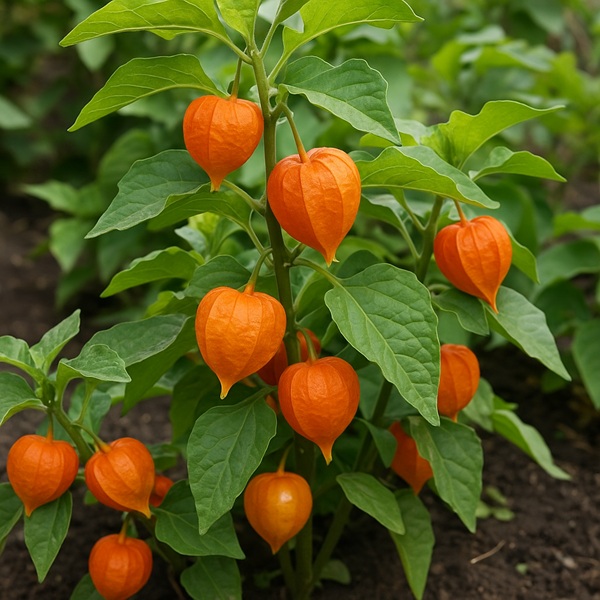
Physalis is a remarkable plant that combines ornamental appeal with practical value. Its golden-orange fruits, enclosed in lantern-like husks formed by the calyx, attract both gardeners and landscape designers. However, physalis is interesting not only for its appearance: many species produce edible fruits rich in vitamins A and C, organic acids, and pectin.
Physalis originates from Central and South America, but the crop has successfully acclimatized in many parts of the world. In Ukraine, physalis is grown mainly as an annual in open ground or as a perennial in the case of ornamental species. Culinary varieties are especially popular in the south of the country, while ornamental types such as Chinese lantern are often found in gardens in Zakarpattia, Kyiv region, and Poltava region.
The main groups of physalis are:
Vegetable physalis (large fruits, used after heat treatment);
Berry physalis (sweet fruits suitable for fresh consumption);
Ornamental physalis (valued for its bright husks, fruits are inedible).
Interestingly, physalis is highly undemanding: it easily tolerates heat, drought, and moderate cold spells, does not require complicated care, and grows well on different soil types. Still, choosing the right variety and understanding the basic growing techniques significantly increase the chances of getting an abundant harvest.
In Ukraine, physalis is suitable for almost all regions, from the southern oblasts to Volyn and Chernihiv region. In northern areas, it is recommended to grow it through seedlings in order to harvest before the onset of cold weather. In areas with a short summer, early-ripening varieties such as Caramel or Golden Placer should be preferred.
Physalis prefers loose, fertile soils with a neutral or slightly alkaline reaction (pH 6.5–7.5). In acidic soils, the crop develops poorly: germination declines, growth is delayed, and the fruits become smaller. That is why it is important to test the soil before planting and, if necessary, lime the plot.
Ideal conditions:
Light loams or sandy loams;
Good water permeability;
High organic matter content in the soil.
An excess of nitrogen in the soil is undesirable, since it stimulates excessive leafy growth at the expense of flowering and fruiting.
Preparation stages:
In autumn, dig the soil to a depth of 25–30 cm.
Apply organic matter — compost or well-rotted manure (4–5 kg/m²).
If necessary, deacidify the site with dolomite flour or lime (300–500 g/m²).
In spring, loosen and level the soil again before planting.
Physalis does not tolerate stagnant water, so in areas with high groundwater it is necessary to provide drainage or plant it on ridges.
Physalis likes sunny locations protected from wind. It also grows in partial shade, but yields will be lower there. When choosing a site, crop rotation should be taken into account:
Good preceding crops: cabbage, carrots, cucumbers, onions.
Poor preceding crops: potatoes, tomatoes, peppers, due to shared diseases of the nightshade family.
Physalis should be returned to the same place no sooner than after 3–4 years.
When buying seeds, it is worth paying attention to:
The purpose of the variety (vegetable, berry, ornamental);
Ripening time;
Adaptation to Ukrainian climatic conditions.
Good-quality seeds should be whole, without cracks or damage. If desired, you can collect your own seeds from the best fruits.
Preparation measures:
Grading (soaking in a salt solution and selecting the heavy seeds);
Disinfection (treating in a weak potassium permanganate solution for 20–30 minutes);
Soaking in a growth stimulant, if desired.
These procedures improve germination and the resistance of future plants.
Sowing times:
For central and northern regions — the second half of March;
For the south — early March.
Steps:
Prepare containers 6–8 cm deep.
Fill them with a loose, nutritious substrate (humus, turf soil, and sand in a ratio of 2:1:1).
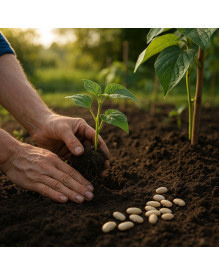
Sow the seeds to a depth of 0.5–1 cm.
Moisten the sowings and cover them with film or glass to create a greenhouse effect.
After seedlings emerge (in 7–14 days), remove the cover.
Pricking out is done at the stage of 2–3 true leaves, transplanting the seedlings into separate pots with a volume of 0.2–0.5 liters. Two weeks before planting in open ground, the seedlings must be hardened off.
Physalis is a drought-tolerant crop, but regular watering is necessary to obtain a good harvest, especially during active growth, flowering, and fruit filling.
Basic recommendations:
Water once every 7–10 days, depending on weather conditions;
In hot periods, increase watering to 2 times a week;
Water at the root, avoiding wetting the leaves and stems.
After each watering, loosen the soil to a depth of 4–6 cm to improve root aeration. Weeds should be removed in time, since they hinder physalis growth and promote the spread of disease.
Physalis responds well to feeding, especially when grown on poor soils.
Recommended schedule:
2 weeks after transplanting seedlings — nitrogen feeding (mullein solution 1:10);
At the budding stage — phosphorus-potassium fertilizer to stimulate flowering;
During fruit filling — feeding with wood ash (100 g per 10 liters of water).
Too much nitrogen at later stages may delay fruit ripening and cause excessive leafy growth.
To increase yield and make care easier, tall physalis varieties require shaping:
Removal of suckers from the lower part of the plant;
Moderate pinching of the tops to stimulate branching.
Tall bushes are tied to supports such as wooden stakes or netting to prevent lodging and fruit contamination.
Physalis is generally resistant to many diseases, but under conditions of excess moisture or overcrowding it may be affected by:
Late blight — brown spots on leaves and fruits;
Mosaic virus — wrinkling and variegation of the leaves;
Root rot — wilting without obvious external causes.
Preventive measures:
Use healthy seeds;
Follow crop rotation rules;
Control soil moisture;
Ensure good air circulation in the planting.
At the first symptoms, the plants should be treated with fungicides such as Fundazol or Fitosporin-M.
The most common pests are:
Colorado potato beetle;
Aphids;
Spider mites;
Whiteflies.
Control methods:
Hand-picking pests;
Spraying with infusions of garlic, wormwood, or tobacco;
In cases of severe infestation, using biological products such as Fitoverm or Bikol.
Keeping the area clean, loosening regularly, and removing weeds promptly significantly reduces the risk of pest outbreaks.
Physalis fruits ripen 90–150 days after emergence, depending on the variety.
Signs of ripeness:
The husk dries out and turns brownish;
The fruit separates easily from the plant;
Some fruits may fall to the ground on their own.
Fallen fruits should be collected as quickly as possible to avoid damage.
Harvesting process:
Carefully pick the fruits together with the dry husks.
After harvesting, remove damaged fruits.
Air-dry the harvest for a few hours.
Physalis can be left in its husk for better storage.
Physalis stores well under the following conditions:
Temperature +2 to +5 °C;
Humidity 70%;
Stored in boxes in a single layer or packed in dry sand.
Berry varieties of physalis are excellent for fresh eating, making jams and preserves, and freezing.