Beans are not just a crop, but a true source of nutrients essential for humans. They are rich in protein, B vitamins, potassium, magnesium, and fiber. That is why beans have traditionally held an important place in home gardens and on farms across Ukraine. The climate of most regions of the country makes it possible to obtain stable yields of both early-ripening and mid-late varieties.
Growing beans not only provides tasty produce, but also benefits the soil. Thanks to the nitrogen-fixing bacteria on their roots, the plants actively enrich the soil with nitrogen, increasing its fertility and reducing the need for mineral fertilizers. This makes beans an ideal crop for organic farming.
Characteristics of beans:
They require a moderately warm climate without sharp temperature fluctuations;
They do not tolerate frost or waterlogged soil well;
They respond well to light, fertile soils with a neutral reaction.
Beans come in different forms: from bush varieties, which are compact and early-ripening, to climbing varieties that need support but produce heavier yields. In Ukraine, bush beans are most often grown for quick harvests, although decorative arches of climbing beans are becoming more common in private gardens.
Special mention should be made of snap beans (string beans), in which the tender pods are eaten before full maturity. They are especially popular among cooks for their mild flavor and versatility in a wide range of dishes.
Beans have certain soil requirements. For successful growth, it is important to choose a loose, well-aerated substrate rich in organic matter. The best soils for beans are:
Light loams;
Sandy loam soils;
Chernozem soils with neutral acidity (pH 6.0–7.0).
Heavy clay, acidic, or waterlogged soils are unsuitable. In such areas, the crop either becomes seriously diseased or produces a very poor harvest.
To prepare a site for beans:
Dig the soil in autumn to the depth of a spade bayonet.
Apply organic fertilizers (well-rotted compost or humus — about 5–7 kg/m²).
In spring, before sowing, level the site and, if necessary, add wood ash (100–150 g/m²) to optimize acidity.
It is also important to avoid growing beans in the same place for two years in a row. The best preceding crops are:
Tomatoes;
Cucumbers;
Root crops;
Cabbage.
After beans, crops that need a lot of nitrogen, such as cabbage or cucurbits, grow especially well.
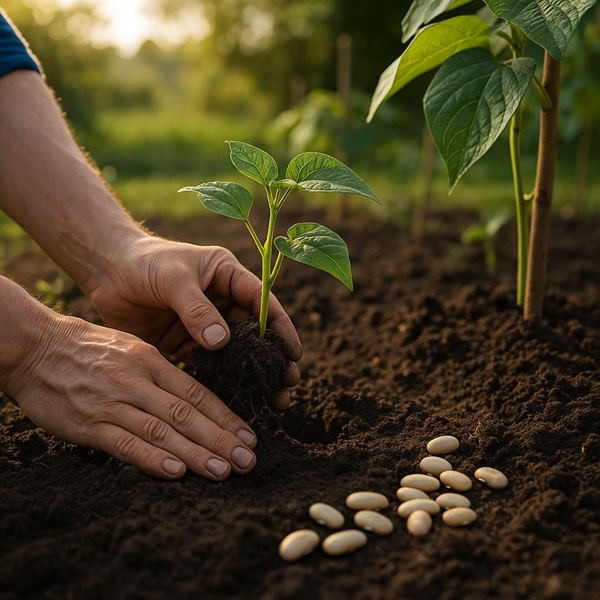
Beans are very sensitive to soil temperature. The seeds begin to germinate only when the soil warms to +10…+12°C. In Ukraine, the optimal sowing times are:
In the south: from late April;
In the central regions: the first ten days of May;
In the north and the Carpathians: from mid-May.
Early sowing is dangerous because of return frosts, while late sowing may mean insufficient warmth during the period of active growth.
When sowing, follow these planting depths:
Light soils — 5–6 cm;
Heavy soils — 3–4 cm.
The spacing between plants depends on the variety: bush beans are sown 20–25 cm apart, while climbing beans are sown 30–40 cm apart.
Choosing the right bean variety is half the battle. In Ukraine, the following groups of varieties are popular:
Early-ripening bush beans (for example, “Pospikh,” “Perlyna”);
Snap beans (“Nasoloda,” “Zolota Koroleva”);
Mid-season climbing beans (for example, “Shokoladka,” “Kobra”).
It is recommended to choose varieties adapted to the local climate, as well as those resistant to diseases, especially anthracnose and bacterial blight.
Before sowing:
Soak the seeds in warm water for 6–8 hours to speed up germination.
If desired, treat them with growth stimulants or biological products for disease protection.
Beans are sown in rows. The distance between rows should be 40–50 cm for bush varieties and 60–70 cm for climbing ones. Place 2–3 seeds in each hole; after emergence, leave the strongest plant.
Care for the sowings at the initial stage includes:
Regular loosening of the soil;
Monitoring soil moisture and preventing the top layer from drying out;
Thinning if the planting becomes too dense.
At the stage of active growth, especially for climbing varieties, it is necessary to install supports — stakes or stretched netting at least 1.5–2 meters high.
Beans are sensitive both to a lack of moisture and to excess water. That is why it is especially important to organize watering correctly. The main rules are:
Before flowering begins — moderate watering once every 7–10 days;
During flowering and pod formation — abundant watering every 4–5 days;
During ripening — reduced watering to prevent the pods from cracking.
It is best to use warm, settled water. Water at the base of the plant, avoiding wetting the leaves — this reduces the risk of fungal diseases.
Regular weeding is especially important in the early stages of growth, when the beans have not yet covered the spaces between the rows. Weeds not only take away nutrients, but also encourage excessive moisture around the stems, creating favorable conditions for disease development.
The soil should be loosened carefully so as not to damage the root system. Light loosening (to a depth of 3–5 cm) is best done after every watering or rain.
Beans need moderate feeding. Excess nitrogen causes the plants to produce too much green mass at the expense of pod formation.
Recommended feeding schedule:
At the 2–3 true leaf stage: water with a solution of a complex fertilizer with a higher proportion of phosphorus and potassium.
At the budding stage: foliar feeding with micronutrients (boron, molybdenum).
At the beginning of pod formation: water with a wood ash solution (100 g of ash per 10 liters of water).
Beans also respond well to organic feeding, for example, a mullein infusion diluted at a ratio of 1:10.
Beans are susceptible to a number of fungal and bacterial diseases. The most common are:
Anthracnose — dark spots on leaves and pods;
Bacterial blight — watery spots on leaves and brown ulcers on stems;
Gray mold — gray coating on flowers and fruits.
Preventive measures:
Use only healthy seed material;
Treat seeds with biological products before sowing;
Follow crop rotation;
Ensure air circulation in dense plantings.
At the first signs of disease, biological fungicides such as Fitosporin and Trichodermin are used, and in severe cases chemical products are applied according to instructions.
Beans may be attacked by:
Bean aphids;
Spider mites;
Bean weevils, especially during storage.
Protection methods:
Regular inspection of the plants;
Spraying with onion husk or garlic infusions in the early stages;
Using biological insecticides in the case of heavy infestation.
To protect the harvest from bean weevils, after harvest the beans must be thoroughly dried and stored in a dry, cool place.
Harvest time depends on the type of bean being grown:
Snap beans: harvesting of young pods begins 50–60 days after emergence, while the pods are still tender and juicy.
Dry beans: harvesting is done after the pods have fully matured, when they have dried out and begun to rattle.
To extend the harvest period of snap beans, it is recommended to remove mature pods regularly, which stimulates the formation of new ones.
When harvesting dry beans:
The pods are carefully picked by hand;
They are dried in the shade or under a shelter until completely dry;
Then they are threshed to remove the seeds.
It is very important not to leave beans on the plants too long, in order to avoid yield losses from pod splitting and seed shedding.
For long-term storage, beans must be thoroughly dried. Ideal conditions are:
Temperature +5…+10°C;
Air humidity no higher than 50%;
A dark, well-ventilated room.
To protect beans from bean weevils:
Store the seeds in airtight jars;
Layer the beans with dry bay leaves or add small cloth bags filled with salt.
For seed material, beans remain viable for 3–4 years under proper conditions.