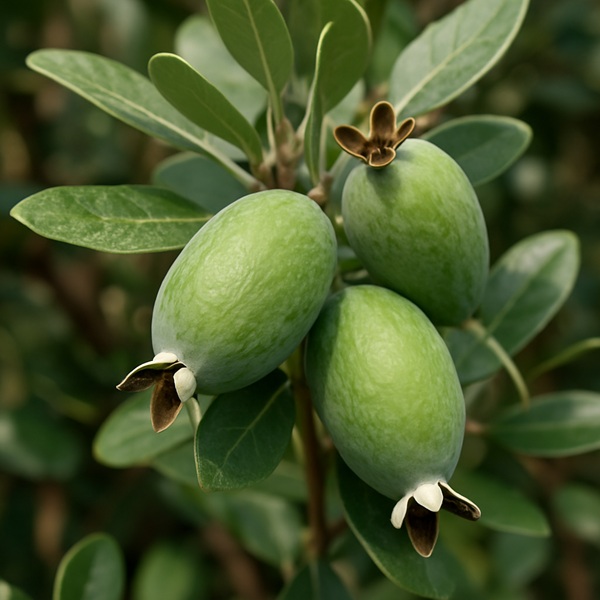
Feijoa is an evergreen shrub or small tree from the myrtle family, known for its aromatic fruits rich in iodine, vitamin C, and antioxidants. The plant is native to South America, but today it is also successfully grown in the subtropical regions of other countries. In Ukraine, due to climate change and warming, feijoa is becoming increasingly popular among enthusiastic gardeners, especially in the southern and western regions.
Feijoa fruits resemble green oval berries with sweet-and-sour flesh and a rich flavor combining pineapple, strawberry, and guava. They are eaten fresh, made into jams, compotes, and liqueurs, and are also used in cosmetology. The plant has not only food value but also decorative appeal: its large fluffy flowers decorate the garden and attract pollinators.
The main advantages of feijoa:
It tolerates drought well after establishing;
It is undemanding in regard to soil type;
It is resistant to most garden pests;
It can be grown both in open ground and in containers.
However, for full fruiting, feijoa needs certain conditions: enough warmth, sunlight, and protection from severe frost. In Ukraine, the greatest potential for growing feijoa is in the southern regions (Odesa, Mykolaiv, Kherson) and Zakarpattia. In other regions, the plant is grown in containers with mandatory winter protection or moved into cool indoor spaces.
When choosing a feijoa variety, it is important to consider its winter hardiness, ripening speed, and ability to cross-pollinate. There are many varieties worldwide, but the following are best suited to Ukrainian conditions:
Coolidge — an early-ripening variety capable of setting fruit even without cross-pollination;
Nikitskaya Aromatnaya — a Ukrainian-bred variety with a strong aroma and relative tolerance to cooler conditions;
Superba — a variety with large fruits that needs a partner for a better harvest;
Andre — a vigorous variety with frost resistance down to -12 °C.
For good pollination, it is recommended to plant 2–3 different varieties at once. Although some plants can self-pollinate, cross-pollination significantly increases yield.
Feijoa prefers sunny, wind-protected locations. The ideal site should meet the following requirements:
Maximum light exposure;
Light, well-drained soil (loam or sandy loam);
Moderate fertility with good water permeability.
Before planting, the soil is dug to a depth of 40–50 cm, organic fertilizers (humus, compost) are added, along with a little wood ash. Too much nitrogen is undesirable, since it stimulates leafy growth at the expense of flowering and fruiting.
For container growing, use containers with a volume of at least 20 liters and drainage at the bottom.
When buying feijoa seedlings, pay attention to the following:
They should be grown from cuttings, not from seed, since seed-grown plants do not preserve varietal traits;
The seedlings should have a healthy, well-developed root system;
The leaves should be green, without spots or signs of disease.
Before planting, the roots can be soaked in a growth stimulator solution for 2–3 hours to improve establishment.
In Ukraine, feijoa is planted in spring, after the danger of frost has passed — usually from late April to mid-May. Autumn planting is possible only in the southern regions, in September–October, with mandatory winter protection.
Container plants can be transplanted from spring to autumn as long as the root ball is preserved.
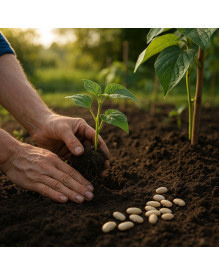
Planting algorithm:
Dig a hole measuring 60×60×60 cm.
Place a 10–15 cm drainage layer at the bottom.
Fill the hole with a mixture of fertile soil, humus, and sand in a 2:1:1 ratio.
Set the seedling in the center of the hole and gently spread the roots.
Backfill with soil, lightly firming it to avoid air pockets.
Water generously with 10–15 liters per plant.
Mulch the root zone with peat or straw.
For group planting, keep at least 3 meters between plants.
At the initial stage, it is necessary to:
Water the plants regularly;
Protect young seedlings from scorching sun;
Treat preventively with biofungicides to prevent disease.
If these rules are followed, by the end of the second season feijoa will be actively developing and begin to form buds.
Feijoa has moderate moisture needs. Its greatest demand for water occurs during active shoot growth, flowering, and fruit filling.
Basic watering recommendations:
In spring and summer — once every 5–7 days depending on the weather;
In hot weather — increase watering to 2–3 times a week;
In autumn, after harvest — reduce watering.
It is important to remember: excess moisture is just as dangerous for feijoa as the soil drying out. Water stagnation around the roots may cause fungal infections and rot.
For container plants, moisture control is especially critical: the soil should be slightly moist, but not wet.
Feijoa responds well to balanced fertilizers with a higher content of potassium and phosphorus. Nitrogen is applied in limited amounts so as to encourage flowering and fruit set.
Feeding schedule:
Early spring — a complex fertilizer with nitrogen (20–30 g per bush);
During bud formation — potassium-phosphorus mixes such as monopotassium phosphate;
After flowering — potassium fertilizers to improve fruit quality;
In autumn — minimal feeding or none at all.
Feijoa also responds very well to organic feeding: humus infusion, biohumus, and wood ash.
Crown formation is very important for plant health and productivity.
Basic rules:
In early spring, remove weak, frost-damaged, and overcrowding shoots;
Form a framework of 3–5 main trunks;
In summer, carry out sanitary pruning to improve ventilation.
Feijoa can be grown as a shrub or as a small tree. In container culture, it is recommended to form a low trunk of 30–50 cm.
Feijoa has good disease resistance, but in conditions of excessive moisture or poor ventilation, the following problems may occur:
Phytophthora — brown spots on the leaves, root rot;
Powdery mildew — a whitish coating on leaves and shoots;
Root rot — wilting of the plant and discoloration of the tissues.
Preventive measures:
Control the watering regime;
Loosen the soil regularly;
Ensure good ventilation;
Spray preventively with biological products such as Fitosporin or Alirin-B.
At the first signs of disease, treatment with systemic fungicides is necessary.
The main pests that may affect feijoa are:
Spider mite;
Scale insect;
Whitefly, especially in greenhouses.
Control methods:
Regular inspection of the plants;
Spraying with garlic or tobacco infusions;
In cases of heavy infestation, using bioinsecticides such as Fitoverm or Aktofit;
Sanitary pruning of infected parts of the plant.
Container plants are also recommended to be washed occasionally with a mild soap solution for prevention.
In Ukraine, feijoa usually begins to bear fruit in the 3rd–4th year after planting. Harvesting takes place from mid-October to late November, depending on the variety and the region.
Signs of fruit ripeness:
The berries separate easily with a light touch;
The fruits become soft when pressed;
They develop a bright, rich aroma.
Unripe fruits can be ripened indoors at room temperature.
Feijoa is a highly perishable product. In the refrigerator, fresh fruits keep for 10–14 days. To extend shelf life:
Sort the harvest and remove damaged fruits;
Store them in perforated bags;
Use them for processing into jam, fruit leather, or dried products.
It is also possible to freeze the pulp or make purée for long-term storage.
In southern Ukraine, feijoa can be left in open ground if you provide:
Mulching of the root zone with straw or leaves;
Covering the plant with agrofabric or burlap.
In regions where winter temperatures drop below -10 °C, container plants must be moved to a cool, bright room with temperatures of +5 to +10 °C.
With proper preparation, feijoa survives winter successfully and develops actively in the following season.