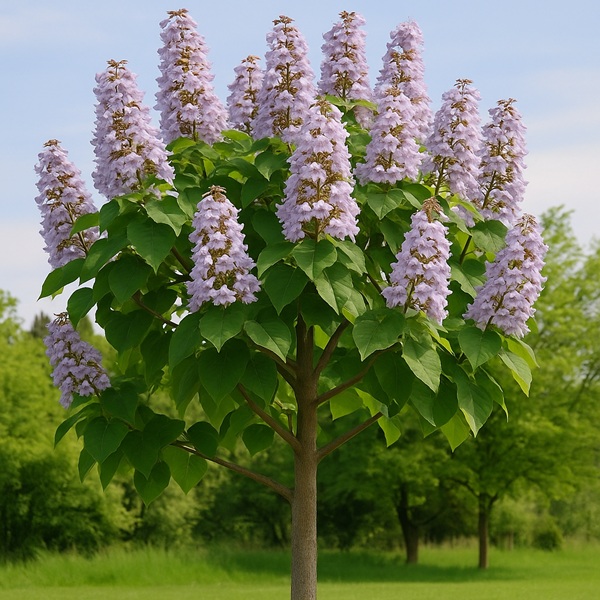
Paulownia is an exotic but increasingly popular tree that is rightfully called “imperial” thanks to its majestic appearance, rapid growth, and wide range of uses. Native to East Asia, paulownia — especially Paulownia tomentosa, Paulownia elongata, and Paulownia Shan Tong — adapts well to temperate climates and is being actively introduced into Ukrainian horticulture and agroforestry. It is valued not only for its decorative qualities — large leaves and lush violet-lilac spring blossoms — but also for the unique properties of its wood.
The main feature of paulownia is its impressive growth rate. In favorable conditions, a seedling can reach 2–3 meters in its first year alone, and within 5–6 years it grows into a full-sized tree 10–15 meters tall. This makes paulownia a promising crop both for landscaping and for industrial use: timber production, biomass, honey production, and ornamental planting. In Ukraine, paulownia establishes itself well in the southern and central regions — including Odesa, Mykolaiv, Dnipropetrovsk, and Kyiv oblasts. Successful cultivation is also possible farther north, provided the seedlings receive careful care and protection during their first winters.
Paulownia has a powerful root system that gives it drought tolerance, the ability to grow on poor soils, and fast recovery after damage. Its leaves can reach up to 60 cm in diameter, and its flowers, gathered in large clusters, have a pleasant fragrance and attract bees, bumblebees, and other pollinators. This also makes the tree useful for apiaries. Still, its greatest value lies in the wood: lightweight, strong, resistant to warping, and easy to work with. It is used in furniture making, construction, and also as an alternative to poplar and pine for shelterbelts and energy plantations in Ukraine.
Despite its vigor and rapid growth, paulownia requires the right planting site and proper soil preparation. It is not a demanding tree, but young plants are very sensitive to excess moisture and lack of light. The first years after planting determine long-term success: if the tree gets a strong start, it will establish quickly and enter an active growth phase.
Optimal conditions for paulownia:
Light: full sun for at least 8–10 hours a day. In shade, growth slows down significantly, which is especially critical in the first years.
Soil: light, breathable, and well-drained. Sandy loam and loam soils with a neutral or slightly alkaline reaction (pH 6.5–7.5) are best.
Drainage: essential, especially in dense soils or low-lying areas. Standing water is dangerous for the root system.
On heavy soils, it is recommended to add sand, peat, and organic matter in advance. Planting on raised ridges or in specially prepared pits with drainage works especially well. It is not advisable to plant where groundwater is closer than 1.5 m to the surface. For commercial plantations, it is best to carry out an agrochemical soil analysis and add the necessary nutrients, especially phosphorus and potassium.
Site preparation:
Clear the area of weeds, especially perennial ones such as thistle and couch grass.
If necessary, carry out deep loosening or plowing.
Two to three weeks before planting, apply compost or humus, superphosphate, and potassium fertilizers.
Prepare planting pits or trenches, in the case of dense planting, at least 50×50×50 cm in size.
Well-prepared soil gives the plant a confident start and reduces transplant stress. Paulownia responds very noticeably to soil fertility, especially in the first year when the main biomass is being formed.
The best time to plant paulownia in open ground in Ukraine is spring, from mid-April to late May. In the southern regions, earlier planting is also possible, beginning in late March. Autumn planting is possible too, but spring planting gives the tree a longer period for adaptation and growth. In the early stages, it is advisable to use covers or protective materials.
Planting recommendations:
Use one-year-old seedlings with a closed root system. They establish better and are less sensitive to stress.
Water immediately after planting, using 10–15 liters per seedling.
Mulch the trunk zone without fail, using straw, pine needles, or agrofabric, to retain moisture and suppress weeds.
In exposed sites, it is advisable to install wind protection such as wooden rings or plastic screens.
Planting layouts:
For timber: 4×4 m or 5×5 m.
For ornamental landscaping or honey production: 6×6 m.
For biomass: 2×2 m, with later thinning.
The root collar should be buried by 2–3 cm, but no deeper. If the soil is likely to settle, it is better to plant on a slight mound. During the first two weeks, it is important to monitor moisture levels, especially in a dry spring.
Paulownia is an incredibly fast-growing tree, but during its first two years it is especially vulnerable to outside conditions. This is when the strong root system is formed, the trunk develops, and the main climatic adaptation takes place. If young plants are cared for properly, paulownia will later grow with minimal intervention.
Watering:
In the first year, maintain steady moisture and water 1–2 times a week, especially in dry weather.
Later, the tree tolerates drought, but during active growth it still needs water at least once every 10 days.
In plantation cultivation, drip irrigation is highly advisable.
Weeding and mulching:
Weed regularly until the crown shades the surrounding ground.
Mulching with straw, wood chips, or agrotextile prevents weed growth and preserves moisture.
Feeding:
In early spring, apply nitrogen fertilizers such as urea or ammonium nitrate to stimulate growth.
In summer, use balanced fertilizers with potassium and phosphorus to strengthen the wood and support bud formation.
In autumn, do not fertilize, to avoid untimely growth before frost.
Special attention should also be paid to pests. Young plants may be attacked by aphids, whiteflies, and spider mites. In case of infestation, systemic insecticides or natural remedies such as garlic, tobacco, or ash infusions are used.
Paulownia has a clearly expressed central leader, which makes it easy to form a straight trunk. Depending on the purpose of cultivation, pruning is done in different ways.
As an ornamental tree:
A low trunk is formed, 1.5–2 m high, with a dome-shaped crown.
In the second year, 3–4 main branches are left, and the rest are removed.
Formative pruning is carried out in early spring, before sap flow begins.
For timber:
Only the central leader is left, while all side branches are removed up to a height of 2–4 m.
The top is left untouched until the tree reaches the desired height of 6–8 m.
This creates a tall, straight trunk for future harvest.
For biomass:
Cutting back to the base is done every 2–3 years.
New shoots develop from the root system, allowing a large quantity of green mass to be produced.
Cut surfaces should be treated with garden sealant or special fungicides. This kind of pruning also improves vegetation and stimulates the development of a powerful leafy canopy, which is especially valuable for green biomass or ornamental effect.
Although paulownia can withstand frosts down to -20°C, in the first years of life the seedlings require careful protection. This is especially relevant in northern and central Ukraine. As the trees mature, they usually tolerate winter well without additional shelter.
Winter preparation:
In October–November, mulch the trunk zone with peat, straw, or bark.
Cover young plants with agrofabric or burlap up to a height of 1.5 m.
In regions with little snow, add an extra insulating layer such as spruce branches or leaves.
Container-grown plants should be moved to a cool, bright place at +2 to +8°C.
From the third year onward, most paulownia varieties no longer require winter protection even in Kyiv, Cherkasy, and Vinnytsia oblasts.
Areas of use in Ukraine:
Landscaping: squares, park alleys, and garden compositions.
Honey production: its spring blossoms attract large numbers of bees.
Wood: light, durable, and suitable for furniture and interior finishing.
Bioenergy: production of pellets, briquettes, and green biomass.
Shelterbelts and slope stabilization: the strong root system reinforces the soil.
So, paulownia is not just an exotic tree — it is a promising crop that can bring both aesthetic value and real economic benefit to Ukrainian growers, designers, and entrepreneurs.