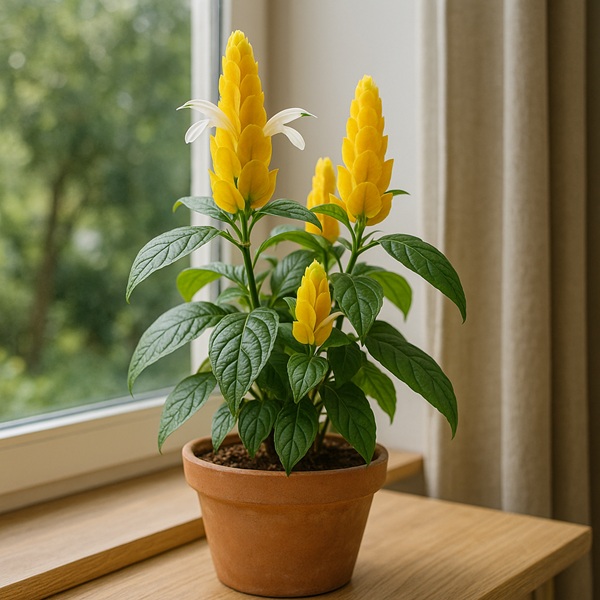
Pachystachys is an ornamental plant from the acanthus family that has long won over flower lovers thanks to its exotic appearance. Although the genus includes more than a dozen species botanically, in Ukraine two are mainly grown in practice: yellow pachystachys and red pachystachys. Both are very attractive, but they differ both in their care requirements and in how they behave indoors.
Yellow pachystachys (Pachystachys lutea) is the clear favorite. It adapts easily to apartment conditions, blooms abundantly with moderate care, and tolerates slight drying of the soil fairly well. Its main decoration is its bright lemon-yellow bracts, from which small white flowers emerge. Even after the flowers fade, the bracts remain decorative for several more weeks, creating the illusion of continuous blooming.
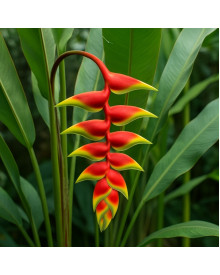
Red pachystachys (Pachystachys coccinea), by contrast, is more demanding. Its elongated red inflorescences are striking, but for them to appear it needs high air humidity, a stable temperature, and good diffused light. In addition, it tolerates pruning less well: the shoots recover more slowly, and shaping the bush takes more time.
Conclusion: if you are just getting acquainted with pachystachys, choose the yellow one. It is more forgiving of mistakes, adapts quickly to indoor conditions, and blooms more often. The red type is better suited to experienced growers who are ready to create an individual microclimate for it. In greenhouses, winter gardens, or humid enclosed balconies, red pachystachys reveals its full beauty.
How should pachystachys be planted so that it not only takes root, but also grows actively, branches, and blooms? It is not just about choosing a pot — a whole set of conditions matters: the soil, the lighting, and the first days after repotting.
Step-by-step process:
Pot: choose a wide, shallow one. Pachystachys has roots that spread horizontally, and with deep planting, water stagnates at the bottom.
Drainage: essential. Expanded clay, pebbles, or broken brick — no less than 2–3 cm.
Soil: light, airy, and nutritious. The ideal mix is turf soil, leaf humus, peat, and perlite (2:1:1:1). Add a little charcoal to help prevent fungal issues.
Mulch: sphagnum moss or coconut fiber helps retain moisture, prevents drying out, and slows fungal processes.
Repotting is done every spring. Young plants especially need it, because they develop quickly and exhaust the substrate. But even mature specimens need the soil replaced, otherwise the root system begins to suffocate in a compacted medium.
A typical beginner’s mistake is watering immediately after repotting. This is stressful for the plant. It is better to wait 2–3 days so the roots can “rest” and heal. After that, return to the usual care routine, but for the first while it is best to protect the plant from direct sun.
Creating the right conditions is 50% of success when growing pachystachys. The plant does not forgive extremes: neither dry air, nor drought, nor scorching sun. But if you achieve the right balance of light, moisture, and temperature, it turns into a truly blooming sculpture.
Let us look at each factor separately:
1. Light: pachystachys loves light, but is afraid of direct rays. East- or west-facing windows are ideal. On a south-facing window, it needs shading. On a north-facing one, it stretches out and does not bloom. In winter, supplemental lighting is essential (10–12 hours a day).
2. Humidity: critically important. The minimum is 60%. In winter, apartments may have only 30%. Humidifiers, misting, trays with expanded clay, and grouping plants together help. Without this, leaf tips dry out and growth slows down.
3. Watering: moderate and regular. In summer — every 2–3 days; in winter — once every 5–7 days. The main thing is that the soil should stay slightly moist, but not wet. Overwatering leads to rot, especially in cool conditions.
A common situation: pachystachys stands on a windowsill, is watered “on schedule,” but the leaves are wilting. What should you do? Check whether there are drafts, whether it gets enough light, and whether water is stagnating in the tray. In pachystachys care, everything is about balance. But once that balance is achieved, the plant rewards you with abundant flowering.
For pachystachys not just to survive, but to develop with dense foliage and bright flowers, it needs regular formative pruning. This especially applies to the yellow type, which, with proper care, can turn into a lush, compact bush. Without pruning, it stretches out, loses its ornamental value, the lower leaves fall off, and the plant starts to look unattractive.
The main rule is regular pinching. As soon as a shoot reaches 15–20 cm, its tip should be pinched. This stimulates the formation of side branches and, as a result, creates a denser crown. After flowering, the inflorescences are cut back 1–2 internodes lower so that no bare branches remain. In this way, you both preserve the shape of the plant and stimulate a new wave of buds.
Practical tips:
Pinch all young shoots once every 2–3 weeks from April to August.
Make sure no long, unpruned shoots are left — they spoil the symmetry.
After pruning, do not fertilize the plant for 1–2 weeks — let it rest.
By the way, pruning also gives you excellent planting material. Cuttings root easily in water or in a loose substrate. It is worth creating a greenhouse effect — cover them with polyethylene or a glass jar. After 2–3 weeks, roots appear, and a new plant can be planted. This is convenient: when the old bush loses its shape, you already have a young, healthy new generation.
Pachystachys is not the most troublesome plant, but if care conditions are нарушed, it reacts quickly with disease or pest attacks. Most often, problems arise with overwatered soil, excessively dry air, and lack of light.
Typical symptoms:
Brown spots on the leaves — the result of overwatering or burns.
Leaf curling — a sign of dry air or a sudden drop in temperature.
Wilting — possible root rot or lack of light.
Coating, dots, webbing — check for mites, aphids, or thrips.
What to do:
Found pests? Wash the leaves under a warm shower, then treat with Fitoverm or Aktara.
Roots are rotting? Urgently repot into a new dry substrate, cut away the affected parts, and treat with a fungicide such as Fundazol or Topaz.
Dry air? Install a humidifier, add misting, and place other plants nearby.
Once every 2 months, wipe the leaves with a damp cloth — this improves photosynthesis and reduces the risk of infections.
Prevention is your main tool. Following the correct watering regime, ventilating the room, controlling humidity, and inspecting the plant regularly will help you avoid problems. If you do not over-fertilize or overwater pachystachys, it will reward you with steady growth and ornamental beauty.
Pachystachys is not just a houseplant. It is a living color accent that blends harmoniously into any interior. Thanks to its vertical inflorescences and rich green leaves, it adds brightness and depth to a space. It looks equally good in modern interiors and in classic ones. Pachystachys is especially striking when paired with other ornamental foliage plants such as calatheas, aglaonemas, and alocasias.
Placement ideas:
An east- or west-facing windowsill — a great solution for a living room.
A winter garden or warm enclosed balcony — among other tropical plants.
An office or reception area — pachystachys is well suited to decorating workspaces thanks to its neat appearance.
On a balcony in summer — the main thing is to avoid direct rays and strong wind.
But do not forget: pachystachys does not like drafts or temperature fluctuations. It feels best at +18 to +24°C with stable humidity. Regular care, controlled conditions, and a little attention — and the plant will reward you with bright candle-like inflorescences against a background of dense foliage.
Most importantly, pachystachys is a living and dynamic plant. It responds to your care, changes throughout the year, forms new shoots, and develops. It is not a static decorative object, but a full green presence in the home. That is exactly why experienced growers value it so highly.