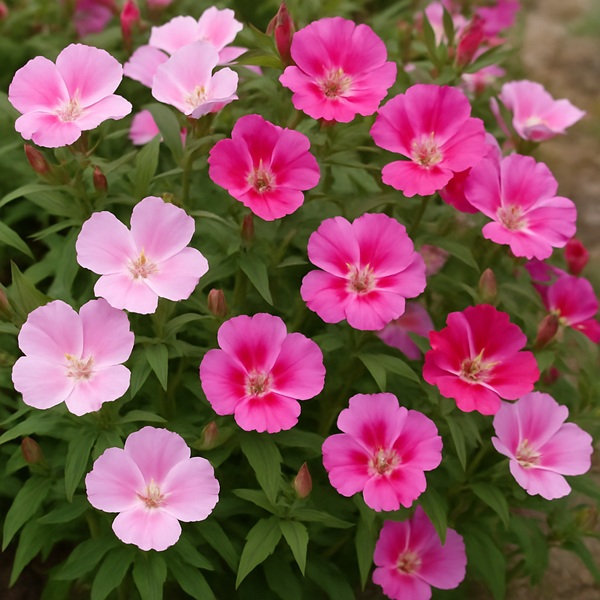
Clarkia is a graceful annual that has proven itself very well in Ukrainian conditions as an undemanding and abundantly flowering plant for flower beds, borders, and balcony boxes. It was named after Captain William Clark, the explorer of North America where wild forms of this plant were first found. It belongs to the evening primrose family (Onagraceae) and is known for its dense flowering, which creates colorful carpets or clouds of bloom, sometimes almost completely covering the foliage.
Among the best-known species is elegant clarkia (Clarkia elegans), which reaches up to 90 cm in height and forms upright stems abundantly covered with single or double flowers up to 4 cm in diameter. Its color palette includes white, pink, salmon, lilac, and purple shades. Also popular is Clarkia pulchella, which is less spreading, with characteristic three-lobed flowers and a height of up to 60 cm. In the southern regions of Ukraine, Clarkia amoena can also be grown, as it stands out for its drought tolerance.
Clarkia is highly valued for its abundant, long-lasting flowering from June to September, as well as for its ability to blend naturally with other flowers in landscape compositions. It is used for decorating borders, mixborders, flower beds, and alpine gardens. Thanks to its straight and sturdy stems, clarkia is also suitable for cutting — in a vase, the flowers stay fresh for several days, especially if the stems are re-cut and the lower leaves are removed. Tall varieties look best in the back of flower beds, while compact ones are better suited to the front or to containers.
Clarkia prefers sunny or lightly shaded locations. Ideally, it should be planted in a spot protected from wind but with good air circulation. In open ground in Ukraine, the plant grows well in almost all regions, except perhaps the farthest north. At the same time, the crop is fairly cold-tolerant — light spring frosts are not a problem for it, which makes early sowing possible.
Seeds can be sown directly into open ground or started as seedlings. In most regions of Ukraine, direct sowing is practiced in April, once the soil has warmed up. The seeds are very small, so they are sown on the soil surface and lightly dusted with a thin layer of sand or soil. The spacing between rows should be 20–30 cm, and between plants 15–20 cm. If the seedlings emerge too densely, they should be thinned out, leaving only the strongest plants. Seedlings are transplanted in May, when they are 4–5 weeks old. During transplanting, it is important not to damage the roots.
The soil should be light, well-drained, and neutral to slightly acidic. It is recommended to dig over the site in advance with the addition of humus or compost. Fresh manure is not suitable, as it encourages leaf growth at the expense of flowering. On heavy soils, sand or peat should be added. If the area is overly wet, drainage should be arranged. It is also useful to mulch the soil around the plants — this helps retain moisture and suppress weeds.
Clarkia does not require complicated care, but proper lighting and watering are crucial to its decorative effect. In nature, the plant grows in open areas, so in the garden it also prefers full sun. With a lack of light, the stems become leggy, the flowers grow smaller, and their color intensity fades. Bright sunlight is ideal, with some shade during the hottest midday hours, especially in the southern regions.
Watering should be moderate. Overwatering can lead to fungal diseases, while drying out can stop growth. During bud formation and flowering, it is especially important to keep the soil slightly moist. It is best to water at the base of the plant, avoiding getting water on the flowers. After watering, the soil should preferably be loosened, especially if it is not mulched.
Clarkia responds well to gentle feeding. Once every two weeks, liquid mineral fertilizers with phosphorus and potassium can be applied. Organic options include wood ash infusion or compost water. Excess nitrogen is undesirable, as it stimulates leafy growth at the expense of flowers. With proper care, the plant will bloom profusely and for a long time, delighting with vivid color throughout the summer.
Clarkia is fairly resilient, but if growing conditions are disturbed — excessive watering, overcrowded planting, or high humidity — it may suffer from diseases or pests. Most often, problems appear during abundant flowering or in prolonged rainy weather.
The most common diseases:
Powdery mildew. A white coating appears on the leaves and buds. It develops in high heat and humidity. Treatment: remove affected parts, treat with products such as Topaz or Skor; prevention includes proper spacing between plants.
Root rot. Caused by stagnant water. Symptoms include wilting despite moist soil and black spots on the root collar. Repotting or moving the plant into drier soil with drainage can help, along with treatment with Fundazol or Maxim.
Gray mold (botrytis). Appears as brown spots that later become slimy. It affects buds and stems. Broad-spectrum fungicides are used, watering is reduced, and ventilation is improved.
Pests:
Aphids. They attack young shoots, causing the leaves to curl and the plant to weaken. Treatment includes tobacco infusion, soapy water, or Aktara.
Spider mite. In dry air it forms webbing and causes yellowing. Control: increase humidity and spray with acaricides such as Actellic or Fitoverm.
Thrips and caterpillars. They may damage petals and leaves. Insecticides are used for control, avoiding treatment during the hottest hours of the day.
Prevention includes following the recommended planting scheme, watering moderately, ensuring ventilation, removing weeds, and treating the plants with calendula or yarrow infusions once every 2 weeks.
Clarkia is an annual, so it must be grown from seed each year. Fortunately, this process is very simple, even for beginners. The seeds are small, but they germinate well, sprout quickly, and establish easily in a new place.
1. Sowing in open ground.
This is done in April, as soon as stable warmth sets in. The seeds are sown on the surface, lightly pressed into moist soil, and dusted with a thin layer of sand. The first seedlings appear in 7–10 days. They are thinned out after 2–3 true leaves have formed.
2. Growing through seedlings.
This begins in March. Seeds are sown in boxes or trays. Light is essential — without it, the seedlings become leggy. They are transplanted into open ground in May. It is important not to damage the roots, so transplanting by the slip method is best.
3. Self-seeding.
In the southern regions, clarkia is able to self-seed in spring. If a few bushes are left after flowering, the seeds will ripen and fall — in March or April, new plants will appear. They only need to be thinned out.
The plant develops quickly and blooms just 2 months after germination. This makes it possible to create waves of flowering by sowing several times during the season. It combines well in mixborders, rabatkas, and alpine gardens.
To achieve long-lasting flowering and minimize problems, it is important to follow a simple yearly care cycle:
March–April:
– sow for seedlings or directly into open ground in southern regions;
– prepare the site: dig the soil and enrich it with compost;
– thin out the first seedlings.
May:
– transplant seedlings into open ground;
– water, mulch, and apply light feeding;
– install supports for tall varieties.
June–July:
– intensive flowering, seed formation;
– regular watering at the base, weeding;
– remove faded flowers and continue feeding.
August:
– collect seeds if needed;
– resow for a repeat wave of flowering, up to September;
– gradually reduce feeding.
September–October:
– remove plant remains;
– prepare the soil for winter;
– winter sowing is also possible.
By following these recommendations, you will get bright, long-lasting flowering even in difficult climatic conditions.