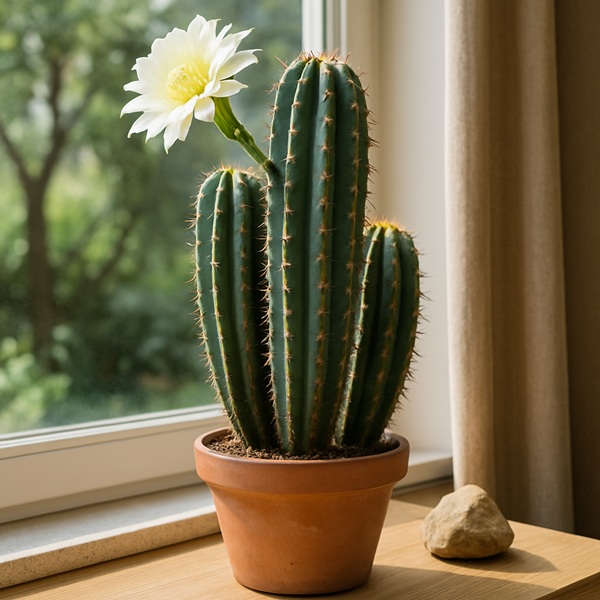
Cereus is a member of the cactus family, known for its elongated ribbed stems and its ability to reach impressive sizes even in indoor conditions. The genus includes about 50 species, many of which are successfully grown in Ukraine as ornamental plants. The most popular among them are Peruvian apple cactus (Cereus peruvianus), giant cereus (Cereus giganteus), spiral cereus (Cereus forbesii ‘Spiralis’), and Cereus jamacaru. Each of them has its own distinctive features — from straight to twisted stems, from bluish-green to deep green coloring, from smooth surfaces to pronounced ribs with spines.
Under Ukrainian climatic conditions, where winters are accompanied by frost, cereus is grown mainly as a houseplant or temporarily planted outdoors during the summer. However, if insulated greenhouses or winter gardens are available, large specimens can be kept year-round in a semi-warm space. Some varieties may be taken out onto a balcony or into the garden, but only if the temperature does not fall below +10°C. All cereus species are light-loving, so the best place for them is a south- or southwest-facing windowsill. A lack of light leads to stretched stems, loss of ornamental appeal, and even halted growth.
Some species of cereus, with proper care, can bloom even indoors. Flowering is rare and short-lived, most often occurring at night, which is especially typical of the Peruvian apple cactus. Its large white or cream flowers, up to 20 cm in diameter and with a delicate fragrance, open for only one night. Other species have less pronounced but still striking blooms. For buds to form, the plant needs a winter dormant period — with temperatures lowered to +10...+12°C, reduced watering, and a complete stop to feeding.
Planting cereus at home requires taking several important factors into account. First of all, an appropriate pot must be chosen. Cereus has a powerful but shallow root system, so the container should be stable, of medium depth, and обязательно have a drainage hole. A drainage layer — expanded clay, pebbles, or broken brick, at least 3 cm thick — should be placed at the bottom. This is necessary to prevent moisture stagnation, which can cause root rot, one of the main problems when growing cacti.
The soil for cereus should be light and permeable to both air and water. A ready-made cactus substrate can be used, but it is also easy to prepare your own. The basic recipe includes: leaf soil — 1 part, turf soil — 1 part, coarse river sand — 1 part, plus a little brick chips or charcoal. This composition provides good drainage and reduces the risk of souring. Cereus grows poorly in heavy and alkaline soils — the roots suffer from lack of oxygen and excess moisture.
After repotting, cereus needs time to adapt. As a rule, watering is resumed not immediately, but after 4–5 days, when any root damage has dried. The best period for repotting is spring (April–May), when active growth begins. Young specimens are repotted every year, while mature ones are repotted once every 3–4 years, though the top layer of soil should preferably be renewed every season. It is also important to provide bright light and a moderate indoor temperature. Direct sun should be softened for a few days after repotting to avoid burns.
Cereus, as a typical desert dweller, uses moisture very sparingly. Its stems serve as a kind of reservoir, storing water for times of drought. That is why overwatering is the plant’s main threat. In Ukraine, especially in spring and summer, cereus is watered moderately — after the soil ball has dried out completely. Usually this means once every 7–10 days. The water should be settled, at room temperature, and free of excess salts and chlorine. In autumn, watering is reduced, and from November to February it is brought down to a minimum or stopped entirely, especially if the plant is kept cool.
Cereus does not require high air humidity, which makes it ideal for apartments with central heating. On the contrary, excessive humidity and poor ventilation can provoke fungal diseases and stem rot. Still, on hot summer days the plant may be misted with soft water, especially if it is standing in the sun, growing on a balcony, or kept in the garden. The main thing is to avoid water stagnating in the grooves between the ribs.
Lighting is a key factor for successful cultivation. Cereus prefers direct sunlight, so it can safely be placed on a southern windowsill. If it does not get enough light, it loses its rich color, and the stems become elongated and fragile. If the plant must be kept under artificial lighting in winter, it is advisable to use grow lights for at least 10–12 hours a day. During the summer months, cereus can be taken out onto a balcony or into the yard, but after winter it should be gradually reintroduced to the sun — at first leaving it in partial shade.
Successfully growing cereus in Ukrainian apartments and greenhouses requires not only basic care, but also an understanding of the nuances involved in stimulating growth and flowering. It is important to keep in mind that the cactus goes through two main periods — active growth (spring–summer) and relative dormancy (autumn–winter). During the growth phase, the plant is fed once a month with cactus fertilizers. These formulas should have a reduced nitrogen content, since excess nitrogen makes the tissues watery and distorts the shape. Formulas richer in phosphorus and potassium are considered ideal — they strengthen the stems and encourage bud formation.
An approximate seasonal care routine:
Spring: start of growth, repotting, first feeding, regular watering, intense light.
Summer: period of peak activity. Fresh air exposure, watering after the soil dries, feeding every 3–4 weeks.
Autumn: gradual drop in temperature, reduced watering, stop feeding.
Winter: dormant state. Temperature +8...+12°C, minimal moisture, no feeding or repotting.
To stimulate flowering, it is important not only to follow the seasonal rhythm, but also to create a mild “stress situation”: in winter, the temperature must be lowered and watering limited. If the plant remains constantly in a warm and humid environment, its physiological processes do not enter the phase needed to prepare for budding. That is why, in apartments where it is hard to provide cool conditions, flowering can be difficult to achieve. A glazed insulated balcony or loggia can be a solution.
Despite its general hardiness, cereus is vulnerable to certain diseases and pests, especially if it is cared for improperly. The most common problem is root rot, which develops because of excessive watering. The first signs are softness and darkening at the base of the stem, along with halted growth. In that case, the plant should immediately be removed from the pot, the affected roots trimmed off, treated with a fungicide such as Fundazol, and transplanted into fresh dry substrate. Watering should not be resumed earlier than a week later.
Other typical problems:
Mealybug — a white coating between the ribs. It is removed with cotton soaked in alcohol, followed by treatment with an insecticide such as Aktara.
Spider mite — causes yellowing and wilting of the stems. Visible signs include fine webbing. Effective products include Fitoverm and Neoron.
Scale insect — dense brown spots. Removed by hand, then treated with an insecticide.
Fungal spots — dark, dry patches with a border. Treated with copper-based products.
Prevention includes the correct watering regime, good ventilation, and regular inspection of the plant. It is especially important to avoid moisture accumulating in the saucer and in the lower part of the pot. It is recommended to renew the top layer of soil every year, even without repotting — this reduces the chance of salts and disease-causing organisms building up.
Cereus is not only a botanical curiosity, but also a stylish design element. Thanks to its spiny, sculptural form, it looks excellent in minimalist or exotic interiors. Compositions of several cacti are especially striking: the tall columns of cereus can be combined with spherical echinocacti, agaves, and aloes. Sandy mulch, a decorative planter, and a few stones create the feeling of a miniature desert landscape.
Placement options:
windowsills, especially on the south side;
winter gardens, greenhouses, loggias;
offices — thanks to its tolerance of dry air;
in summer — balconies, terraces, inner courtyards.
Besides its decorative function, cereus is believed to help purify the air and, according to some views, reduce the level of electromagnetic radiation from household appliances. In folk traditions, cacti are considered “guardians of the home,” protecting it from negativity. Regardless of such beliefs, one thing is obvious: a well-kept cereus is a living sculpture that enhances any space.
It is also interesting that the Peruvian apple cactus can produce edible fruit — “pitahaya.” It is often confused with the fruit of Hylocereus, but with proper cultivation and once the plant reaches a significant age, fruiting is possible even in Ukraine. So proper care offers not only beauty, but also potential practical benefit.