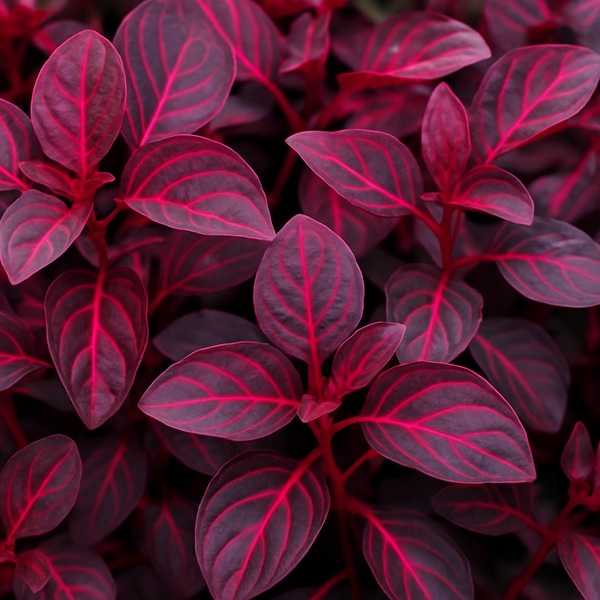
Iresine is a striking ornamental foliage plant valued in decorative gardening for its expressive leaf coloration and high adaptability to different growing conditions. Its name comes from the Greek word eirene, meaning “peace,” associated with the harmonious appearance of the bush. It is also popularly called “bloodleaf” or “purple nettle” because of its rich burgundy shades. It belongs to the amaranth family (Amaranthaceae), and its native range is the tropics of South America: Brazil, Paraguay, and Bolivia. In Ukraine, iresine is grown both outdoors during the summer season and as an indoor or greenhouse plant all year round.
This is a perennial plant, although in open ground under a temperate climate it is grown as an annual or moved indoors for wintering. Iresine stems are upright or trailing, while the leaves may be oval, heart-shaped, or lanceolate depending on the species. Its main ornamental value lies in its brightly colored foliage: purple, crimson, violet, or burgundy with pink or golden veins. The flowers are small, inconspicuous, and arranged in spike-like inflorescences; they have no decorative value.
The most common species of iresine:
– Iresine herbstii — the best-known species with large purple leaves; the cultivar ‘Brilliantissima’ stands out for its rich crimson coloring with a metallic sheen.
– Iresine lindenii — a compact species with lanceolate leaves and reddish veins against a green background.
– Iresine diffusa — with trailing shoots, used as an ampel plant or groundcover.
– Iresine acuminata — a rare species with olive leaves and creamy veins, popular in collections.
Thanks to its expressive coloring, iresine is often used as an accent plant in flower beds, container arrangements, and mixed borders. It pairs harmoniously with plants in contrasting tones such as silvery cineraria, yellow chrysanthemums, and green grasses. It is suitable for balconies, loggias, windowsills, and garden borders.
Before planting iresine, it is important to choose a location where the plant can show its full decorative potential. In Ukraine, it is planted in open ground in late spring, after the threat of frost has completely passed, usually after May 15. In indoor cultivation, repotting is usually done in spring or as needed.
The plant is light-loving. With insufficient light, iresine loses its rich leaf color and the shoots become stretched. At the same time, direct midday sun should be avoided, as it may cause burns. Eastern or western exposures in the garden, or windowsills with diffused light indoors, are ideal. On cloudy days, supplemental lighting is desirable.
The soil should be light, nutritious, and neutral to slightly acidic. The optimal mix is turf soil, leaf humus, peat, and sand in equal parts. For container growing, a ready-made substrate for ornamental foliage plants with added vermiculite is suitable. Drainage is essential: at least 3–4 cm of expanded clay or broken brick at the bottom of the pot or planting hole.
In open ground, the spacing between plants should be 25–30 cm, as iresine quickly forms a lush bush. After planting, watering and mulching are essential to preserve moisture. For pots, it is better to use wide, stable containers, since the plant needs space for root development.
Watering is one of the key aspects of iresine care. During the active growth period, from April to September, watering should be regular but moderate. The soil should remain slightly moist, without waterlogging. In containers, excess moisture should be poured out of the saucer to prevent root rot.
In dry air, especially indoors, it is helpful to spray the plant with warm, settled water. This improves leaf condition and helps prevent spider mites. In winter, watering is reduced to once every 7–10 days, especially if the temperature drops to +16 to +18°C. If supplemental lighting is provided, watering may be slightly more frequent.
Iresine responds well to pinching and bush shaping. Regular pinching of the tips stimulates branching and helps form a dense, compact plant. If the shoots become too elongated, they can be cut back by one third — iresine recovers quickly and produces new side branches. Shaping is especially important for potted specimens and balcony arrangements.
Despite its general hardiness, iresine may suffer from unfavorable care conditions. The main problems are excess moisture, lack of air circulation, and dry indoor air. Under such conditions, both fungal diseases and pests may appear.
The most common diseases:
– Root rot. Caused by water stagnation. Symptoms include wilting, darkening at the base of the stem, and a moldy smell. Treatment involves repotting into fresh substrate, removing damaged roots, and applying fungicides.
– Gray mold. Often affects dense plantings under high humidity. Wet spots with a gray fuzzy coating appear on the leaves. Affected leaves should be removed, and the plant treated with products such as Fundazol or HOM.
– Leaf spot. Appears as dark or yellowish spots on the leaves. Caused by fungi or bacteria. Treatments with Skor, Fitosporin, or ash solution infusions are effective.
Pests:
– Spider mite. Especially common in apartments with dry air. The leaves turn yellow and fine webbing appears. Control measures include spraying, increasing humidity, and using Actellic or Fitoverm.
– Aphids. They attack the shoot tips and cause leaf curling. Treatment: soapy solution, tobacco infusion, or Aktara.
– Whitefly. Often appears in greenhouses and on balconies. The leaves turn yellow and become sticky. Yellow sticky traps and treatments with Fufanon or biological products help.
Prevention includes ventilation, careful watering without stagnation, proper spacing between plants, and regular leaf inspection. Once a month, the plant may also be treated with biofungicides or infusions of calendula or garlic.
The most convenient method of propagation is cuttings. The seed method is rarely used, since the plant almost never flowers in a temperate climate, and seedlings do not preserve varietal traits. Cuttings, on the other hand, give fast and reliable results.
1. Cuttings.
In spring or summer, cut apical cuttings 10–15 cm long. Remove some of the leaves, and place the lower part in water or a light substrate made of peat and sand. Roots appear in 7–10 days. The seedling is then transplanted into a pot or open ground.
2. Layering.
Shoots can be bent to the ground, fixed in place, and lightly covered. Roots appear within 1–2 weeks. After that, the new plant is separated and planted on its own.
3. Division of the bush.
Suitable for large, branched plants. During repotting, the bush is divided into 2–3 parts. Each part should have its own roots and shoots. The new plants are temporarily shaded and watered moderately.
After propagation, direct sunlight should be avoided and stable moisture maintained. Young iresine plants root very quickly and within a few weeks already take on a decorative shape.
Iresine adapts to different conditions, but for maximum decorative effect it is important to follow its yearly care cycle. Below is an approximate calendar for the Ukrainian climate:
Spring (March–May):
– repotting into fresh soil;
– cuttings and rooting;
– start of regular watering and feeding;
– moving the plant to a balcony or garden after the frost period ends.
Summer (June–August):
– watering 2–3 times a week;
– feeding every 2 weeks with complex fertilizers;
– shaping the bush, pruning elongated shoots;
– protection from burns and pests.
Autumn (September–October):
– reducing watering and stopping fertilization;
– moving indoors when temperatures drop below +10°C;
– prevention of fungal diseases;
– pruning and renewing the shape of the bush.
Winter (November–February):
– watering once every 10–14 days;
– no feeding, temperature +16 to +18°C;
– supplemental lighting may be installed;
– regular inspection and ventilation of the room.
By following these recommendations, iresine will remain healthy and decorative all year round, brightening both flower beds and interiors.