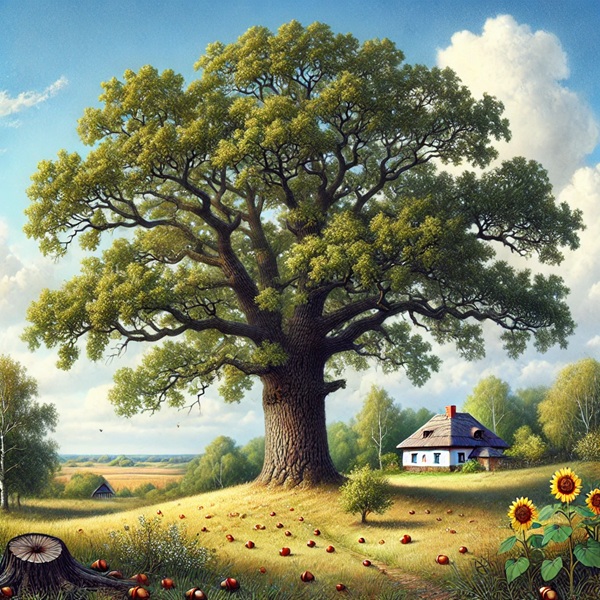
Oak (Quercus) is one of the most majestic and symbolic trees in Ukrainian nature. It is not only an important part of forest ecosystems, but also has tremendous cultural, historical, and practical significance. Since ancient times, oak in Ukraine has been associated with strength, longevity, and nobility. Its wood is valued for its durability and long service life, while its fruits (acorns) serve as animal feed and as raw material in certain processing industries. Today, oak is actively used in landscaping, afforestation, ornamental gardening, and even in the reclamation of damaged lands.
The oak genus includes about 600 species, several of which occur naturally in Ukraine — the most widespread is pedunculate oak (Quercus robur), as well as sessile oak (Quercus petraea), red oak (Quercus rubra), bur oak, swamp oak, downy oak, and others. Pedunculate oak is typical of the forest-steppe and Polissia zones, and it is also found in the Carpathians and even in the northern steppe. Red oak, introduced from North America, has acclimatized well in Ukraine and is used as both an ornamental and a forest-forming species.
Oak is a long-lived tree that can live for 500–1000 years. It is a deciduous plant with a powerful root system that penetrates deeply into the soil, ensuring resistance to drought and wind. The height of a mature tree may exceed 30 meters, and the trunk diameter may reach 1.5–2 meters. The oak crown is broad and massive, with spreading branches. The tree blooms in spring, and the fruits — acorns — ripen in autumn. Acorn yields vary: productive years alternate with years of low fruiting.
Thanks to its ecological properties, oak is widely used in urban landscaping, parks, school grounds, private estates, and around administrative buildings. These trees create dense shade, trap dust and reduce noise, strengthen slopes, and form a favorable microclimate. Oak plays a particularly important role in forestry — oak groves are considered among the most resilient and productive forests in temperate climates.
In agricultural practice, oak is increasingly viewed as an element of landscape design, shelterbelts, land reclamation on degraded soils, and as an ornamental or symbolic tree. It is grown both in nurseries and in private households — as individual trees, alleys, or in mixed plantings with other species.
For successful oak cultivation in Ukraine, it is necessary to choose the right tree species and provide suitable conditions. Depending on the purpose of planting and the region, both native and introduced species are used. If the goal is landscaping or establishing protective plantings, pedunculate oak (Quercus robur) is recommended as the most hardy and versatile species. It adapts well to various soil and climatic conditions and has high frost and drought resistance.
For ornamental purposes, red oak (Quercus rubra) is often planted. Its main advantage is the bright autumn foliage color (from red to burgundy), as well as faster growth compared to pedunculate oak. Sessile oak is also suitable for cultivation in Ukraine, preferring dry, rocky soils and being especially appropriate for Transcarpathia and Podillia. Moist lowlands and floodplains may be planted with swamp oak, although it is sensitive to frost.
Site selection is of primary importance. Oak is a light-demanding tree, especially when young, so it needs an open, well-lit location. With insufficient light, the tree stretches upward, develops a weak crown, and loses its ornamental value. Oaks do not tolerate prolonged water stagnation, although mature specimens are more tolerant of moisture fluctuations. Oak grows best in deep, loose, fertile loams and sandy loams with a neutral or slightly acidic reaction (pH 5.5–7.0). On heavy clay or poor sandy soils, preparation is required: adding organic matter, soil improvement, drainage, or mulching.
Before planting, the site is cleared of weeds, loosened, and, if necessary, dug over. For container-grown seedlings, surface preparation is sufficient, but for seedlings with an open root system, a pit of at least 60×60×80 cm is prepared. A mixture of fertile soil, compost, and sand is placed at the bottom. It is important to avoid water stagnation. If the seedling was grown in a container, the root ball is carefully loosened before planting to stimulate root development.
Planting is carried out in spring (March–April) or autumn (September–October). During spring planting, it is important to provide regular watering, especially during dry periods. After planting, the seedling is tied to a stake if necessary, and the trunk area is mulched with peat, wood chips, or leaves. This helps retain moisture, protects against overheating, and suppresses weeds.
Despite its natural hardiness, oak requires systematic care, especially in the first years after planting. The success of cultivating this tree depends on regular watering, protection from pests and diseases, crown shaping, fertilization, and compliance with general agricultural practices. Young seedlings are the most sensitive to external influences and may die or show stunted growth without proper care.
Watering is extremely important in the first years after planting. After planting, the tree should be watered regularly — especially during the first growing season. The approximate rate is 15–20 liters of water 1–2 times a week in the absence of rain. Watering is carried out in the morning or evening, avoiding soil overheating. Mature oaks are drought-tolerant and rarely require additional moisture except during extremely dry periods.
Mulching with peat, wood chips, or humus helps preserve moisture, suppress weeds, and protect the root system from overheating. The mulch layer is renewed in spring and autumn. It is also important to loosen the soil and regularly remove weeds, especially during the first 2–3 years of the tree’s life.
Fertilizing begins in the second year after planting. In spring, nitrogen fertilizers (ammonium nitrate, urea) are applied for active shoot growth. In late summer or early autumn, it is advisable to add phosphorus-potassium complexes, especially on poor soils. It is important not to overload the tree — excessive fertilization may weaken the wood and delay shoot maturation.
Oak is pruned rarely, mainly for sanitary purposes. During the first 5–7 years, the crown is formed and damaged, dry, or crossing branches are removed. If the tree grows near buildings or in avenue plantings, formative pruning may be done to regulate height and growth direction. Usually, oak naturally forms a beautiful, symmetrical crown.
To protect young trees in urban conditions or near roads, it is recommended to install fences or supports. During the first winters, it is advisable to protect the lower part of the trunk from frost cracks by using burlap, reeds, or special protective materials.
Although oak is considered fairly resistant to pests and diseases, serious problems may arise under conditions of excessive moisture, overcrowding, or poor care. Among the most common diseases are powdery mildew, downy mildew, bark canker, wilting, root rot, and fungal infections such as honey fungus and bracket fungi. Pests include the oak silkworm, weevils, leaf beetles, aphids, leaf-roller caterpillars, and sawflies.
Powdery mildew and other fungal diseases usually develop under conditions of excessive moisture and dense plantings. Symptoms include a white or gray coating on the leaves, shoot deformation, and premature leaf fall. Fungicides such as Skor, Topaz, and Horus are used for treatment, along with sanitary pruning.
Root rots spread in heavy soils with poor drainage. Signs include weak growth, leaf discoloration, and reduced annual increment. For prevention, proper drainage should be ensured and fungicides such as Previkur and Trichodermin should be used. If the damage is severe, the tree is removed.
Among pests, the most dangerous are caterpillars (leaf rollers and silkworms), which feed on the leaves and reduce photosynthesis. In cases of mass infestation, biological products (Lepidocide, Bi-58), traps, or insecticides are used. Aphids, weevil beetles, and sawflies damage young leaves and shoots and may carry infections. Systemic treatments such as Aktara and Confidor are effective against them.
Prevention includes cleaning the trunk circle, loosening the soil, removing fallen leaves, sanitary pruning, and using only healthy planting material.
Oak is not just a tree, but a key element of the ecosystem. In the natural environment, it forms oak forests — resilient woodland areas with rich biodiversity. Unique herbaceous layers develop beneath its crown, and the tree itself provides shelter for dozens of species of birds, mammals, and insects. One mature oak can support more than 500 species of living organisms.
In landscape design, oak is used as a specimen tree, in avenues, shelterbelts, parks, and recreation areas. Its powerful crown, dense shade, and ability to clean the air of dust and gases make it indispensable in cities. Oak also lowers air temperature in summer, creates shade, and improves the microclimate.
In ornamental landscaping, red oak is especially popular thanks to its bright autumn foliage. Pyramidal oak, with its narrow crown, is also used for planting along roads or on narrow plots.
Oak wood is one of the strongest and most valuable types of timber. It is widely used in construction, the furniture industry, the production of wine barrels, and artistic woodworking. In agriculture, acorns serve as animal feed and also as raw material for coffee substitutes, flour, and similar products.
Thus, oak is an investment for generations. It beautifies a site, enriches the soil, stabilizes the landscape, increases the ecological value of an area, and helps preserve biodiversity. In the conditions of Ukraine, it is one of the best options for long-term green plantings.