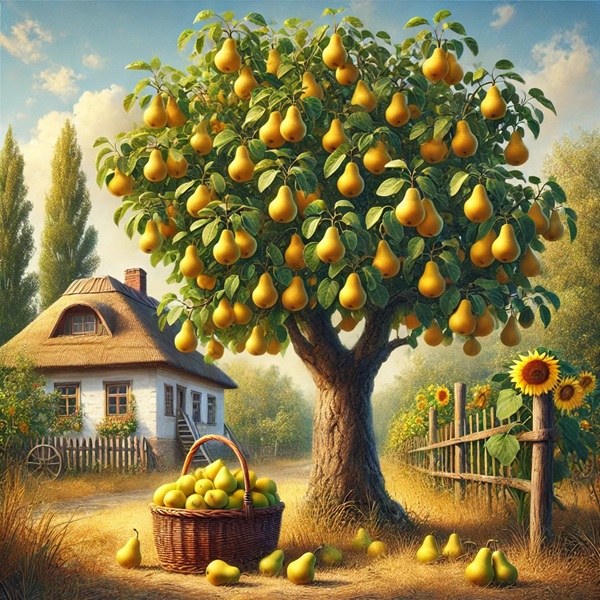
Pear (Pyrus communis) is one of the oldest fruit crops known to humanity since ancient times. It stands out not only for its high nutritional value, but also for its excellent taste qualities. In Ukraine, pear holds one of the leading places among fruit trees alongside apple, cherry, and plum. Thanks to its wide varietal diversity, pear can be successfully grown in almost all regions of the country — from Zakarpattia to Luhansk region, and from Chernihiv region to Kherson region.
Pear belongs to the rose family (Rosaceae) and is a deciduous fruit tree that, depending on the variety, may reach a height of 3 to 20 meters. Its crown is pyramidal or rounded, with dense or sparse branch arrangement. The leaves are oval, the flowers are white or slightly pink, gathered in inflorescences. Flowering takes place in spring (April–May), and the fruits ripen from July to October depending on the variety. The lifespan of the tree may reach 50 years or more, and some trees in old orchards continue bearing fruit for over a hundred years.
Pear fruits are rich in sugars, organic acids, vitamins (especially C, P, B1, and B2), tannins, and pectins. Due to their high fiber content and low caloric value, pears are recommended for dietary and children’s nutrition, as well as for kidney, heart, and gastrointestinal conditions. In addition, pears are an excellent product for processing: jams, compotes, dried slices, fruit leather, juices, and even cider.
Ukraine’s climate is generally favorable for pear cultivation, though certain difficulties do exist. Among the main ones are high sensitivity to spring frosts, drought in southern regions, and susceptibility to diseases such as scab, fire blight, and fruit rot. Still, with proper agricultural practices and careful variety selection, pear can provide stable yields both in private gardens and in commercial orchards. Cultivation is considered especially promising in the central and southern regions, where pears are less affected by fungal diseases compared with the humid northwestern areas.
Pear breeding in Ukraine has a rich history. Specialists from the Melitopol and Uman research institutes, as well as the Institute of Horticulture of the National Academy of Agrarian Sciences of Ukraine, have developed dozens of high-yielding varieties adapted to Ukrainian conditions. These varieties are disease-resistant, tolerate temperature fluctuations well, and have excellent taste characteristics. Thanks to modern technologies — intensive orchard establishment, the use of clonal rootstocks, drip irrigation, and mechanized pruning — pear is becoming an increasingly profitable crop not only for household growers but also for farmers.
Successful pear cultivation in Ukraine largely depends on the correct choice of variety and rootstock, as well as on proper site selection. Pear varieties are classified by ripening time (summer, autumn, winter), taste, keeping quality, fruit shape, resistance to disease, and frost hardiness. For each region of Ukraine, it is advisable to select varieties specifically adapted to its climate and soil conditions.
Among early summer varieties, Bergamot Litnii, Krasulia, and Chudesnytsia perform well. Autumn varieties include Conference, Red Williams, Autumn Dream, Talgar Beauty, and Forest Beauty. Winter varieties include Passe-Crassane, Victoria, Kyiv Winter, and Concorde. When establishing an orchard, it is advisable to use at least 2–3 varieties for cross-pollination, which significantly increases productivity. Trees on the site should be spaced at least 4–5 meters apart, and in commercial orchards planted according to a 4×6 or 5×5 meter layout.
The rootstock is of great importance. Seedling rootstocks (mostly wild pear or quince) produce vigorous trees that begin bearing fruit in the 5th to 7th year. Clonal rootstocks (for example quince C, A, MA) ensure earlier fruiting (in the 3rd to 4th year), smaller tree size, easier care, and the possibility of denser planting. However, quince as a rootstock is not always compatible with certain pear varieties — in such cases, an interstem graft is used.
The planting site must be well lit, without stagnant water, and with deep groundwater occurrence (at least 1.5 m). Pear does not tolerate waterlogged and heavy clay soils, although it can withstand slight salinity. Optimal soils are sandy loam and light loam, rich in humus, with a neutral or slightly acidic reaction (pH 5.5–6.5). If necessary, the soil is limed in autumn. It is also worth considering wind direction — young trees may be damaged by strong gusts, especially in spring.
Site preparation begins in advance: weeds are removed, organic fertilizers (well-rotted manure, compost), as well as phosphorus and potassium supplements, are applied. Planting pits are dug at least 70×70×70 cm, especially on heavy or poor soils. A drainage layer (crushed stone, sand) is placed at the bottom, followed by a fertile mixture of topsoil, humus, and wood ash. Seedlings are planted in spring (second half of March to early April) or autumn (late September to October), depending on the region.
After planting, the seedling is pruned to a height of 70–90 cm to stimulate the growth of side branches, tied to a stake, and the trunk circle is mulched with peat, straw, or humus. The root collar should be at ground level or slightly above it. Crown formation begins as early as the following year.
Pear is a crop that requires systematic and attentive care at all stages of vegetation. Successful cultivation is impossible without regular watering, fertilization, crown formation, and protection from frosts and pests. These measures are especially important during the first 3–5 years after planting, when the tree is still forming.
Watering is critical, especially in the southern and central regions of Ukraine, where summers may be dry. Young trees are watered 1–2 times a week with 10–15 liters per plant. The most important period is June–July, when the fruit set is forming. Mature trees are watered less often, but more abundantly — up to 30–40 liters under each tree. After watering, the soil should be loosened to prevent crust formation, and the trunk circle mulched with organic materials such as straw, peat, or sawdust.
Fertilizing begins in the second year after planting. In spring (April), nitrogen fertilizers (urea, ammonium nitrate) are applied to stimulate growth. During flowering and fruit set, complex fertilizers with phosphorus and potassium are used. In July–August, foliar feeding with micronutrients such as boron, magnesium, and zinc is advisable. Fertilizers are not applied in autumn so as not to provoke late-season growth. Excess nitrogen may cause excessive vegetative growth instead of flower bud formation.
Crown formation depends on the type of rootstock and the planting purpose. In home gardens, a sparse-tiered or vase-shaped form is popular; in commercial orchards, a spindle shape is more common. In the first years, it is important to establish a strong tree framework to ensure good lighting and crown ventilation. Every year in spring and autumn, sanitary pruning is carried out: dry, broken, and thickening shoots are removed.
Pear is very sensitive to spring frosts. This is especially important in the northern and eastern regions. For protection, smoke treatment, covering with agrofabric, and spraying with water before the onset of frost are used. It is also advisable to choose varieties with late flowering or increased frost resistance of flower buds.
Pear is vulnerable to many diseases and pests, especially in conditions of high humidity and dense planting. The most common diseases are scab, fruit rot (moniliosis), rust, fire blight, and cytosporosis. The main pests are pear codling moth, leaf rollers, aphids, gall midges, psyllids, pear moths, and scale insects.
Scab is a fungal disease that appears as dark spots on leaves, fruits, and shoots. In wet years, it may affect up to 80% of the crop. Preventive fungicide treatments (Horus, Skor, Topaz) are effective at the “green cone” and “pink bud” stages. After flowering, treatments are repeated every 10–14 days. It is important to remove fallen leaves and carry out pruning to improve crown ventilation.
Moniliosis (fruit rot) affects ripe fruits, causing them to rot. Infected fruits should be removed and burned. Effective fungicides include Switch, Teldor, and copper-based preparations. Rust appears as orange spots on leaves. Its development is encouraged by proximity to juniper, which is the intermediate host of the fungus. Control measures include fungicide spraying, removal of infected leaves, and pruning.
Fire blight (caused by Erwinia amylovora) is a very dangerous disease capable of destroying a tree in a single season. Symptoms include blackening of flowers, leaves, and shoots. Treatment is difficult: infected parts are removed, and the tree is treated with antibiotics (streptomycin) and copper-containing preparations. Planting material must be carefully verified.
Among pests, the pear codling moth causes the greatest damage, as its larvae injure the fruit. Protective agents include Confidor, Bi-58, Mospilan, and Engio. Pheromone traps and sticky bands are also effective. Against aphids, psyllids, and other sucking pests, Aktar, Apache, and treatments with infusions of garlic, ash, and soap are used. Treatments are carried out according to the pest’s development stages.
Pears ripen from July to October depending on the variety. Summer varieties are harvested at the stage of eating ripeness, as they do not keep for long. Autumn and winter varieties are harvested at the stage of removable ripeness (firm, fully formed), after which they ripen in storage. Timely harvesting is key to preserving flavor and keeping quality. Fruits are picked carefully, without damaging the skin or stem, and sorted immediately.
Pears are stored at a temperature of +0 to +2 °C and humidity of 85–90%. Autumn varieties keep for up to 2 months, winter ones for up to 6 months. It is important to avoid contact with damaged fruits, use ventilated boxes, and separate the fruit with paper or shavings. In commercial production, cold storage chambers with controlled atmosphere are used.
Pruning of mature trees is carried out in spring before sap flow begins (March–April). Excess, diseased, and dry branches are removed. Sanitary pruning is also possible in autumn. To rejuvenate old trees, the skeletal branches are shortened, stimulating the growth of young shoots. Regular pruning ensures crown illumination, improves fruit quality, and supports the overall health of the tree.
Preparation for winter includes whitewashing the trunk (with a lime solution plus copper sulfate), mulching the trunk circle (peat, straw, humus), and protection against rodents (with mesh, wrapping, or repellents). Young trees in northern regions should be covered with agrofabric or spruce branches.
Pear is one of the most valuable orchard crops in Ukraine. It produces high and stable yields, has excellent taste qualities, adapts well to the conditions of different regions, and is promising both for private gardening and for farming businesses.