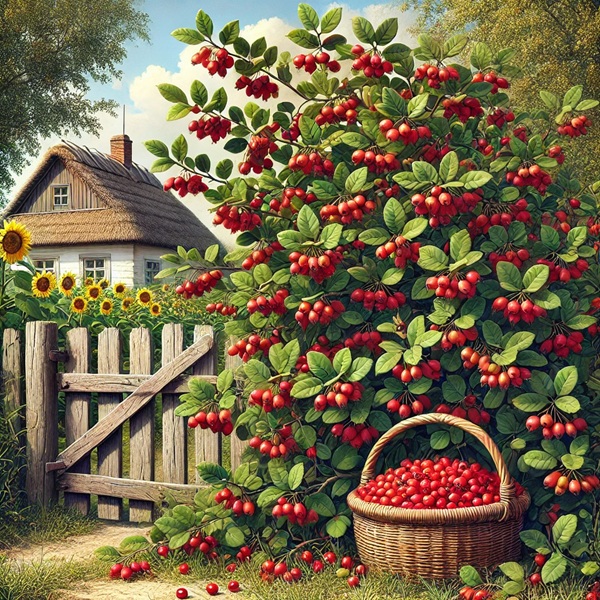
Dogwood (Cornus) is a versatile ornamental plant widely used in landscape design, horticulture, and greening projects. In nature, dogwood occurs throughout the temperate regions of Europe, Asia, and North America. In Ukraine, it is an autochthonous representative of the flora, especially in forest and forest-steppe zones. Thanks to its unpretentious nature, high ornamental appeal throughout the year, and ability to grow on various soil types, dogwood has become popular both among private homeowners and professional landscape designers.
The dogwood genus includes more than 50 species of shrubs and trees. In Ukraine, the most widespread are white dogwood (Cornus alba), stolon dogwood (Cornus stolonifera), blood-red dogwood (Cornus sanguinea), and Cornelian cherry, or male dogwood (Cornus mas). Each of these species has its own characteristics and can be used for different purposes, from ornamental plantings to fruit plantations.
The ornamental value of dogwood is especially evident in the ярке color of its shoots, leaves, and fruits. White dogwood and stolon dogwood decorate the garden in winter with their red or bright yellow shoots, in spring with white inflorescences, in summer with dense foliage, and in autumn with purple coloring and ornamental berries. Because of this, dogwood can serve as a hedge, border planting, specimen plant, or group planting. In addition, it recovers quickly after pruning, which makes it ideal for shaped hedges and geometric compositions.
A special place belongs to Cornelian cherry, or male dogwood (Cornus mas) — a fruit-bearing species that combines decorative qualities with high productivity. Its fruits are elongated drupes of dark red or yellow color, rich in vitamins C and P, organic acids, and pectins. They are eaten fresh, dried, and processed into preserves, fruit leather, compotes, and tinctures. Cornelian cherry is traditionally grown in the southern and central regions of Ukraine, where it is valued as a medicinal plant and an element of traditional cuisine.
Dogwood is resistant to air pollution, frost (withstanding temperatures down to –35 °C), and wind, and it can grow in partial shade, making it a valuable element for urban landscaping and home gardens. It establishes easily, grows quickly, and does not require complex care. With proper cultivation practices and a competent approach, dogwood can decorate a site for 30–50 years, while fruiting forms of Cornelian cherry can produce stable harvests for decades.
The choice of a suitable dogwood species and variety depends on the purpose of cultivation, the climatic characteristics of the region, and the site conditions. For ornamental purposes, white dogwood (Cornus alba) and its numerous cultivars are used most often: Elegantissima, Sibirica, Kesselringii, and Ivory Halo. These cultivars differ in leaf coloration (green with a white edge, variegated, dark burgundy) and in the intensity of shoot coloring during winter. For southern and dry regions, cultivars of stolon dogwood and blood-red dogwood are also suitable, as they are highly drought-tolerant.
If the goal is fruit production, Cornelian cherry (Cornus mas) is the best choice. The most widespread and proven cultivars in Ukraine are Semenivskyi, Yevhenii, Lukianivskyi, Coralovyi Marmelad, Volodymyrskyi, and Elegantnyi. These cultivars are distinguished by large and sweet fruits, resistance to diseases and frost, and good transportability. Many of them are recommended for cultivation in the southern, central, and partly eastern regions of Ukraine.
The planting site is selected depending on the species. For ornamental forms, it is better to choose sunny or partially shaded areas. In full sun, dogwood develops brighter foliage and shoot color and blooms and fruits more abundantly. In shade, growth slows and ornamental value decreases, although the plant continues to survive. Cornelian cherry requires well-lit places with southern or southwestern exposure, which promotes sugar accumulation in the fruits and faster ripening.
The soils may vary from loamy to sandy loam. The main thing is to avoid water stagnation. Excess moisture may lead to root rot. Optimal conditions are loose, fertile soil with a neutral or slightly acidic reaction (pH 5.5–7.0). Before planting, it is advisable to add organic matter (humus, compost), especially on poor or sandy soils. On heavy clays, it is desirable to create a drainage layer of sand or gravel.
Planting is carried out in spring (late March to early May) or in autumn (late September to mid-October). Planting pits are prepared in advance: 40×40×40 cm for ornamental forms and 60×60×60 cm for Cornelian cherry. A layer of compost or well-rotted manure mixed with fertile soil is added to the bottom. The seedling is placed vertically, and the root collar is not buried. After planting, it is watered abundantly (up to 10 liters of water per shrub) and mulched.
Dogwood is one of the most undemanding plants in Ukrainian gardens, but with proper care its ornamental value and productivity significantly increase, especially in the case of Cornelian cherry. The main care elements are watering, mulching, fertilizing, pruning, and disease prevention. During the first 1–2 years after planting, it is especially important to ensure good establishment and root system development.
Young shrubs are watered 1–2 times a week in dry weather. One mature shrub receives 10–15 liters of water, depending on the weather and soil type. Cornelian cherry is especially sensitive to moisture during flowering and fruit filling, while ornamental forms tolerate drought better. Mature dogwood can withstand short-term drying of the soil, but with chronic moisture deficiency it loses part of its foliage and ornamental appeal.
Mulching the trunk circle with organic materials such as straw, sawdust, or bark helps retain moisture, suppress weed growth, and improve soil structure. The mulch layer is renewed in spring and autumn. Periodic loosening of the soil around the shrub to a depth of up to 5 cm is also beneficial.
Fertilizing is not mandatory, but it promotes better growth and more intense coloration. In spring (March–April), nitrogen fertilizers such as ammonium nitrate or urea are applied; in June, complex fertilizers such as nitroammophoska; and in August, phosphorus-potassium fertilizers such as superphosphate and potassium sulfate. This is especially important for Cornelian cherry, as it improves shoot maturation and winter hardiness.
Pruning is a key element of care. In spring (March–April), sanitary pruning is carried out by removing diseased, broken, and dried branches. In summer, if necessary, light formative pruning can be done, especially when dogwood is used as a hedge. For ornamental forms (Cornus alba, Cornus stolonifera), complete rejuvenation can be carried out every 4–5 years by cutting the plant back to a height of 10–20 cm above the ground. This stimulates the growth of bright young shoots.
Dogwood generally has high resistance to diseases and pests, but under unfavorable conditions, with overcrowding or stagnant moisture, problems may arise. The most common diseases are septoria leaf spot, powdery mildew, anthracnose, bacterial leaf spots, and root rot.
Septoria appears as gray spots with a dark border on the leaves. Powdery mildew shows up as a white coating on leaves and young shoots. Fungicides such as Topaz, Skor, and Horus are effective for control. Anthracnose causes leaf deformation and weakens the shrub. Infected parts should be removed and the plant treated with fungicides.
Root rot occurs in areas with stagnant moisture, especially on heavy soils or where groundwater levels are high. Symptoms include wilting, weak growth, and darkening of the roots. Control measures include improving drainage, transplanting, and treatment with fungicides such as Previkur or Fundazol.
Among pests, aphids, scale insects, and spider mites sometimes occur. Aphids weaken young shoots, deform leaves, and may transmit viruses. Effective treatments include Aktara, Confidor, and the biological products Fitoverm and Biotlin. Mites are active in hot weather: light spots and leaf curling appear on the foliage. Protective treatments include Neoron and Actellic.
Prevention includes regular pruning, good ventilation, the absence of stagnant moisture, cleaning away fallen leaves, and using high-quality planting material. In autumn, spraying with copper-containing preparations is advisable.
Dogwood is easily propagated both vegetatively and by seed. The simplest method is layering: in spring, a lower shoot is bent to the ground, fixed, and covered with soil. After 2–3 months, it roots and can be separated. Green cuttings are taken in June–July and rooted in a moist substrate of sand and peat under film. In autumn, propagation by hardwood cuttings is also possible.
Seed propagation is more suitable for Cornelian cherry. The seeds require stratification for up to 6 months in moist sand at +3 to +5 °C. Sowing is done in spring. Fruiting begins in the 4th to 6th year.
In landscape design, dogwood is a multifunctional plant. It is planted as hedges, borders, accent shrubs on lawns, and near water features. It is especially decorative in winter thanks to its brightly colored shoots — red, yellow, or purple. Throughout the year it delights with flowering, foliage, and fruits. Cornelian cherry has additional value as a food and medicinal crop and is also used as a rootstock for some fruit plants.
Dogwood combines well with barberry, ninebark, hydrangeas, and hostas, and it can serve as a groundcover plant or an element for slope stabilization. It is also planted along paths, in mixed borders, and against the background of conifers.
Thus, dogwood is not only beautiful, but also extremely practical. It is hardy, long-lived, easy to care for, and versatile in use. And Cornelian cherry is also tasty, medicinal, and profitable to grow under Ukrainian conditions.