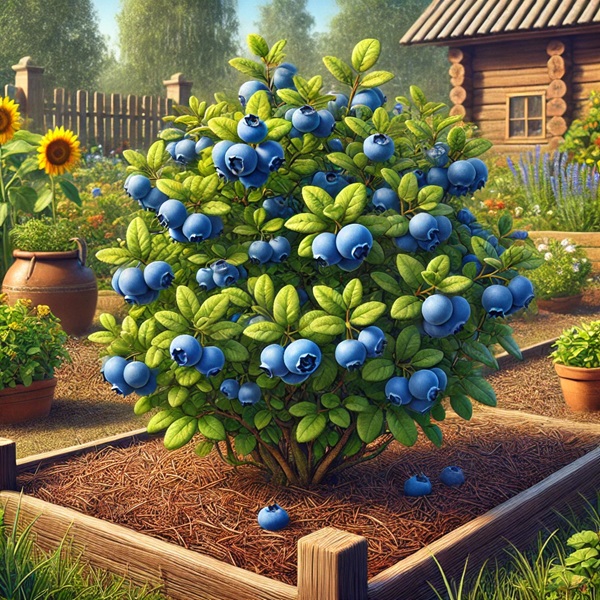
Blueberry is one of the most promising and popular berry crops in modern Ukrainian horticulture. It is valued for its high content of antioxidants, vitamins, organic acids, and pectins. Blueberry berries have a characteristic bluish-blue color, a sweet-and-sour taste, and versatile uses — they can be eaten fresh, processed into juices and jams, dried, or frozen. In addition to their taste qualities, blueberries have strong medicinal potential: they improve cardiovascular function, strengthen capillaries, support digestion, and are beneficial for eyesight.
From a botanical point of view, blueberry is a perennial shrub of the heath family (Ericaceae), genus Vaccinium. The most common species for cultivated production is highbush blueberry (Vaccinium corymbosum), which at maturity can reach 1.5–2 meters in height. There are also low-growing forms and hybrids, but highbush blueberry is considered the most suitable for both farm and household cultivation. Its advantages are high yield, disease resistance, and good fruit transportability.
In Ukraine, blueberry cultivation has been actively developing since the early 2000s. At first, the crop was considered suitable only for the northern and western regions (Polissia, Volyn, Lviv, and Rivne regions) because of the presence of acidic peat and sandy soils close to blueberry’s natural habitat. However, modern cultivation practices, particularly artificial soil acidification and moisture control, have made it possible to adapt the crop to almost all regions of Ukraine: from Zhytomyr and Chernihiv regions to Odesa, Kherson, and even the eastern regions.
When growing blueberries, it is important to understand that this is not just “another shrub” in the garden. The crop has specific requirements: acidic soil (pH 3.5–5.0), good drainage, protection from stagnant moisture, and a proper watering regime. In nature, blueberries grow in moist forest bogs with acidic, well-aerated soil, so when planting and caring for them, ordinary methods typical for currants or raspberries should not be used. Ignoring these features is the main reason beginners fail with this crop.
Thanks to its high profitability and strong market demand, blueberry has become not only a crop for home gardeners, but also an important part of agribusiness. In Ukraine, there are already large farms with blueberry plantations covering dozens of hectares. Even on private plots, however, provided proper cultivation practices are followed, one blueberry bush can produce up to 5–7 kg of berries annually for 20–30 years.
A key factor in successful blueberry cultivation in Ukraine is choosing the right variety. All blueberry varieties are divided into three groups by ripening time: early, mid-season, and late. This makes it possible to plan the harvest season efficiently and avoid overload within a short period. Among the early varieties, Duke, Patriot, and Spartan are popular; among the mid-season ones — Bluecrop, Toro, and Nelson; and among the late ones — Elliott, Aurora, and Darrow. Under Ukrainian conditions, Bluecrop and Chandler have performed especially well — they are adapted to a temperate climate, disease-resistant, and produce stable yields.
The variety should be adapted to the climatic conditions of the region, above all to winter frosts. Most blueberry varieties can withstand temperatures down to –25 °C, and even lower if covered. However, in areas with harsh winters, such as eastern Ukraine, mulching, wind protection, and covering the root zone with agrofabric are recommended. It is also important to consider the variety’s need for an acidic environment and its sensitivity to calcium content in water and in the substrate.
Choosing the planting site is very important. It should be a well-lit, well-ventilated area, preferably with a slight slope for drainage of excess water. Partial shade is acceptable, but insufficient light reduces yield and worsens the flavor of the berries. Places with a high groundwater level (less than 60 cm from the surface) and heavy clay soils without drainage are категорically unsuitable. In such cases, raised beds or planting in containers with an acidic substrate are essential.
Soil preparation is a critically important stage. The optimal mixture for blueberries consists of high-moor peat (pH 3.5–4.5), sand, conifer litter, pine bark, and agroperlite. When planting in the ground, pits 60–70 cm deep and wide should be dug, filled with an acidified mixture, and isolated from the surrounding soil, for example with geotextile or by planting in a box structure. Two to three weeks before planting, the soil must be acidified using colloidal sulfur, citric or malic acid, or special preparations.
Blueberry is a cross-pollinated crop. Although one bush can bear fruit, planting 2–3 different varieties nearby significantly increases both the quantity and quality of the berries. The distance between bushes should be 1–1.5 meters, with 2 meters between rows. This ensures good air circulation, access to light, and ease of care, especially if the plot is used commercially.
Blueberries require regular and attentive care throughout the growing season. One of the key factors is a proper watering regime. In natural conditions, blueberries grow in a moist environment, but stagnant water is destructive to their root system. It is therefore important to maintain constant soil moisture without overwatering. Young bushes are watered 2–3 times a week, mature ones 1–2 times depending on the weather and the structure of the substrate.
The most effective irrigation method is drip irrigation, which allows even moistening of the root zone without wetting the leaves excessively. This reduces the risk of fungal diseases. On hot days, especially in the southern regions, it is also useful to humidify the air around the plantings in the morning or evening hours. The use of sprinkler systems is less desirable, especially with hard or alkaline water.
Mulching is extremely important. It helps retain moisture, suppresses weed growth, stabilizes root temperature, and over time improves soil acidity. The best mulch materials are pine bark, conifer sawdust, conifer forest litter, or acidic peat. The mulch layer should be at least 7–10 cm thick and renewed every six months. At the same time, direct contact between the mulch and the stem should be avoided to prevent rot.
Blueberries should be fertilized carefully, since the plant is sensitive to excess nutrients, especially nitrogen and calcium. In spring, nitrogen fertilizers such as ammonium sulfate are applied; during budding and fruiting, phosphorus-potassium fertilizers such as superphosphate and potassium sulfate are used. Specialized fertilizers for ericaceous crops are also suitable, as they have an acidifying effect as well.
Foliar feeding with iron, magnesium, and boron chelates works well, especially in cases of chlorosis (yellowing of leaves). Manure, poultry litter, wood ash, or lime must not be used — they alkalize the soil and can cause serious harm. All cultivation measures should be accompanied by regular soil pH checks, preferably with a digital meter or laboratory analysis.
Despite its high resistance, blueberry can also be affected by diseases and pests, especially under improper cultivation practices and excessive moisture. The most common diseases are phytophthora root rot, gray mold, anthracnose, berry mummification, cane canker, and chlorosis. Their appearance is often caused by overwatering, poor bush ventilation, and lack of light.
Phytophthora appears as wilting of the upper part of the bush; the roots turn brown and become soft. Gray mold causes brown spots covered with a gray coating. Anthracnose affects leaves and fruits, causing dark spots with a purple border. Copper-containing preparations such as Bordeaux mixture, as well as systemic fungicides such as Horus, Previkur, Ridomil Gold, and Switch, are used for treatment. Prevention is the most effective measure.
Among blueberry pests, the most dangerous are aphids, leaf rollers, weevils, thrips, and spider mites. They damage leaves, flowers, and fruits, reducing yield. Effective treatments include systemic insecticides such as Aktara, Engio, and Bi-58, as well as biological products such as Fitoverm and Lepidocide. Regular inspection, removal of affected parts, tool disinfection, and proper spacing between bushes are essential measures.
It is recommended to plant disease-resistant varieties such as Bluecrop, Duke, and Patriot, carry out sanitary pruning on time, keep the site clean, and ensure good aeration of the plantings. This is especially important in commercial plantations, where overcrowding and high humidity lead to rapid spread of infections.
Pruning is a necessary procedure for maintaining the health and productivity of blueberry bushes. During the first 2–3 years, it is hardly performed at all — only weak or damaged shoots are removed. From the 3rd or 4th year onward, bush formation begins: 6–8 evenly spaced main shoots are left. Extra branches growing inward or thickening the crown are cut out. Annual growth is left intact, because future berries form on it.
Every year in spring or autumn, sanitary pruning is carried out — old, broken, diseased, and dry branches are removed. With age, after 7–8 years, rejuvenating pruning is performed: old branches are gradually cut out, leaving new replacement shoots. Proper pruning helps maintain high productivity for 20–30 years.
Blueberries are propagated mainly by green cuttings, layering, or division of the bush. In June, cuttings 10–15 cm long with 2–3 nodes are rooted in a moist peat-sand substrate under film. Layering is obtained by bending a lower shoot to the ground and covering it with soil. After a year, it can be separated. Seed propagation is used rarely, since it is slow and does not guarantee preservation of varietal traits.
In regions with severe winters, especially in the north and east, young plants are covered with agrofabric and mulched with a thick layer of peat or sawdust. In container culture, pots are moved to cool rooms. At the end of autumn, watering is reduced and nitrogen fertilization is stopped. During winter, snow should be monitored — excess snow may damage branches, so it should be shaken off carefully.
In spring, after the snow melts, the bushes are inspected, pruned, and the mulch layer is renewed. With proper care, blueberry becomes a long-lived, high-yielding, environmentally safe, and exceptionally valuable crop for Ukrainian gardens.