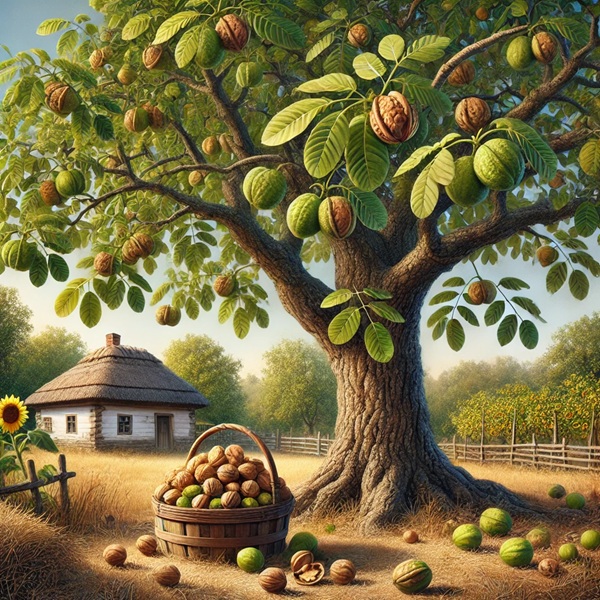
Walnut (Juglans regia) is not just a tree that produces tasty and nutritious fruits. It is a perennial tall-growing crop with great economic potential, distinguished by drought resistance, longevity, and versatility of use. Walnut is valued for its fruits — kernels with a high content of oil, proteins, and vitamins — as well as for its wood, which has high mechanical and decorative qualities. In Ukraine, walnut is a traditional crop, especially in the southern and central regions, where it is widely grown both in private gardens and in commercial plantations.
A walnut tree can reach 20–25 meters in height and have a spreading crown up to 15 meters in diameter. Its root system is strong and deep, which ensures drought resistance, although the plant is also sensitive to soil type. Fruiting begins in the 5th to 10th year, depending on the variety, planting material, and cultivation practices. Maximum productivity is observed in the 15th to 20th year, while the total productive lifespan may reach 100 years or more. One mature walnut tree can yield from 30 to 100 kg of fruit annually.
In Ukraine, walnut has deep historical roots. As early as the 19th century, it was actively cultivated in the Odesa, Vinnytsia, Khmelnytskyi, and Chernivtsi provinces. Modern research shows that Ukraine has great potential in this field: climatic conditions are suitable for cultivation almost throughout the entire country. The most favorable regions are considered to be Zakarpattia, the southern parts of Vinnytsia, Kirovohrad, Cherkasy, Mykolaiv, and Kherson regions, as well as parts of Dnipropetrovsk and Zaporizhzhia regions. At the same time, cultivation is also possible in the north, provided that frost-resistant varieties are selected and protection from spring frosts is ensured.
Walnut fruits have not only nutritional but also pharmaceutical value. The kernels are used in cooking, the oil-and-fat industry, and confectionery production. Walnut oil is valued as a dietary and medicinal product. The leaves, partitions, and husks are used in folk medicine for preparing decoctions and infusions with anti-inflammatory and antiseptic properties. In addition, walnut wood is one of the most expensive and valuable materials in furniture production.
In Ukraine, walnut can be grown both as an element of a mixed orchard and as the basis for establishing an intensive walnut orchard. In recent years, interest in commercial plantations has been steadily increasing, since the price of walnuts remains consistently high, demand on foreign markets is substantial, and the domestic market is still not saturated. All this makes walnut a promising crop both for small farms and for large agribusiness.
One of the key factors in successful walnut cultivation is choosing the right variety. It is this choice that determines the time of entering fruiting, productivity, frost resistance, disease resistance, fruit size and shape, as well as suitability for mechanized harvesting. In Ukraine, both local and foreign varieties are cultivated. Among the domestic ones, the best known are Bukovynskyi-1, Bukovynskyi-2, Carpathian, Urozhainyi, and Pishchanskyi. These varieties are well adapted to the Ukrainian climate, frost-resistant, and have stable productivity.
Foreign varieties, especially those of French and American breeding such as Chandler, Lara, and Franquette, produce larger and more marketable fruits, but they require a warmer climate and better-quality care. For commercial cultivation, varieties with a compact crown and upright growth are usually chosen, as this makes it possible to establish denser orchards with mechanized maintenance. At the same time, it is important to consider such characteristics as shell thickness, kernel percentage, and resistance to leaf spot diseases and bark canker.
Site selection is also a critical factor. Walnut is a light-loving crop, so it should be planted in open, well-lit areas without shade. The plant does not tolerate stagnant water, so areas with a high groundwater level (less than 1.5 m) should be drained, or seedlings should be planted on rootstocks resistant to excessive moisture. The tree grows best on light loams and sandy loam soils with a neutral or slightly alkaline reaction (pH 6.0–7.5).
Before planting, deep digging is carried out, perennial weeds are removed, and acidic soils are limed if necessary. Two to three months before planting, organic matter (well-rotted manure or compost), phosphorus-potassium fertilizers, and micronutrients are applied. Planting pits should be at least 60×60×60 cm and filled with a fertile mixture. The distance between trees should be 8–10 m within the row and 10–12 m between rows. This ensures good lighting, ventilation, and convenience for mechanized maintenance.
Planting is carried out in spring or autumn, depending on the region. In the north, spring planting is preferred; in the southern regions, autumn planting is more common. Seedlings are planted so that the root collar is 3–5 cm above soil level, taking settling into account. After planting, abundant watering and mulching of the trunk circle are carried out.
Although walnut is considered an undemanding and drought-resistant crop, in the first years after planting it requires increased attention. It is during this period that the root system, the skeletal part of the crown, and the overall structure of the tree are formed. The main care measures include timely watering, weed control, frost protection, formative pruning, and fertilizer application.
Watering is especially important during the first 3–5 years. Young trees do not tolerate prolonged drought, so they are watered 1–2 times a week with 15–20 liters of water per tree when there is no rain. The most important period is from late April to July. Mature trees are watered only during severe drought in order to prevent fruit cracking and yield reduction.
Keeping the trunk circle clean is essential for orchard health. Weeds take away moisture and nutrients, so they are removed manually or suppressed by mulching. Mulch such as straw, sawdust, humus, or leaves also helps retain moisture and improve soil structure.
Fertilizing begins in the second year. In spring, nitrogen fertilizers such as ammonium nitrate or urea are applied; in summer, complex fertilizers with phosphorus and potassium are used. In autumn, superphosphate or wood ash is added in moderate amounts. Excess fertilizer stimulates excessive vegetative growth at the expense of fruit formation. On poor soils, the application of boron, magnesium, and zinc is advisable.
Walnut is sensitive to late spring frosts, especially in the northern regions. Damage to young shoots can seriously reduce the yield. Protection involves smoke treatment, covering with film, or irrigation before frosts. Forming the tree during the first 4–5 years helps create a strong framework and prevents branch breakage in the future.
Walnut has natural resistance to many diseases, but under intensive cultivation and high humidity, infections may occur. The most common diseases are bacterial blight (bacteriosis), Marssonina leaf blotch, anthracnose, root rot, and bark canker. Among pests, walnut codling moth, mites, aphids, scale insects, and rodents may cause damage.
Bacteriosis appears as black spots on leaves, shoots, and fruits. It becomes active in cool and rainy weather. Control measures include spraying with Bordeaux mixture or Kuproksat, and cutting out and burning the affected parts. Marssonina causes brown spots and leaf drop. Fungicides such as Horus, Topsin-M, and Skor are used. Prevention includes removing fallen leaves, loosening the soil, and following crop rotation practices.
Among pests, the walnut codling moth is the most dangerous — its caterpillars damage still-green fruits, making them unsuitable for harvesting. It is controlled with insecticides such as Confidor and Decis, as well as pheromone traps. Mites cause leaf curling and the appearance of fine webbing, and are controlled with products such as Actellic and Neoron. Against aphids and scale insects, systemic preparations such as Aktara and Engio are effective.
Rodents such as hares and mice may gnaw the bark of young trees in winter. Trees are protected by whitewashing, wrapping the trunks with mesh or agrofabric, and using natural repellents such as tar water, garlic infusion, or ash. Mechanical traps or baits may also be placed in the orchard.
Regular inspection of the trees, sanitary pruning, removal of fallen leaves, and control of moisture are the best prevention against diseases. In commercial orchards, phytosanitary monitoring and, if necessary, laboratory testing for infections should be carried out.
Walnut begins bearing fruit in the 5th to 7th year, with grafted forms doing so earlier, and produces a full crop from the 10th to 12th year. The fruits ripen from late August to early October, depending on the variety. The main sign of ripeness is the cracking of the green husk and the falling of the fruits to the ground. Harvesting is carried out manually or mechanically; in commercial orchards, vibration systems are used.
After harvest, the nuts are cleaned of the green husk, washed, and dried in the shade at a temperature of +25 to +30 °C until a moisture content of 8–10% is reached. They are stored in a ventilated room at temperatures up to +10 °C in mesh bags or containers. Under such conditions, the kernels retain their quality for 12 months or more.
Pruning walnut is an important practice, especially when the tree is young. Formative pruning begins in the first year, leaving one strong leader and 3–4 lateral branches. Then a strong framework of the tree is developed, the height is regulated, and excess, weak, diseased, or overcrowding shoots are removed. Mature trees require annual sanitary pruning in spring before sap flow begins.
Preparation for winter includes mulching the trunk circle, whitewashing the trunk, and protecting young trees with agrofabric or mesh. In the southern regions, trees may overwinter without additional cover, but in the central and northern regions, especially for young or grafted seedlings, insulation is recommended.
Proper care of a walnut orchard makes it possible to obtain stable harvests for decades. Walnut is a long-term investment that provides not only a tasty and healthy product, but also profit, especially under conditions of growing demand on both the domestic and foreign markets.