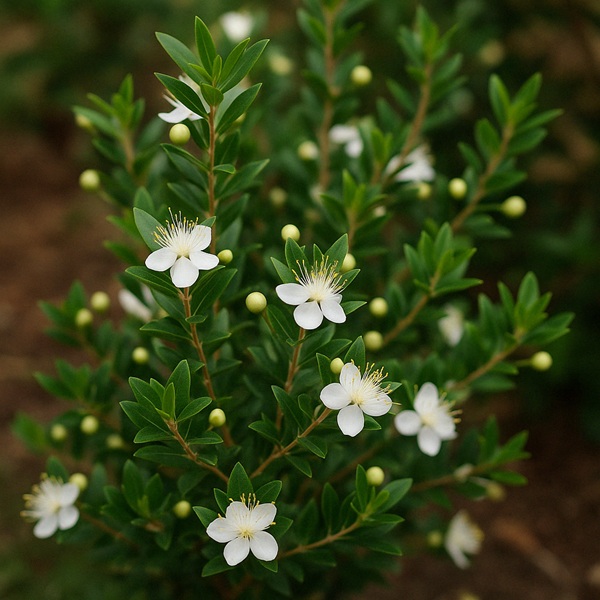
Common myrtle (Myrtus communis) is an evergreen ornamental shrub known since ancient times for its unique properties. It belongs to the Myrtle family and originates from the Mediterranean, where it grows naturally in the wild. Myrtle is a symbol of purity, love, and longevity; it is often mentioned in myths and rituals and is also used in cosmetology and medicine. In Ukraine, myrtle is mostly known as a houseplant, but with proper care it can also be successfully grown outdoors in the southern regions or as a container plant that is moved into the garden for the summer and overwintered indoors.
Myrtle forms a compact shrub ranging from 50 cm to 2 m in height, with dense shoots and small, glossy, aromatic leaves. During the flowering period, usually from June to August, the shrub becomes covered with small white or cream-colored flowers with long stamens that give it a soft, fluffy appearance. The flowers have a delicate fragrance, and after they fade, blue berries form that are suitable for processing. The leaves contain essential oils, which is why myrtle has antiseptic and bactericidal properties. In addition to its ornamental and medicinal value, myrtle is appreciated as a phytoncidal plant that purifies indoor air.
In Ukraine, especially in the south, such as Odesa, Mykolaiv, and Kherson regions, myrtle can be grown outdoors as a seasonal or semi-hardy shrub. However, it is most often cultivated as a tub plant: in summer it thrives on balconies, terraces, and in winter gardens, and for the winter it is moved to cool indoor spaces. In indoor culture, myrtle requires a special balance of light, humidity, and regular care, but in return it offers abundant flowering, an elegant shape, and a pleasant fragrance. It can be trained into a shrub, a small tree, or even a bonsai, which is especially popular among collectors.
When choosing a myrtle variety, it is important to consider the purpose of cultivation and the growing conditions. The most common type is common myrtle (Myrtus communis), valued for its resilience, attractive form, and long flowering period. There are also ornamental forms, including dwarf types, variegated-leaf varieties, and double-flowered selections. Compact, slow-growing varieties are well suited for indoor cultivation. In southern Ukraine, where myrtle is kept outdoors in large containers, it is practical to choose vigorous forms that develop into dense shrubs and flower abundantly.
Myrtle needs good lighting but does not tolerate direct midday sun, especially indoors. In the garden, it is best placed in partial shade on the eastern or western side to prevent the leaves from overheating. Indoors, the best option is a south-facing window with light shading or an eastern exposure. In winter, the plant should receive as much light as possible; if natural light is insufficient, grow lights are used. The optimal temperature in summer is +18 to +25°C, and in winter +5 to +10°C. A dormant period with lower temperatures and limited watering is important for the formation of flower buds.
Air humidity also plays an important role: myrtle does not tolerate dry air, especially during the heating season. In an apartment, the plant should be sprayed regularly, placed on trays with moist expanded clay, or supported with humidifiers. Outdoors, myrtle feels better, as natural air circulation and morning dew create a favorable microclimate. During summer, it is advisable to move the plant to a balcony or garden, gradually acclimating it to outdoor conditions. Myrtle loves fresh air but does not tolerate drafts or sudden temperature fluctuations.
Myrtle grows best in a loose, water- and air-permeable substrate. The ideal soil mix consists of turf soil, leaf mold, peat, and sand in a 2:1:1:1 ratio. When growing in containers, a drainage layer of 3–5 cm of expanded clay or gravel at the bottom of the pot is essential. Myrtle prefers a slightly acidic to neutral medium with a pH of 5.5–6.5, so it is advisable to check the acidity before planting and adjust it if necessary. When planting, the root collar should not be buried and must remain at soil level.
Planting or repotting is carried out in spring, in March or April, before active vegetation begins. Young plants are repotted annually, while mature ones are repotted once every 2–3 years as needed. Repotting is done by the transshipment method, trying not to disturb the root ball. The pot should be chosen only slightly larger than the previous one, about 2–3 cm wider, because too much extra space slows root development and delays flowering. After repotting, the plant is watered generously and shaded from bright light for several days.
When growing outdoors in the southern regions, the planting hole is prepared in advance, 1–2 weeks before planting. Drainage is placed at the bottom, topped with a nutritious soil mix that is compacted and moistened. The seedling is placed vertically, covered with soil, lightly firmed, and watered well. The root zone is mulched with peat, bark, or pine needles to preserve moisture and protect the roots from overheating. During the first weeks after planting, it is especially important to monitor soil moisture, particularly in sunny weather.
Caring for myrtle requires consistency and a systematic approach, especially when it is grown indoors or in tubs. Watering is one of the most important aspects, as the plant is sensitive both to drying out and to excess moisture. In spring and summer, myrtle is watered generously as soon as the top 1–2 cm of soil dries out. Soft, settled water at room temperature is used. Hard water may cause leaf chlorosis. In winter, watering is greatly reduced, approximately once every 7–10 days, especially if the temperature is lower.
Feeding is carried out from spring to autumn once every two weeks. Complex mineral fertilizers for decorative foliage or flowering plants are used. In spring, preference is given to fertilizers with a higher nitrogen content, which stimulate green growth. In summer, especially during flowering, phosphorus-potassium formulas are used to encourage bud formation and strengthen the plant’s immunity. In autumn, fertilizers are not applied so as not to interfere with the dormant period. Outdoors, humus, compost, and wood ash can additionally be added around the root zone.
Crown shaping is an essential part of care, especially in container culture. Myrtle tolerates pruning well and can be shaped into various forms: a ball, a pyramid, a standard tree, or even a bonsai. Formative pruning is carried out in spring before active growth begins, removing weak, crowded, or badly directed shoots. In summer, young shoots are pinched to increase branching. Faded flowers are also removed after blooming. Myrtle responds well to pruning, but excessive cutting can weaken it, so it is important to maintain a balance between decorative form and the plant’s natural shape.
Under favorable conditions, myrtle blooms in its second or third year after planting, provided that pruning is done correctly and the winter rest regime is maintained. Flowering takes place in summer, from June to August, and sometimes lasts until September. The flowers are fragrant, with long stamens, white or cream-colored, and positioned in the leaf axils. Indoors, flowering may be less abundant because of insufficient light or an overly warm winter. If the plant spends winter in cool conditions, around +8°C, with moderate watering, this stimulates the formation of flower buds.
After flowering, dark blue berries may form, especially if the myrtle is grown outdoors or has been hand-pollinated. The fruits are conditionally edible and are used in folk medicine and aromatherapy. Cross-pollination is important for fruiting, and indoors this can be done with a small brush. The fruits ripen in autumn, after which they can be collected either for sowing or as decorative material.
Myrtle is propagated by seed or by cuttings. Seeds are sown in February or March in a loose substrate of peat and sand, covered with glass or film, and kept at a temperature of +20 to +24°C. Seedlings usually appear in 2–4 weeks. After 2–3 true leaves form, the seedlings are pricked out. However, the seed method takes longer, and plants flower only in the third to fifth year. A faster method is propagation by cuttings. Semi-woody cuttings 7–10 cm long are taken in summer or at the end of winter, treated with a rooting stimulant, and rooted in moist substrate or water. After 4–6 weeks, the rooted plants are transferred to pots.
One of the most important stages in caring for myrtle in Ukraine’s climate is proper wintering. Since myrtle is a heat-loving plant, it can overwinter outdoors only in the warmest southern regions of Ukraine and only with mild winters and reliable protection. Most often, myrtle is wintered indoors, and the way this period is managed determines the plant’s condition and its ability to flower. The ideal winter temperature is +5 to +10°C, with good lighting and minimal watering. If the temperature remains at room level, the plant should be given as much light as possible and high air humidity.
Before wintering, the plant is inspected, dry and excess shoots are pruned, and watering is reduced. No fertilizers are applied in late autumn. In winter, it is important to avoid drafts and sudden temperature changes. Monitoring air humidity in heated rooms is essential, otherwise the leaves may fall. In spring, starting in March, watering is gradually increased, the plant is moved to warmer conditions, and repotting is carried out if necessary.
Myrtle is resistant to most pests and diseases, but in a dry and hot room it may be affected by spider mites, aphids, and scale insects. Signs include curled leaves, sticky secretions, and a white coating. Control methods include washing with soapy water and treatment with biological products such as Fitoverm or Actellik. Among diseases, fungal infections such as gray mold and powdery mildew sometimes occur, mainly under overwatered conditions. Prevention includes moderate watering, ventilation, and cleanliness of the pot and tools. Regular inspection and timely action will help keep myrtle healthy and attractive for many years.