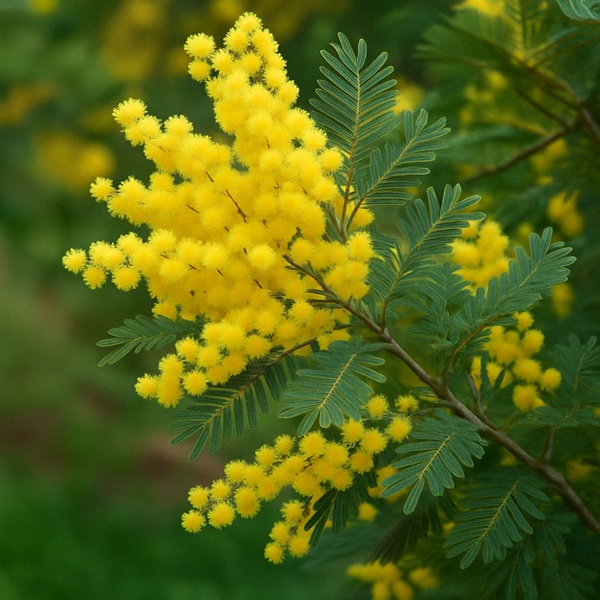
Mimosa is a general name used for several plant species belonging to different botanical genera. However, in ornamental horticulture this name most often refers to two plants: sensitive plant (Mimosa pudica) and silver wattle (Acacia dealbata), which is also mistakenly called mimosa, especially in the context of March 8. Both plants have ornamental value, but they require different growing conditions. In Ukraine, with its temperate continental climate and cool winters, the most realistic option is to grow sensitive plant as a houseplant or annual, while silver wattle can be grown in the southern regions or in protected cultivation.
Sensitive plant is a compact herbaceous perennial that is more often grown as an annual. Its main feature is the ability of its leaves to fold when touched, as well as its delicate fluffy pink-violet flowers gathered in spherical inflorescences. Silver wattle, by contrast, is a fast-growing tree with airy silvery foliage and fragrant yellow inflorescences made up of many tiny flowers. It is used as an ornamental tree in parks and botanical gardens in southern Ukraine, particularly in Odesa and Crimea, provided suitable winter protection or special overwintering conditions are ensured.
Given the sensitivity of these plants to cold, in most regions of Ukraine mimosa is grown either as an indoor crop, as an annual, or by using greenhouse methods. It is especially important to take into account the plant’s requirements for lighting, air humidity, and temperature. Both species need plenty of light, although direct midday sun may cause leaf scorch. Ideally, the plants should be placed on eastern or southern windows, protected from direct rays. The optimal temperature for sensitive plant is no lower than +18 to +22°C, while silver wattle can tolerate short drops to –5°C only with protection. In Ukraine, this limits its open-ground cultivation to the southern regions only.
The most realistic way to grow mimosa in Ukraine is to cultivate sensitive plant as an ornamental houseplant or as an annual for balconies, terraces, and containers. It is grown from seed, which germinates easily under favorable conditions. Mimosa seeds have a dense seed coat, so before sowing they are recommended to be scarified — lightly filed or scalded with hot water (+60°C), then soaked for 12–24 hours. This promotes uniform seedlings and speeds up germination.
Sowing is carried out in March to early April. The seeds are sown in shallow containers with a loose, light substrate based on peat, sand, and humus in a 1:1:1 ratio. The sowing depth should be no more than 1 cm. The crops are moistened and covered with glass or film to create a greenhouse effect. The optimal germination temperature is +22 to +26°C. Seedlings appear on the 5th to 10th day. After 2–3 true leaves appear, the seedlings are pricked out and transplanted into separate pots 8–10 cm in diameter. It is extremely important not to damage the roots, as mimosa tolerates transplanting poorly.
Care for sensitive plant consists of regular watering, loosening the soil, providing good light, and protecting it from drafts. Watering should be moderate — both drying out and overwatering are harmful. In summer, the plant is fed with complex fertilizers for ornamental foliage plants once every two weeks. When grown on a balcony or in the garden, it is advisable to protect it from strong wind and rain, since its thin stems break easily. In autumn, when the temperature drops below +15°C, the plant is either brought indoors or replaced with a new one grown from seed the following season. With proper care, mimosa blooms from June to September, and its sensitive foliage becomes a real highlight for both adults and children.
Silver wattle is a beautifully flowering tree native to Australia, introduced to Europe in the nineteenth century. In Ukraine, it is most often called mimosa and is grown as an ornamental plant on the southern coast, in the southern districts of Odesa region, in Mykolaiv region, and partly in Kherson region. Where winters are mild, the tree can overwinter without cover, although during prolonged frosts below –10°C it freezes out. In other regions, it can only be grown in tubs, taken outside in summer and overwintered indoors. Despite climatic limitations, silver wattle grows quickly, begins flowering as early as the second or third year after planting, and with proper care becomes a true ornament of the site.
Silver wattle is mainly propagated by seed. As with sensitive plant, the seeds need to be scarified — lightly nicked or poured over with hot water. Sowing is carried out in February to March, and germination lasts 10–14 days at a temperature of +20 to +24°C. The seedlings develop quickly, and by May they can be planted in open ground or large containers. Silver wattle prefers sunny places and light sandy loam or loamy soils with a neutral reaction. Stagnant moisture must be avoided, since excess water causes root rot. Watering should be moderate, more abundant in hot weather, but the topsoil should be allowed to dry between waterings.
For container growing, large pots with a volume of at least 10 liters are chosen. A drainage layer must be placed at the bottom — expanded clay, gravel, or coarse sand. In summer, silver wattle grows actively and needs frequent watering and feeding. Fertilizers with a higher potassium and phosphorus content are used to stimulate flowering. In September, watering is gradually reduced in preparation for winter dormancy. For winter, the pots are moved to a bright, cool room with a temperature of +5 to +10°C, and watering becomes infrequent, only enough to preserve some moisture in the soil. In spring, the plant is pruned to form a compact crown and stimulate new flowering.
Caring for mimosa, regardless of the species — sensitive plant or silver wattle — requires following the basic rules of cultivation. Despite their delicate appearance, these plants are quite hardy when given proper watering, regular feeding, shaping, and protection from unfavorable conditions. In Ukraine, these requirements become especially important because of frequent weather fluctuations in spring and summer.
Watering should be moderate but regular. Young plants are especially sensitive to drying out, so during the first weeks after planting the soil should be kept evenly moist. In hot weather, watering is done every other day; in cooler weather, once or twice a week. Silver wattle tolerates drought better, but during active growth and flowering it also requires enough moisture. It is important to avoid stagnant water, especially in containers, in order to prevent root rot.
Feeding is carried out at different stages of development. In spring and the first half of summer, nitrogen-containing fertilizers are desirable to stimulate leaf growth. Before flowering, phosphorus-potassium complexes are used, as they promote abundant bud formation and strengthen the plant. Mimosa is fed every 2–3 weeks. This is especially important for potted plants, since the soil volume there is limited. After flowering, feeding is stopped. Crown formation includes pinching the tops of sensitive plant and spring pruning of silver wattle, which stimulates branching and preserves its decorative shape.
Mimosa, like most ornamental crops, may suffer from diseases and pest attacks, especially when growing conditions are not respected. The most common problems are fungal infections — root rot, leaf spot, and gray mold — which arise from excess moisture and insufficient ventilation. Prevention consists of controlling humidity, avoiding water stagnation, and airing the plants regularly. At the first signs of infection, fungicides are used.
Among pests, the greatest threat comes from spider mites, aphids, and scale insects. Spider mites most often appear in warm, dry conditions, especially indoors in winter. Their presence is indicated by fine webbing on the underside of the leaves and yellowing foliage. Aphids settle on young shoots, sucking out the sap and suppressing growth. In cases of minor infestation, soap solution and infusions of garlic or onion can help. In more serious cases, biological preparations are used. Scale insects are removed mechanically by wiping the stems with a cotton pad moistened with alcohol or soapy water.
Regular inspection of the plants, proper spacing, ventilation of indoor spaces, and reduced humidity help prevent problems. In autumn, after the growing season ends, it is advisable to carry out preventive treatment against diseases and pests, especially if the plant will overwinter indoors. In open ground, mulching and wind protection are important, as they increase the plant’s resistance to external stress.
The winter period is a critical stage in growing mimosa under Ukrainian conditions. Both forms — sensitive plant and silver wattle — are sensitive to cold, so proper overwintering is essential. Sensitive plant is usually grown as an annual, but if desired, it can be kept through winter indoors, extending its life cycle.
Silver wattle requires a more careful approach. In the southern regions of Ukraine, where winter temperatures rarely fall below –5 to –7°C, it can be left in the ground, covered with a thick layer of mulch, spruce branches, or agrofibre. In other regions, it is grown in containers that are moved in autumn to warm, bright rooms with temperatures of +5 to +10°C. Watering is reduced to once every 2–3 weeks — only enough to keep the root ball from drying out completely. A complete pause in growth is actually beneficial, since the plant accumulates strength for spring awakening.
In spring, mimosa is gradually accustomed to the sun, watering is increased, and pruning is carried out. It is important to slowly increase the time spent in fresh air, from 2–3 hours to a full day, especially before moving it to its permanent place. The first feeding is given 2 weeks after the beginning of vegetation. With proper care, silver wattle can live 20 years or more, each year producing lush, fragrant flowering as early as February–March — a true symbol of spring, warmth, and joy.