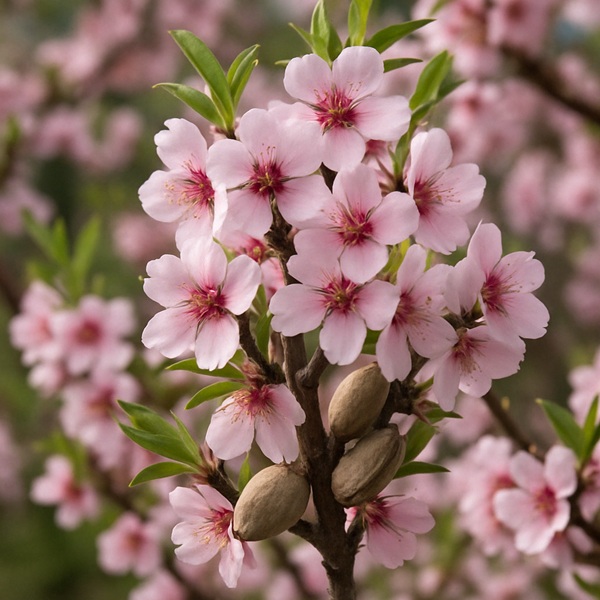
Almond is not only a tasty nut, but also a beautiful ornamental tree that decorates the spring garden with its early flowering. In botany, almond (Prunus dulcis) belongs to the plum genus and is actually a stone fruit crop rather than a true nut. The homeland of almond is Central Asia and the Middle East, but thanks to breeding it is successfully grown in many regions of the world, including the southern and partly central regions of Ukraine. In Ukrainian conditions, almond can serve not only as a source of nutritious fruits, but also as an element of landscape design — thanks to its abundant flowering already in March–April, even before the leaves appear.
Ukraine’s climate is moderately continental, with cold winters and hot summers, which makes it possible to grow almond provided the right variety and planting site are chosen. The most favorable regions are Zakarpattia, the southern parts of Odesa, Mykolaiv, Kherson, and partly Dnipropetrovsk regions, as well as southern slopes in Vinnytsia and Cherkasy regions. For successful cultivation, the plant must be given maximum sunlight, protection from northern winds, and the risk of winter freezing should be minimized. Almond is especially sensitive to spring frosts, which can damage the flowers. Therefore, it is worth choosing protected places — near buildings or with natural relief protection.
Almond is a light-loving, drought-tolerant crop that prefers loose, well-drained, neutral, or slightly alkaline soils. It grows poorly in heavy clay and acidic soils, and it also does not tolerate stagnant water, which leads to root rot. The ideal option is sandy or light loamy soil with the addition of lime and organic matter. In autumn before planting, it is advisable to dig over the plot, add compost or humus (up to 5 kg per m²), as well as ash or dolomite flour if the soil is acidic. At the same time, a planting hole 50–60 cm deep and 60–70 cm wide is prepared — this is especially important on low-fertility soils.
Choosing a variety is one of the key steps when establishing an almond orchard or planting a single tree. Modern breeding offers both bitter and sweet varieties that differ in flowering time, crown shape, and disease resistance. In Ukraine, such varieties as ‘Nikitsky 62,’ ‘Aivazovsky,’ ‘Primorsky,’ and ‘Dessertny’ have become the most widespread, as they have increased frost resistance and good productivity. These varieties tolerate winter well in the southern and central regions of the country, especially when protection is provided. It should be remembered that most almond varieties are self-sterile, so to obtain a crop it is necessary to plant 2–3 varieties for cross-pollination.
Planting material can be purchased in the form of one- or two-year-old saplings with either an open or closed root system. When choosing, attention should be paid to origin — it is better to give preference to nurseries that specialize in southern crops and offer varieties adapted to Ukraine’s climate. Before planting, it is advisable to soak the roots in water with the addition of growth stimulants for 4–6 hours. If the root system is open, damaged or overly long roots are trimmed. The root collar should remain at soil level when planting.
The optimal time for planting almond is autumn, from late September to early October, or early spring, from March to the first half of April, when the soil has already warmed up but still retains moisture. In autumn, planting is done mainly in southern Ukraine, where the plant has time to establish itself before frost. In the central and northern regions, spring planting is preferable to avoid freezing. The planting pattern is at least 3–4 meters between trees, since almond forms a wide, spreading crown. After planting, the sapling is watered, the trunk circle is mulched, and a support is installed to protect it from wind and promote even growth.
Almond is a crop that requires attention to cultivation practices, especially in the first 2–3 years after planting. During this period, the root system develops, the crown forms, and the potential for future fruiting is established. Watering is especially important during the first summer: the soil is moistened 1–2 times a week depending on the weather. A mature tree is drought-tolerant, but for a stable harvest it is advisable to organize drip irrigation. Excess moisture is also harmful — stagnant water causes root rot and fungal diseases.
The first feedings are applied already in the first year. In spring, at the beginning of sap flow, nitrogen fertilizers are used — urea or ammonium nitrate (30–50 g/m²), which stimulate the growth of leaves and shoots. During budding and flowering, phosphorus-potassium feedings are used, which promote ovary formation. In autumn, after harvesting, it is useful to add compost or humus. It is also advisable to lime the soil once every 3–4 years to maintain a slightly alkaline reaction — especially in Ukraine’s conditions, where soils tend to acidify under prolonged use of nitrogen fertilizers.
Crown formation is an essential part of care. A sparse-tiered or vase-shaped form is used. Pruning is carried out in early spring before sap flow begins: dry, damaged, crossing, and thickening branches are removed. In the first years, 3–4 strong skeletal shoots are left. In summer, sanitary pruning is possible if diseases or pests are found. Almond responds well to pruning — it stimulates rejuvenation and active fruiting. Annual thinning ensures ventilation and lighting inside the crown.
Almond is one of the earliest flowering crops among fruit trees. In Ukraine, its flowering begins as early as March or early April, depending on the region and the weather. This early flowering is exactly what makes it especially vulnerable to return frosts, which may destroy the flowers before the ovary forms. The greatest risk is observed in the central and northern regions. To protect from cold, agrofibre or temporary covers can be used. It is advisable to plant almond on slopes and avoid lowlands where cold air accumulates.
Since most almond varieties are self-sterile, obtaining a harvest requires the presence of several pollinating varieties that bloom at the same time. The distance between trees should be no more than 10–15 m in order to ensure effective cross-pollination by bees and other insects. To attract pollinators, it is important to avoid using insecticides during flowering. If possible, place an apiary nearby or at least several beehives. Recently, self-fertile varieties have been gaining popularity, but even they show better productivity when another variety is planted nearby.
The fruits develop from successfully pollinated flowers and ripen by August–September. They have a hull, a hard shell, and an edible kernel. As they ripen, the outer covering cracks open and reveals the nut. The crop is harvested by hand or by shaking the fruits onto fabric. A mature tree can yield from 5 to 15 kg of kernels per season. After harvesting, the fruits are cleaned, dried in the shade, and stored in a dry, cool room.
Almond, like all stone fruit crops, is sensitive to diseases and pests. The most common fungal infections are moniliosis (gray rot), leaf curl, scab, cytosporosis, and shot hole disease. They are provoked by high humidity and insufficient crown ventilation. Moniliosis is recognized by wilted flowers and shoots that look scorched. For prevention, in spring, before bud break, trees should be treated with copper-based products: Bordeaux mixture, copper oxychloride, or fungicides such as Horus or Skor.
Leaf curl appears as swellings and reddish spots on young leaves. The affected parts should be pruned and burned, and the tree treated with fungicides such as Topaz, Ridomil Gold, or Cuproxat. Scab and shot hole disease lead to deformation and dropping of fruits and leaves. Protection requires sanitary pruning, removal of fallen leaves, and regular preventive treatments.
Among pests, aphids, codling moth, weevil, and mites pose a particular danger. Aphids spread quickly over young shoots, sucking out the sap. With light infestation, a soap solution or garlic and tobacco infusions can help. In cases of severe damage, biological or chemical preparations are used. Against codling moth, pheromone traps, treatment with biological products, and collection of fallen fruits are effective. It is important to follow the treatment schedule, alternate products, and take into account the waiting period before harvest.
Although almond is resistant to drought and heat, it does not tolerate severe frosts well, especially under conditions of sharp temperature fluctuations or early thaws. Young trees up to 3 years old require mandatory winter protection. The trunk circle is mulched with a thick layer (10–15 cm) of sawdust, compost, or dry leaves. The trunk is wrapped with burlap or another breathable material. In regions where frosts fall below –15°C, it is advisable to cover the crown as well — especially in the case of ornamental or heat-loving varieties.
With age, almond’s frost resistance increases, and mature trees are able to withstand –20 to –25°C without significant damage. However, spring return frosts remain a threat even to mature plants. To minimize risks, smoke protection, temporary agrofibre covers, or heat-retaining screens can be used. It is also undesirable to apply nitrogen fertilizers in autumn — this stimulates the growth of young shoots that do not have time to mature before frost.
With proper care, almond lives and bears fruit for 25–30 years, and with high-quality pruning and protection from diseases, up to 40 years. It gives not only nutritious fruits, but also decorates the garden in spring with its abundant flowering. Thanks to its versatility, almond can be grown both in ornamental compositions and in fruit plantings. This crop adapts well to Ukrainian conditions and can become a true gem of your garden.