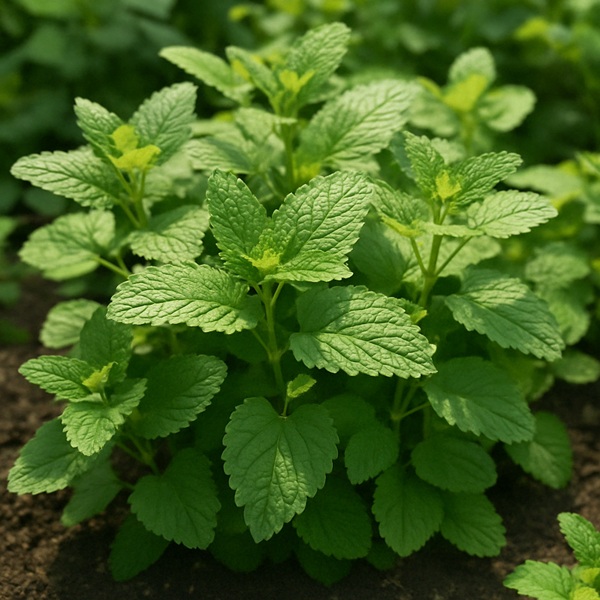
Lemon balm, or balm mint (Melissa officinalis), is a perennial herbaceous plant of the mint family that has long been known for its medicinal, culinary, and ornamental properties. It is distinguished by a pleasant lemon fragrance rich in essential oils, which makes lemon balm a popular plant both in medicinal herb gardens and in decorative flower beds. Thanks to its hardiness and high resistance to climatic changes, lemon balm is successfully grown in all regions of Ukraine — from Zakarpattia to Luhansk region — both in open ground and in containers or on balconies.
The plant forms a bush up to 70–90 cm tall with numerous branched shoots and oval serrated leaves covered with fine hairs. Flowering takes place from June to August; the flowers are small, white or pale violet, gathered in whorls, and attract bees, which makes lemon balm an excellent honey plant. The essential oils contained in the leaves have calming, antispasmodic, and anti-inflammatory effects. Infusions and decoctions of lemon balm are used in folk and official medicine, cosmetology, and even cooking — as an addition to tea, meat dishes, salads, and desserts.
Growing lemon balm in Ukrainian conditions does not present major difficulties, but to obtain strong, fragrant bushes, certain horticultural practices should be followed. The plant is light-loving, although it can tolerate light partial shade. With sufficient light and nutrition, lemon balm forms spreading bushes with a high essential oil content — which is especially important when harvesting it as raw material. At the same time, lemon balm does not tolerate stagnant water well, especially in the colder months, so the drainage qualities of the soil should be taken into account when choosing a planting site. Southern or south-western slopes with light loamy or sandy loam soil rich in organic matter and with neutral acidity are ideal.
Choosing the right site is one of the key factors in successfully growing lemon balm. In Ukraine, where the climate varies from humid in the west to drier in the east, it is extremely important to consider the local characteristics of the plot. Lemon balm develops best in sunny, well-warmed places, although in the southern regions, where the sun is especially intense, light partial shade is also suitable. In full shade, the bushes become stretched, lose their compactness, the leaves pale, and the aroma becomes less pronounced.
The soil should be loose and permeable to both water and air. If the plot tends to retain water, drainage should be provided — for example, by growing lemon balm on raised beds or elevated areas. Heavy clay soils are improved by adding sand and humus, while poor sandy soils are enriched with compost. During autumn digging, to a depth of 25–30 cm, up to 5 kg of compost or humus per square meter is added, along with 200–300 g of wood ash. The use of fresh manure is not recommended, since it causes excessive growth of green mass at the expense of the plant’s aromatic qualities.
Lemon balm is planted in open ground in spring — in late April or early May, when the soil has warmed well and the danger of frost has passed. In the southern regions of Ukraine, autumn planting in September is also possible, as the plants have time to root before the cold arrives. Lemon balm can be sown from seed or propagated vegetatively — by dividing the bush, by cuttings, or by layering. The distance between plants should be at least 30–40 cm, since mature bushes form dense growth. In the first year, special attention is given to weeding and loosening the soil so that the plant can root well and build up green mass.
Lemon balm can be propagated in several ways: by seed, cuttings, division of the bush, or layering. Each method has its advantages and is used depending on the gardener’s goals and possibilities. In Ukraine, the most popular methods are seed propagation and division of the bush — they make it possible to obtain a large amount of planting material for household and farm plots. Cuttings and layering are more often used for ornamental or container-grown plants.
The seed method is the simplest and most accessible. Seeds are sown either directly into open ground in late April to early May or for seedlings in March. For seedlings, a light, nutritious substrate is used, along with containers with drainage holes and a cover of glass or film. Seedlings appear in 10–14 days at a temperature of +20 to +24°C. After 2–3 true leaves form, the seedlings are pricked out into separate pots. Seedlings are planted into open ground at the age of 40–45 days in stable warm weather. With seed propagation, lemon balm flowers in the second year after planting, but already in the first year it produces abundant greenery.
Vegetative propagation gives faster results. Division of the bush is carried out in spring or autumn. For this, a healthy mature plant aged 3–4 years is chosen, dug up, and divided into 3–5 parts so that each has a root and a developed rosette of leaves. Cuttings are taken from young shoots 10–15 cm long and rooted in water or moist sand at a temperature of +22 to +25°C. In 2–3 weeks, roots form, and the cuttings can be planted in open ground. The layering method involves bending a side shoot to the ground, fixing it in place, and covering it with soil — after a month, the rooted shoot is separated from the mother plant.
After successful planting and rooting, lemon balm needs regular but uncomplicated care that ensures active growth, plant health, and a rich essential oil content in the leaves. The main attention should be given to watering, fertilizing, loosening the soil, and shaping the bush. In Ukrainian conditions, where summers may be either dry or wet, it is especially important to maintain a balance between moisture and drainage in order to avoid both drying out and water stagnation.
Watering is carried out as the top layer of soil dries out. In moderately warm weather, one or two waterings per week are usually enough. During the period of intensive growth, from May to June, as well as during the formation of flower stalks, the amount of water is increased, especially on dry days. Excess moisture is harmful — water stagnation near the roots leads to rot and suppressed growth. After each watering, it is recommended to carefully loosen the soil, especially around young plants, to ensure air access to the roots.
Lemon balm is fed 2–3 times during the season. The first feeding is applied 2–3 weeks after planting, using mullein infusion diluted 1:10 or a complex mineral fertilizer with a predominance of nitrogen to stimulate green growth. Later, closer to the flowering period, phosphorus-potassium mixtures are applied, which improve the aroma of the leaves and strengthen the plant’s immunity. In autumn, it is advisable to add ash or humus to prepare the crop for wintering. Bush formation is carried out by pinching the tops of young shoots — this stimulates branching and makes the plant lush and decorative.
Lemon balm leaves are harvested during the budding stage or at the beginning of flowering — it is at this time that the leaves contain the highest amount of essential oil. In Ukraine, the optimal time for the first harvest is late June or early July, depending on the region and weather conditions. Harvesting is done in the morning, after the dew has dried but before the heat sets in. The shoots are cut 5–10 cm above the ground, leaving part of the stem for regrowth. With proper care, 2–3 cuts can be made during the season.
Drying is carried out in a shaded, well-ventilated place. The green mass is spread in a thin layer on paper or mesh trays and turned once or twice a day. Drying in the shade helps preserve the plant’s color and aroma. If a dryer is used, the temperature should not exceed +35°C, otherwise the essential oil evaporates and the value of the raw material decreases. Properly dried leaves break easily and retain a stable lemon fragrance. After drying, the leaves are separated from the stems, optionally crushed, and stored in airtight jars or paper bags in a dry, dark place for no longer than one year.
Lemon balm is used both fresh and dried. Fresh leaves are added to teas, lemonades, salads, meat dishes, and desserts. In folk medicine, it is used for headaches, insomnia, anxiety, and gastrointestinal disorders. Dried lemon balm is included in herbal teas and calming blends sold in pharmacies. In addition, it can be used to scent rooms and repel insects — bunches of lemon balm are often hung in kitchens, pantries, and on balconies as a natural remedy and decorative element.
Lemon balm is a perennial plant that, with proper preparation for winter, can grow in one place for up to 5–6 years, gradually forming a dense bush. However, with age its productivity declines: the shoots become thinner, the leaves smaller, and the essential oil content lower. For this reason, about once every 4–5 years the plant should be rejuvenated by dividing the bush and transplanting it to a new place. This is especially relevant in the northern and eastern regions of Ukraine, where winters can be quite severe.
Preparation for winter begins in October. All shoots are cut back to a height of 5–7 cm above the soil surface. The soil around the bush is loosened and mulched using peat, humus, dry leaves, or straw. The mulch layer should be at least 10 cm thick — this is especially important in regions with little snow in winter. In areas with frequent thaws, additional covering with agrofibre or spruce branches is recommended to protect the rhizome from freezing. In spring, the cover is removed, the soil is loosened, and the plant quickly resumes growth.
To extend the life of lemon balm bushes, spring feeding with nitrogen fertilizers, removal of old and weakened shoots, and thinning of the bush are used. It is also important to monitor prevention of diseases and pests. The most dangerous are powdery mildew, aphids, and root rots. Crop rotation should be observed, overcrowding of plantings avoided, and greenhouses regularly ventilated when grown under cover. With proper care, lemon balm will become not only a fragrant decoration of the plot, but also a useful medicinal and culinary component for many years.