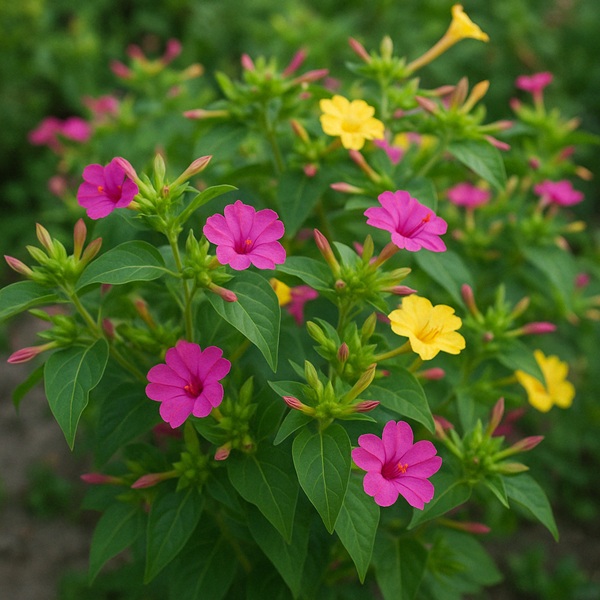
Mirabilis, or four o’clock flower (Mirabilis jalapa), is a bright, fragrant, and undemanding plant that has long won popularity among Ukrainian gardeners thanks to its originality. Native to Central America, mirabilis has adapted well to various climatic conditions and thrives in Ukraine, even in regions with a moderately continental climate. The plant is valued not only for its decorative appeal, but also for an unusual feature: its flowers open closer to evening and release a rich fragrance that is especially noticeable at dusk and at night. Because of this, mirabilis is often planted in evening fragrance gardens, on terraces, balconies, and near gazebos and benches.
Mirabilis is a perennial plant, but in Ukrainian conditions it is most often grown as an annual, since it does not tolerate frost. At the same time, the tubers that form in the soil can be dug up and preserved for planting the following season, much like dahlias. The height of mirabilis ranges from 50 to 100 cm depending on the variety. Its stems are thick and branched, the leaves are bright green and oval-lanceolate. The flowers are funnel-shaped, up to 5 cm in diameter, and come in various colors — from white to purple. Variegated forms also occur, as well as bushes bearing flowers of several colors at once. Blooming lasts from June until the first frosts.
From an agricultural point of view, mirabilis is an ideal plant for beginners. It is undemanding to soil, fairly drought-tolerant, grows well in urban conditions, and is rarely affected by diseases. At the same time, mirabilis can decorate a flower bed, a rabatka, a border, or a container. It is often planted in mixed arrangements with salvia, marigolds, cosmos, and snapdragons. Mirabilis can also be used as a hedge or as a background for lower annuals. For the plant to bloom generously and for a long time, it is important to choose the planting site correctly and prepare the soil properly — especially taking Ukraine’s climate into account.
For full growth and bright flowering, mirabilis needs a well-lit, sunny location. It can tolerate light partial shade, but in shade the flowering will be less abundant, and the bushes will become stretched and loose. In the Ukrainian climate, with its sufficient sunlight, mirabilis grows best in southern and western locations. It is advisable to protect the plantings from cold wind, especially in the northern and eastern regions. On balconies and loggias, it is better to choose a southern or south-western orientation, while in the garden, places protected by fences, buildings, or hedges are preferable.
The optimal soil for mirabilis is loose, fertile, and well-drained. The plant does not tolerate stagnant moisture well, especially in heavy clay soils. The best option is a light loam with a neutral or slightly alkaline reaction. If the soil is too acidic, it is recommended to add dolomite flour or ash. In autumn or spring, the site is dug to a depth of 25–30 cm, compost is added at up to 5 kg per square meter, and on dense soils, sand is also incorporated to improve the structure. Poor soils are additionally enriched with phosphorus-potassium mineral fertilizers.
Mirabilis can be sown in two ways: by seedlings or directly into the ground. In Ukraine’s climate, the seedling method is more reliable, especially in the central and northern regions where late spring frosts may still occur. Mirabilis seeds are large and have a dense coat, so before sowing they are recommended to be soaked for 12–24 hours or scarified by lightly nicking the оболонку. Seedlings are sown in late March to early April in separate cups to avoid transplanting and root damage. At a temperature of +20 to +24°C, seedlings appear in just 5–10 days. The seedlings are ready for planting in open ground after 4–6 weeks.
Mirabilis seedlings are planted in open ground in May, once the danger of frost has passed and the soil has warmed to +15°C. In the southern regions, this may be as early as late April; in the northern regions, it is usually mid-May. The distance between plants should be 30–40 cm, since the bushes spread out and need space. A handful of humus and ash can be added to each planting hole. After planting, the plants are watered generously and shaded for a few days in hot weather.
At the beginning of the growing season, mirabilis needs regular care: watering, loosening, and weeding. Despite its drought tolerance, young plants need stable moisture — drying out of the soil slows development. Water at the root, avoiding wetting the leaves. Two weeks after planting, the first feeding is recommended, using compost infusion or a complex fertilizer for flowering plants. An excess of nitrogen is undesirable, since it stimulates the growth of green mass but suppresses flowering.
After rooting, the plants grow quickly and begin to branch. During this period, it is advisable to pinch the tops — this promotes the formation of a lush bush. The soil around the plants should continue to be loosened regularly to improve oxygen access to the roots. Weeding is important not only for appearance — weeds compete with mirabilis for moisture and nutrients. In regions with rainy summers and dense soils, it is worth mulching the base area around the plants — this will preserve moisture and slow weed growth.
Mirabilis begins to bloom in June and delights with its bright, fragrant flowers until the frosts. The special feature of this plant is that its flowers open in the second half of the day, closer to evening, and remain open until morning. At night they are at their most striking — sweetly and richly fragrant, reminiscent of jasmine or tobacco. For this reason, mirabilis is often planted near gazebos, terraces, verandas, or in the yard, where its fragrance can be enjoyed during evening rest. The flowers may be solid-colored or variegated — pink, white, yellow, purple; flowers of different colors often appear on the same bush. Some varieties have a “marbled” petal coloration, which makes them even more attractive.
To maintain long-lasting and abundant flowering, mirabilis needs regular feeding. The first is given 2 weeks after planting, then every 3–4 weeks throughout the summer. It is good to alternate organic and mineral fertilizers: infusions of green manure or mullein, as well as ready-made complexes with a predominance of phosphorus and potassium. Excess nitrogen leads to overgrowth of green mass at the expense of flowering, so it should not be overused. Fertilizers are applied only to moist soil, preferably in the evening.
Faded flowers do not necessarily need to be removed, since they fall off on their own and do not spoil the plant’s appearance. However, to prolong flowering, it is worth carefully removing spent blooms so that the plant directs its energy toward forming new buds. You should also monitor the leaves: yellowing or curling may indicate problems with nutrition or soil moisture. With proper care, mirabilis remains decorative until the cold weather and looks especially beautiful in well-lit, sheltered locations.
The most common way to propagate mirabilis is by seed, but it is also possible to preserve the tubers that form in the soil by the end of the season. The seeds are easy to collect in autumn — they form in place of the faded flowers as dark, dense nutlets. They are dried and stored until spring in paper packets in a dry room. The seeds remain viable for up to 3 years, but it is best to sow them as fresh as possible, since they germinate better.
Propagation by tubers allows mirabilis to be grown as a perennial. After the first frosts, the tubers are carefully dug up, cleaned of soil, and dried. They are stored in a cool, dry room at a temperature of +3 to +7°C, covered with sawdust or wrapped in paper. In spring, the tubers are planted in pots for sprouting or directly into the ground from late April to early May, depending on the region. This method makes it possible to obtain stronger bushes and earlier flowering.
Sometimes mirabilis can be propagated by cuttings, but this method is rarely used because shoot rooting is not very reliable. It is suitable only for greenhouse conditions or for propagating particularly valuable varieties. In ordinary gardening, the best approach is to combine growing from seed with preserving the most attractive specimens through tubers — this makes it possible to vary colors and varieties from year to year.
Mirabilis is resistant to most diseases and pests, especially in dry, sunny weather, which is typical of summer in Ukraine. However, under excessive moisture, dense planting, or cool rainy conditions, problems may arise. The most common are root rot, powdery mildew, and leaf spot. The main prevention measures are moderate watering, regular loosening, and keeping adequate distance between plants. At the first signs of symptoms, treatment with biofungicides or copper-containing preparations is recommended.
Among pests, aphids, whiteflies, and spider mites appear only occasionally, most often on balconies or in greenhouses. They are controlled with folk remedies such as garlic infusion or laundry soap, or with biological products. In open ground, pests rarely cause serious damage, especially if marigolds, calendula, or lavender are planted nearby — they repel unwanted insects. Regular inspection and prevention are the key to keeping the plants healthy until the end of the season.
With the arrival of autumn, attention should be given to collecting seeds, digging up tubers if needed, and removing the above-ground parts. The stems are cut after the first frosts and destroyed, especially if there were signs of disease. Seeds are collected gradually as they ripen. After cleanup, the soil is loosened, and if necessary, compost or ash is added. If mirabilis is planned to be grown in the same place, it is important to observe crop rotation and not sow this crop every year on the same plot. With proper care, the four o’clock flower will decorate your Ukrainian garden every year with bright and fragrant blooms.