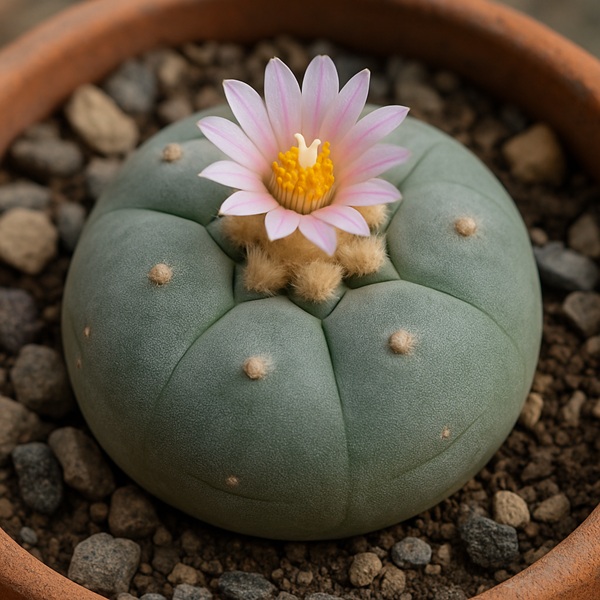
Lophophora is a genus of cacti that inspires admiration among collectors and debate among botanists at the same time. In its natural habitat, the plant grows in the arid regions of Mexico and the southern United States, preferring saline, rocky, and limestone soils. Lophophora is easy to recognize by its velvety surface, spherical shape, and delicate pink or white flowers. In addition to its botanical value, the cactus is known as a psychoactive plant because some species contain mescaline, which calls for particular caution from a legal standpoint. Still, in Ukraine, lophophora can be grown legally as an ornamental houseplant, provided it is not used for non-medical purposes.
The best-known species:
Lophophora williamsii — the most popular variety, also known as “peyote.” It has a dense body with 5–13 ribs, gray-green in color, with spineless areoles. It blooms with white-pink flowers. It grows slowly but steadily.
Lophophora diffusa — light green, with an almost glossy surface, less pronounced ribs, and cream-colored flowers. It contains significantly fewer alkaloids.
Lophophora fricii — a rare species with a bluish tint and large flowers. It grows very slowly and requires careful handling.
Hybrids are also common in cultivation, especially between williamsii and diffusa. They combine hardiness and ornamental appeal. When growing lophophora, it is important to remember that it is not just another cactus. It is highly sensitive to environmental changes and needs stability, a proper microclimate, and attention. In Ukrainian conditions, it is grown exclusively indoors or in a greenhouse, with mandatory control of temperature and humidity.
Planting lophophora is a responsible stage. This is when the foundation is laid for полноценный growth, proper development, and the prevention of rot in the future. Ukraine’s climate is unsuitable for growing this plant in open ground, so it is cultivated exclusively as an indoor plant — in pots or small greenhouses.
Basic planting rules:
Substrate. It must be very light, loose, well-drained, and low in nutrients. The optimal mix is: 50% mineral filler (pumice, zeolite, fine gravel), 30% perlite or vermiculite, and 20% leaf humus. Dolomite flour or lime will help keep the pH at 6.5–7.5.
Pot. It is best to use wide, shallow clay pots with drainage holes.
Drainage. A mandatory layer of expanded clay or broken brick at the bottom, 1.5–2 cm thick.
Before planting, the roots should be inspected: they must be firm, with no signs of rot. If the plant is grafted, the graft union must remain above the soil level. After planting, lophophora is not watered for 7–10 days. This helps prevent rot of the neck. It is also important from the beginning to fix the cactus’s position in relation to the light source so that it does not become deformed later.
Tip: if you bought lophophora from an imported batch, give it 2–3 weeks to adapt in a dry, well-lit place without direct sunlight. Only after that should it be carefully transplanted into a new substrate.
Despite its outwardly undemanding appearance, lophophora is very sensitive to its watering routine. In nature, it receives moisture very rarely, but during rainy periods it actively absorbs water. At home, especially in the Ukrainian climate, it is necessary to follow a clear schedule, avoiding excessive watering under conditions of fluctuating humidity and indoor heating.
Watering rules:
Spring: from mid-March — occasional, deep watering.
Summer: active growth period, watering once every 10–14 days after the substrate has dried out completely.
Autumn: gradual reduction to once every 3–4 weeks.
Winter: if the temperature is below +15°C, watering is stopped completely.
The water must be soft, settled, and at room temperature. Water must not get into the center of the plant — this leads to rot. Water only around the edge of the pot, preferably in the morning.
Lighting is extremely important. Lophophora likes bright, diffused light. A southeast-facing window is best. In summer, it should be shaded from the midday sun to avoid burns. In winter, supplemental lighting with grow lights for 10–12 hours a day is essential. If there is not enough light, the plant stretches, becomes deformed, and becomes more vulnerable to disease.
Lophophora is not the kind of cactus that grows quickly or tolerates carelessness. It requires stability, patience, and careful observation. However, in return for proper care, the plant offers not only aesthetic pleasure but also a unique sense of connection to something special — to a process that cannot be rushed, yet is worth every year of waiting.
To provide favorable conditions for lophophora:
Temperature regime. In summer — +22 to +28°C; in autumn — a gradual decrease. Wintering at +8 to +12°C promotes flowering in the following season.
Air humidity. The plant prefers dry air. If humidity is high (above 60%), ventilation is essential, especially when temperatures drop.
Feeding. In very moderate doses. In March–June — 1–2 applications of a special cactus fertilizer (low nitrogen, higher phosphorus and potassium). No feeding is done in autumn or winter.
Interesting fact: grafted lophophora (for example, on Pereskiopsis or Echinopsis) grows 2–3 times faster. However, such a plant loses part of its natural aesthetics and also becomes less resilient. Own-root lophophora is slower, but more “authentic,” better adapted to a long life, and less afraid of stress.
Do you want the plant to develop faster? Give it stable conditions: constant temperature, soft light, and a rhythmic watering schedule. Any fluctuations are stressful for the cactus, and it may stop developing for several weeks or even months.
Lophophora is quite resistant to disease, but if its care is disrupted, it becomes vulnerable. This especially concerns excessive humidity, temperature fluctuations, and the use of non-disinfected soil. The most important thing is to inspect the plant regularly and track even the slightest changes.
The most common threats:
Root rot. The main cause is excessive watering, especially in cool weather. Symptoms: softness, wrinkling, and darkening at the base. Treatment: dig it up, cut away the affected parts, treat with a fungicide (“Fundazol”), dry it, and transplant it into fresh substrate.
Growth point rot. The most dangerous type of damage. It often proves fatal. The cause is water getting into the center of the plant. Careful watering around the edge helps avoid this.
Mealybug. A white pest that hides in the areoles. It can be controlled with “Aktara,” an alcohol solution, or soap with insecticide.
Prevention includes:
sterilizing the substrate (steaming or heating it);
avoiding drafts and temperature swings;
ventilating the room;
isolating new plants before introducing them into the collection.
Lophophora also reacts poorly to peat-based or organic-rich soils — they often encourage the development of fungal spores. It is better to choose mineral, clean substrates without biological activity.
Among all cacti, lophophora holds a special status. It does not strive for showiness, does not bloom profusely, and does not delight with frequent offsets. But its visual restraint, velvety texture, symmetry, and effortless perfection make it a favorite among collectors who value depth rather than flash.
In a collection, lophophora looks good both as a solitary plant and in group plantings with astrophytums, ariocarpuses, or obregonias. The main thing is not to plant it too densely, not to shade it, and not to change its position relative to the light too often. Older specimens, over 10 years old, with numerous offsets and wrinkles on the surface, are especially valued — these are signs of maturity, experience, and resilience.
In a symbolic sense, lophophora is a plant of patience, contemplation, and inner balance. Its slow development seems to reflect the rhythm of nature itself: without haste, yet constant. It teaches you to wait, to observe, and to pay attention to details. And that is exactly why it is so valued — not only as a cactus, but as a philosophical object in a pot.
Growing lophophora in Ukraine means not simply cultivating an exotic plant — it means joining the circle of those who appreciate natural harmony and calm. All lophophora needs is light, dry air, stability, and your patience. And in return, it will give you decades of effortless beauty.