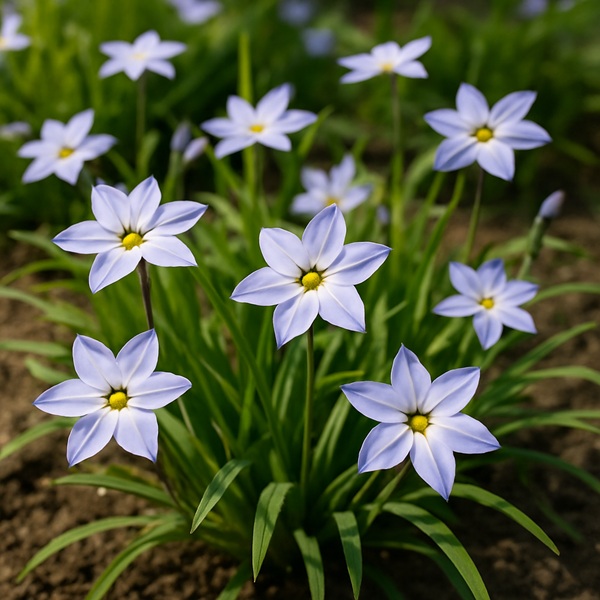
Ipheion is an elegant perennial from the amaryllis family that undeservedly remains in the shadow of more famous spring flowers such as crocuses, daffodils, and muscari. In its natural habitat, ipheion is found in South America, primarily in Argentina and Uruguay, but in recent decades it has been actively adapting to temperate climates, including Ukraine. This miniature plant is valued for its early and abundant flowering, pest resistance, and compact size, which makes it suitable as a border accent, a rock garden feature, or an alpine planting.
The most popular species is Ipheion uniflorum. It is easy to recognize by its star-shaped flowers up to 4 cm in diameter, usually blue or bluish in color, with a characteristic light fragrance reminiscent of garlic — which is why this plant is sometimes popularly called “spring starflower garlic” or “onion garlic.” Breeders have developed many cultivars of this species, among which the following are especially worth noting:
‘Wisley Blue’ — deep blue;
‘Alberto Castillo’ — pure white;
‘Froyle Mill’ — lilac-violet;
‘Rolf Fiedler’ — bright blue with large flowers.
In addition to Ipheion uniflorum, other species such as Ipheion sessile and Ipheion recurvifolium can occasionally be found, although they are used much less often in ornamental gardening. All ipheions are low-growing (up to 20 cm), with thin grassy leaves and a long flowering period, from April to late May depending on the weather. They are ideal for planting in rock gardens, between paving stones, in pots, or in spring containers.
Planting ipheion in open ground is the foundation of abundant flowering and stable growth. In Ukraine, especially in the central and southern regions, this plant can be successfully grown both in the open garden and in containers on a balcony or terrace. Ipheion prefers sunny or lightly shaded sites protected from cold winds. The soil should be light, well-drained, and neutral to slightly alkaline.
Key planting points:
Timing — the best time to plant the bulbs is in autumn, in September–October, so they have time to root before frost. Spring planting is also possible, but the first flowering will be less impressive.
Depth — 5–7 cm is optimal, with 6–10 cm between bulbs. In dense plantings, they form a floral carpet; in looser ones, each plant stands out more distinctly.
Drainage — essential. Standing water is the main enemy of the bulbs. Sand, fine gravel, or expanded clay can be used for drainage.
Before planting, it is worth disinfecting the bulbs with a weak potassium permanganate solution or a fungicide such as Fundazol, especially if the bulbs were bought at a market or from an unknown source. This reduces the risk of fungal disease. After planting, the area should be mulched with dry leaves or sawdust to preserve moisture and protect the bulbs from temperature fluctuations in autumn.
A useful tip: plant ipheions next to other spring flowers — crocuses, tulips, and muscari. They combine beautifully and create a striking patch of color. In addition, once flowering ends, ipheion foliage gradually dies back, but the flower bed will not look empty if later perennials are planted nearby.
Although ipheion is a bulbous plant, its watering needs differ from those of most of its relatives. In nature, it grows in regions with moderate humidity, so in Ukrainian gardens it needs regular but controlled watering. Maintaining that balance is especially important in spring, during its most active growth period.
How to water correctly:
From March to May, water 1–2 times a week depending on the weather.
After flowering, when the leaves begin to yellow, watering is gradually reduced.
In summer, during the dormant period, no watering is needed at all.
As for light, ipheion prefers bright light but not harsh direct sun. The ideal location is a sunny flower bed with slight shade in the second half of the day. When grown in containers, it is better to place pots facing southeast or southwest. If there is not enough light, the plant becomes stretched, flowering weakens, and the leaves turn limp.
A tip: during a cloudy spring with prolonged rain, the plant can be fed with mineral fertilizers rich in phosphorus and potassium to stimulate budding. Bulb fertilizers such as Agricola are suitable. But avoid overfeeding, because that will encourage leaf growth at the expense of flowers.
Ipheion is a plant that does not require constant attention, but it responds gratefully to proper care. Among its main advantages are winter hardiness in the southern and central regions of Ukraine without cover, the ability to renew itself naturally, and ornamental value even without transplanting for several years. Still, if you want to achieve a dense flowering carpet in the garden, it is worth following a few proven practices.
Three key practices for healthy flowering:
Mulching and loosening. After rain or watering, the soil around the plants should be loosened from time to time. This improves aeration and reduces the risk of fungal disease. Mulch such as compost, leaves, or shredded bark helps retain moisture and gradually enriches the soil.
Removing faded flowers. This allows the plant to direct its energy toward strengthening the bulb instead of producing seeds. It also keeps the flower bed looking neat.
Dividing bulb clumps. Every 3 years, it is worth digging up and dividing crowded clumps. This rejuvenates the planting and prevents overcrowding.
An interesting point: under favorable conditions, ipheion can self-seed. Young plants may appear next to the parent plant without any effort on your part — the main thing is not to remove the foliage too early and not to dig up the area every spring. This natural approach gives the planting even more decorative value year after year without extra work.
Ipheion is a fairly resilient plant, but in unfavorable conditions it can become vulnerable to disease or insects. Problems usually arise from overwatering, compacted soil, shade, or overcrowded plantings. Here is what to watch for.
The most common problems:
Bulb rot. This shows up as darkening and softening at the base of the plant. It is often linked to stagnant moisture or lack of drainage. The solution is to dig up the bulb, cut away damaged parts, treat it with a fungicide, and dry it.
Fusarium. A fungal disease that causes the lower leaves to die off. It often appears on weakened plants. Prevention includes bulb disinfection and light soil.
Pests. The most likely are thrips, onion fly, and aphids. They appear more often in damp areas, especially near garlic or onions.
What to do:
Use preventive fungicide treatment such as Fundazol or Maxim before planting.
Spray insecticides such as Aktara or Fitoverm if pests appear.
Avoid evening watering over the leaves to reduce the risk of fungal disease.
Follow crop rotation — do not plant ipheion after other bulbous plants.
In the end, most problems with ipheion are the result of external growing mistakes rather than any weakness in the plant itself. If you follow the basic rules, ipheion can grow and bloom without any chemical treatment at all.
Ipheion is perfect for use in garden design. Its compact habit and long spring flowering make it an excellent choice for the front of flower beds, rock gardens, borders, or as a filler between paving slabs. Thanks to its range of shades — from white to violet — ipheion combines beautifully with other early-flowering plants.
Examples of successful use:
Along the edge of a flower bed or pathway. Ipheion forms an even ribbon of flowers.
Container plantings. In pots, it can be combined with pansies, primroses, and muscari.
Under trees. Because it blooms early, it can be planted beneath deciduous trees that have not yet cast dense shade.
After flowering ends, the leaves gradually fade and usually do not create an aesthetic problem, especially if heucheras, hostas, or low ferns are growing nearby. In design, ipheion works especially well alongside ornamental foliage perennials.
Ipheion is a plant for those who value a combination of low-maintenance care, beauty, and natural grace. It is easy to fit into almost any garden style, and it will always find its place — from a balcony to a large flower bed. Once you plant it, you will most likely never want to give it up.