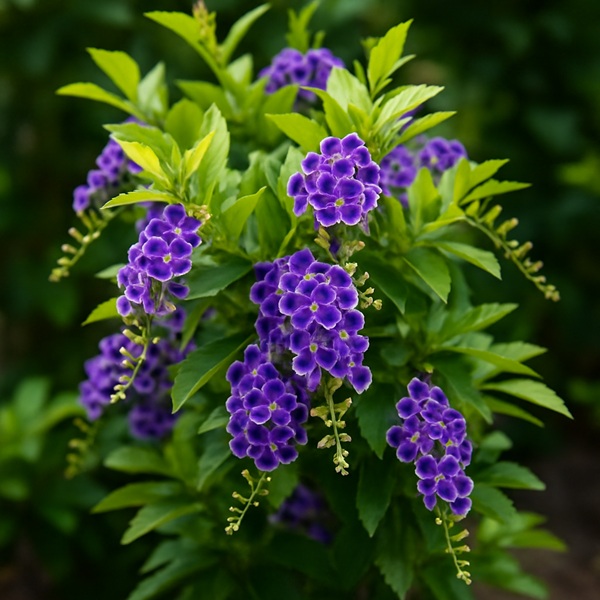
Duranta is a tropical plant from the verbena family that is gradually winning the hearts of Ukrainian flower growers thanks to its unusual ornamental value, fast growth, and relative unpretentiousness. The genus includes more than 30 species, although in ornamental gardening only 2–3 of them are used most often. Most durantas are evergreen shrubs or small trees native to tropical and subtropical regions. In Ukraine, they are grown either as tub plants that overwinter indoors, or as seasonal plants in open ground with mandatory transplanting in autumn.
The best-known types:
Duranta erecta — the main ornamental species, distinguished by branched shoots up to 2 meters high, bright green or variegated foliage, and small blue, lilac, or white flowers in drooping clusters.
Duranta repens — a more compact form with abundant flowering. It is often used for shaping borders and for topiary pruning.
Duranta ‘Gold Mound’ — a cultivar with golden foliage, grown mainly for its bright leaf mass rather than for its flowers.
All varieties of duranta remain decorative throughout the season, especially if the crown is shaped regularly. It usually blooms in summer — from June to September — and with good care may begin flowering as early as May and continue until autumn. In addition to the flowers, the bright berries also attract attention — yellow, orange, or coral-colored — which remain on the branches even after flowering ends. Important: duranta fruits are poisonous, so the plant should not be kept within reach of children or pets.
In Ukraine, duranta is grown in two ways: as a tub plant that overwinters indoors, or as a seasonal ornamental plant in open ground that is moved indoors in autumn. The first option is better suited to the southern regions (Odesa, Kherson), while the second is more suitable for the central and northern parts of the country. Even in the southern climate, leaving duranta outdoors in winter without protection is very risky: temperatures below +5°C can already damage the roots and shoots.
Key points when planting:
Location. Duranta needs plenty of light — in shade it does not bloom, and its leaves become pale. South- or southeast-facing locations are ideal.
Soil. Light loam with neutral acidity. Drainage is essential — in open ground this means sand or gravel, and in a container, expanded clay.
Pot. If grown in a container, choose a pot at least 25–30 cm in diameter with required drainage holes. To protect it from chilling, wooden or foam stands can be used.
Planting in open ground is done in May, once the threat of frost has passed. When transplanting from a pot, it is important to preserve the root ball — duranta does not tolerate root damage well. During the first 5–7 days after planting, the plant should be shaded and sprayed in the evening with warm water — this helps it establish itself. Pine bark or peat works well as mulch.
Tip: in open ground, duranta can be a bright accent in a flower bed or part of a hedge. In a pot, it decorates terraces, balconies, and winter gardens. Compact cultivars such as ‘Compacta’ can even be grown as bonsai.
For duranta to grow actively and bloom well, it is necessary to create a comfortable climate for it. Given its tropical origin, it prefers stable temperatures, bright light, and high air humidity. In summer, it is easy to place it outdoors, but wintering in an apartment or greenhouse requires a more careful approach.
Watering rules:
In summer — 2–3 times a week; in hot weather, even daily, especially in a pot.
In autumn — reduce to 1–2 times a week.
In winter — no more than once every 10 days if the temperature does not exceed +15°C.
Stagnant water is more dangerous for duranta than slight drying out. In overly damp conditions, rot can develop, so drainage is essential. But complete drying out is also unacceptable: the plant sheds leaves and slows its growth, and frequent disruption of the watering routine weakens its immunity.
Lighting should be bright but diffused. Ideally, it needs 6–8 hours of sunlight a day. In the August heat, it is worth shading the plant at midday to avoid burns. In an apartment, duranta feels best on southeast-facing windows or under lamps. Without enough light, it stretches out, loses color, and becomes less decorative.
Duranta grows quickly and forms a lush green mass that, without regular intervention, loses its shape and ornamental appeal. To maintain a compact appearance and stimulate long flowering, pruning is an essential part of care. This is especially important for potted plants or tub-grown specimens used as decorative accents on balconies and terraces.
Types of pruning:
Spring — sanitary pruning. Dry, damaged, or overly elongated shoots are removed, and the main ones are shortened by one third.
Summer — formative pruning. Every 2–3 weeks, the tips are pinched to stimulate branching.
Autumn — pruning before moving the plant indoors. Only strong, mature shoots are left.
Want to grow a standard tree? Leave one strong central shoot and gradually remove the side ones. Tying it to a support will help form a straight trunk, while the top will turn into a decorative crown. In container culture, this looks especially impressive. If the goal is to create a hedge, it is better to stick to dense regular trimming at a height of 30–60 cm.
Duranta is easily propagated by cuttings — green or semi-woody. The best time is late spring or August. Cuttings 10–12 cm long root well in a peat-based substrate under plastic film or a glass jar. After 2–3 weeks, roots appear, and the young plants can be transplanted into separate pots. Seed propagation is also possible, but varietal traits are not preserved in that case.
Duranta is generally a fairly resilient plant, but if conditions are poor — stagnant moisture, bad lighting, overcrowded planting — it becomes vulnerable to diseases and pests. This is especially relevant during wintering in an apartment or greenhouse, where air circulation is limited.
Common diseases:
Gray rot — appears under excessive humidity, especially in cool conditions. Signs: gray coating, rotting at the base. Treatment: remove affected parts, repot, and treat with fungicides.
Powdery mildew — a white coating on the leaves, especially in damp or unstable weather. Remedies: Topaz, Skor, Fundazol.
Dangerous pests:
Spider mite — appears in dry air. Symptoms: light spots on the leaves, fine webbing. Control: Fitoverm, Actellic.
Whitefly, aphids — active in summer. They usually settle on the underside of the leaves. Remedies: insecticides such as Aktara, Inta-Vir.
Preventive measures:
Avoid overwatering the substrate.
Ensure ventilation, especially during wintering.
Quarantine new plants before adding them to the collection.
Inspect the leaves regularly — both underneath and on top.
If the plant suddenly drops its leaves for no obvious reason, it is worth checking the temperature. Sharp fluctuations, cold drafts, or overheating without proper humidity cause stress. Stable conditions are the key to duranta’s health.
The most difficult period in caring for duranta is winter. In open ground without protection, it does not survive. Even in the southern regions of Ukraine, it should be dug up in autumn and moved indoors. Ideally, it should be grown in a pot: outdoors in summer, indoors in winter.
Optimal wintering conditions:
temperature: +10 to +15°C;
light: bright diffused light or supplemental lighting with lamps for 10–12 hours a day;
watering: sparse, once every 10–14 days, with no fertilizer.
After winter, duranta may partially shed its leaves — this is normal. In March–April, as temperatures rise, active recovery begins. At this moment, it is important not to miss the right time for repotting and pruning — crown formation will then be even and balanced.
Ideas for use:
a central element in a composition on a terrace or balcony;
a container hedge;
combined with petunia, lobelia, hibiscus, or dracaenas;
decoration for office space or a winter garden.
Duranta is not just green mass with flowers, but a full-fledged seasonal color accent. It draws attention with its foliage, flowers, and berries — and from spring to autumn it remains an ornament to any corner. In caring hands, it easily survives winter and blooms even more lavishly the following season.