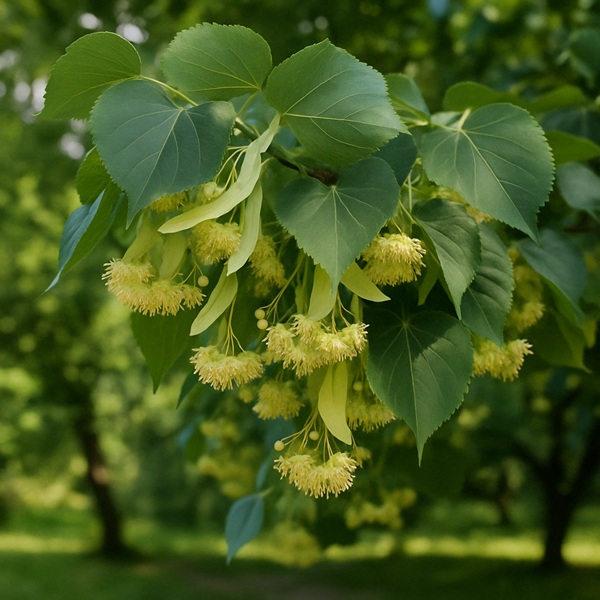
Linden is one of the most recognizable trees, decorating city streets, parks, and home gardens throughout Ukraine. It is valued for its ornamental appeal, dense shade, pleasant flower fragrance, and numerous beneficial properties. Linden belongs to the genus Tilia, and in Ukraine the two most common species are small-leaved linden (Tilia cordata) and large-leaved linden (Tilia platyphyllos). The first species stands out for its high winter hardiness and is better adapted to the climate of the northern and central regions. The second has larger leaves, grows faster, and is better suited to the southern regions, where winters are milder and the growing season is longer.
Linden is planted both as a solitary tree and in avenue plantings. Its crown can be shaped easily, allowing it to be used for hedges, especially in combination with other trees and shrubs. Young trees establish themselves well, grow quickly, and within 8–10 years already create dense shade, making linden an ideal choice for greening a yard or recreation area. In addition to its beauty, linden is a valuable honey plant. Its flowering period falls in late June to early July and attracts countless bees. Its nectar produces fragrant and healing linden honey, highly valued for its essential oil content and antiseptic properties.
Linden has long been used in folk medicine. Its flowers are used to prepare decoctions for colds, inflammation, and as a mild calming remedy. The bark, leaves, and wood also have medicinal properties and are used in pharmacology. Another major advantage is linden’s ability to purify the air of dust, exhaust fumes, and heavy metals, which is why it is actively planted along roads and in industrial areas. From an ecological point of view, linden is one of the best trees for urban greening. However, for the tree to remain healthy and ornamental, it needs proper planting conditions and regular care.
Planting linden in Ukrainian conditions is possible both in spring and in autumn. The most optimal time is autumn, from September to October, when the tree has already finished its growing season and is preparing for dormancy. In autumn, the sapling has time to root well before frost, and in spring it begins growing immediately. Spring planting, in April, is better suited to regions with harsh winters, where there is a risk of young plants freezing. Regardless of the chosen season, it is important to select a well-lit site protected from strong winds. Linden loves light, but also tolerates light shade well, especially in the southern regions.
The soil should be fertile, loose, and fairly deep. Linden grows poorly in heavy clay or waterlogged areas. In such cases, the soil is improved by adding sand, compost, and peat. The optimal acidity level is slightly acidic to neutral, with a pH of 6–7. A planting pit is prepared measuring approximately 60×60×60 cm. A drainage layer is placed at the bottom using crushed stone, expanded clay, or broken brick, followed by a fertile mix of topsoil, humus, ash, and superphosphate. The sapling is positioned so that the root collar remains level with the ground, then the pit is filled, the soil is compacted, and the tree is watered generously.
After planting, the trunk circle is mulched — this helps retain moisture, suppresses weed growth, and protects the roots from sudden temperature changes. During the first year after planting, it is very important to water the tree regularly, especially during dry periods. Linden takes up to two years to establish fully, during which it requires special care: protection from wind, regular loosening of the soil, and the application of organic matter. If planting is done in urban conditions, the tree should be protected from mechanical damage and from salt exposure in winter, for example by using shields or wrapping the trunk in burlap.
Linden has a natural ability to form a beautiful, symmetrical, and dense crown. However, in the first years after planting, the tree needs formative pruning. The first procedure is carried out as early as the second or third year: weak, crossing, and inward-growing shoots are removed. Three to five skeletal branches are formed, evenly spaced around the trunk. Pruning is done in early spring, before sap flow begins. Linden tolerates trimming and rejuvenation well, which is why it is often planted in avenues or shaped into hedges in formal gardens with geometric layouts.
After that, pruning is done every year or once every two years. Dry, damaged, and overcrowding branches are removed. Decorative trimming may also be performed, especially if linden is used as part of topiary landscaping. It should be remembered that excessive pruning in hot weather can cause leaf drop, so the main work should be carried out in spring or at the end of summer. Linden quickly produces new greenery, especially with regular watering and feeding. Fertilizers are applied twice a year: nitrogen-rich ones in spring, and potassium-phosphorus fertilizers in autumn to strengthen the wood and prepare it for winter.
In addition to pruning, watering and mulching remain important components of care. Young trees are watered once or twice a week depending on the weather. In hot conditions, watering is increased, especially if the tree is growing in full sun. Feeding can conveniently be combined with watering by using water-soluble fertilizers. Humus, straw, pine needles, or bark are used for mulching, in a layer up to 5–7 cm thick. Mulch also prevents weed growth. With proper care, in 5–7 years linden develops into a strong, luxurious tree with dense foliage and a well-developed root system.
Linden begins to flower at the age of 8–12 years, depending on growing conditions and care. The flowering period usually occurs in late June to early July and lasts from 10 to 15 days. The flowers are gathered in corymb-like clusters, have a yellowish-cream color, and a distinct pleasant fragrance. In warm, calm weather, the tree literally hums with bees, because linden is one of the most valuable honey plants in temperate climates. One mature tree can yield up to 15–20 kg of nectar, making it extremely valuable for beekeepers.
Linden flowers contain flavonoids, essential oils, vitamin C, tannins, and antioxidants. They are collected at the beginning of flowering, when the clusters are fully open but have not yet started to fall apart. Harvesting is done in dry weather, after which the flowers are dried in the shade or in a well-ventilated place. The dried raw material is used to prepare teas, infusions, and decoctions for colds, inflammatory conditions, and nervous tension. The flowers have a mild fever-reducing, diuretic, and sweat-inducing effect.
Besides its benefits for people, linden plays an important role in natural ecosystems. Its dense crown creates shade and a microclimate for herbaceous plants and small animals, while its bark and leaves provide a habitat for insects and birds. Linden plantings improve air quality, absorb carbon dioxide, and release phytoncides that suppress pathogenic microorganisms. The tree actively traps dust and heavy metals, purifying the air near roads and industrial zones. That is why linden is widely used in urban landscaping — in squares, parks, along roads, and in residential districts.
Linden is considered a resilient tree, but under unfavorable conditions it may suffer from diseases. The most common are powdery mildew, brown leaf spot, and black sooty coating. Powdery mildew appears as a white coating on leaves and shoots, especially in warm, humid weather. For prevention, spraying with fungicides based on sulfur or copper is carried out. Brown leaf spot causes dark marks to appear on the leaves, which later die off. Affected leaves should be collected and destroyed to stop the spread of infection.
Among pests, the most dangerous are aphids, linden leafrollers, scale insects, and spider mites. Aphids suck sap from young shoots and encourage the development of sooty mold. Scale insects and mites weaken the tree, suppress its growth, and reduce its immunity. Biological and chemical products are used to control them. Prevention is also effective: regular inspection of the trees, sanitary pruning, removal of fallen leaves, and destruction of plant debris, especially in autumn.
To keep linden healthier, it is important to maintain its general vigor: water it on time, feed it, loosen the soil, mulch, and prune the crown. Excess nitrogen fertilizers should be avoided, as they may stimulate excessive green growth at the expense of wood hardening. In autumn, it is useful to whitewash the trunk with a lime solution with added copper sulfate — this protects the tree from pests overwintering under the bark and reduces the risk of fungal diseases in spring.
Linden is a frost-resistant tree, especially its small-leaved forms. Mature trees in most regions of Ukraine do not require special winter covering. However, young saplings, especially in the first two or three years after planting, are best protected. In late autumn, the trunk circle is mulched with a thick layer up to 10 cm of peat, leaves, or pine needles. The trunk is wrapped in burlap or another breathable material to protect it from frost cracks and sunscald in February and March. It is also worth protecting the tree from rodents by wrapping the lower part of the trunk with mesh.
In spring, the cover is removed gradually, especially after a snowy winter. The crown and trunk must be inspected: if damage is present, sanitary pruning is carried out and wounds are treated with garden pitch. During the period of active growth, nitrogen fertilizers should also be applied to stimulate the development of new shoots. In summer, linden needs watering, especially if it grows in a dry location or among buildings. It also responds well to evening crown sprinkling, which lowers leaf temperature and improves the overall condition of the tree.
With proper care, linden can live for more than 100 years. In old parks across Ukraine, there are ancient trees that still bloom, produce honey, and create a sense of comfort. Its powerful root system provides resistance to drought and wind, while its ability to recover makes it ideal for urban environments. Linden is rightly considered a tree of longevity, beauty, and usefulness. It will become not only a decoration of the garden, but also a source of health, comfort, and generations of good memories.