Lentils (Lens culinaris) are one of the oldest crops cultivated since ancient times. For thousands of years, they have been valued for their high nutritional qualities, low maintenance requirements, and ability to enrich the soil with nitrogen. In recent years, interest in lentils in Ukraine has grown significantly: more and more farmers and gardeners are taking up their cultivation, especially in the southern and central regions of the country.
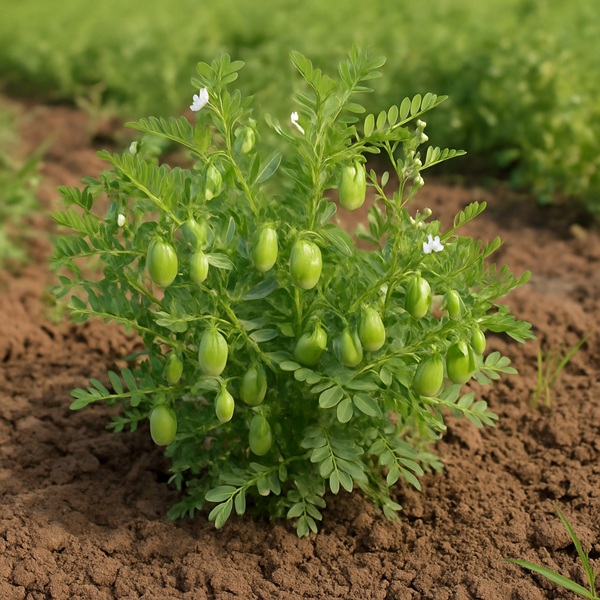
The crop is an annual herbaceous plant 20 to 75 cm tall, with branched stems and pinnate leaves. The flowers are small, white or bluish-violet, and arranged in inflorescences. The fruits are small pods containing 1–2 flat seeds. Lentils are characterized by rapid development, drought tolerance, and the ability to grow on poor soils, which makes them an ideal crop for Ukraine’s continental climate.
Lentil seeds are rich in protein, iron, potassium, and fiber, making them an essential food for a healthy diet. Under Ukrainian conditions, lentils can become a valuable source of food both for personal consumption and for commercial production. They are in demand in cooking, the food industry, and for export, and they also improve soil structure thanks to their ability to fix atmospheric nitrogen.
To grow lentils successfully in Ukraine, it is important to choose the right site and prepare the soil carefully, taking this crop’s characteristics into account.
Requirements for the site:
Light. Lentils require full sun. With insufficient light, the plants become elongated, flower poorly, and produce fewer pods.
Soil. The best soils are light loams or sandy loams with a neutral or slightly alkaline reaction (pH 6.5–7.5). Heavy clay, acidic, and waterlogged sites should be avoided.
Drainage. Good water removal is very important, since stagnant moisture leads to root rot and disease development.
Soil preparation:
In autumn, the site is dug to a depth of 25–30 cm, clearing away weeds and plant residues.
If necessary, liming is carried out to reduce soil acidity.
In spring, before sowing, the soil is loosened and leveled with a rake.
Fertilizers:
Lentils respond poorly to fresh manure, so fertilizers are applied in advance:
In autumn — humus or compost at a rate of 3–4 kg per m².
In spring — if needed, a light application of phosphorus-potassium fertilizers.
Proper site preparation is one of the most important factors in obtaining a high-quality lentil harvest.
Lentils prefer cool conditions at the beginning of growth, which determines their sowing time in Ukraine.
Sowing dates:
Sowing is carried out in early spring, as soon as the soil warms to +5...+7°C and becomes suitable for fieldwork.
In the southern regions, the optimal time is late March to early April.
In the northern regions and in Polissia, it is the second half of April.
Sowing technology:
Seeds are sown at a depth of 3–5 cm depending on the soil type (deeper in light soils, shallower in heavy ones).
The seeding rate is 100–120 kg per hectare with a solid sowing method.
In manual planting on small farms, row spacing is kept at 15–20 cm.
Seed preparation:
Before sowing, it is recommended to treat the seeds with nitrogen-fixing bacteria (rhizotorphin) to speed up nitrogen fixation.
To prevent fungal diseases, the seeds are treated with fungicides.
Well-executed sowing ensures even emergence and the harmonious further development of the plants.
Although lentils are considered a fairly undemanding crop, proper care of the planting ensures high yield and bean quality, especially under the conditions of the Ukrainian climate.
Watering.
Lentils are highly drought-tolerant, especially during flowering and pod formation. However, at the stage of seed germination and early growth, sufficient soil moisture is necessary. In the case of spring drought, irrigation is recommended:
At the seedling emergence stage.
At the beginning of budding.
After the pods have set, watering is stopped to avoid the development of fungal diseases.
Weeding and loosening.
Young lentil plants are very sensitive to shading by weeds. Regular loosening between rows and weeding are especially important in the first 4–6 weeks after sowing. Dense planting sharply reduces yield.
Feeding.
If the soil has been well prepared, additional feeding is usually unnecessary. If signs of phosphorus or potassium deficiency appear, foliar feeding is applied. Nitrogen fertilizers are not used, since lentils are able to fix atmospheric nitrogen through root nodule bacteria.
Thus, proper agricultural practice makes it possible to obtain stable yields without unnecessary expense.
Under Ukrainian conditions, lentils can be affected by a number of diseases and pests, especially under increased humidity or where cultivation practices are not properly followed. Timely prevention is the foundation of a healthy harvest.
Diseases:
Ascochyta blight. Appears as brown spots on leaves and stems. Prevention includes fungicide treatment, for example with chlorothalonil-based products.
Fusarium wilt. Damages the plant’s vascular system, causing wilting. Seed treatment before sowing and crop rotation are required.
Powdery mildew. A white coating on the leaves. Prevention includes thinning the planting and treatment with fungicides.
Pests:
Aphids. Settle on stems and leaves, weakening the plants and transmitting viral infections.
Pea weevil. Can damage lentil pods during storage.
Thrips and spider mites. Especially harmful in dry and hot weather.
Preventive measures:
Follow crop rotation rules, avoiding lentil cultivation after legumes for at least 4 years.
Use healthy seed material.
Carry out preventive treatments during the budding stage.
Comprehensive protection makes it possible to obtain a healthy harvest and minimize losses.
Proper lentil harvesting is crucial for preserving product quality. Mistakes at this stage can lead to grain losses.
Harvesting dates:
Harvesting begins when 70–80% of the pods have turned brown and the stems have dried.
In Ukraine, lentils are mainly harvested in July–August depending on the region and sowing time.
Harvesting technology:
For small-scale production, the plants are cut by hand with a sickle or scythe, then dried and threshed.
On large areas, combines are used with special settings to minimize grain breakage.
After threshing, the grain is cleaned and dried to a moisture content of 12–14% for long-term storage.
Uses of lentils:
Lentils are widely used in soups, porridges, salads, and fillings.
They are actively used in dietary and vegetarian nutrition thanks to their high protein content.
Lentils are becoming increasingly popular in Ukraine due to their nutritional value, low-maintenance nature, and economic appeal for farmers.