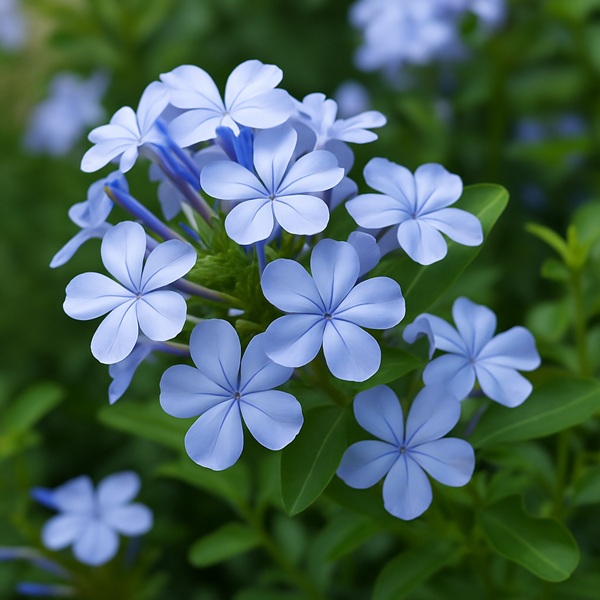
Plumbago, also known as leadwort (Plumbago), is an elegant flowering plant that draws attention with its light, airy form, graceful shoots, and delicate pastel-toned flower clusters. The genus includes more than 20 species, though only a few are commonly grown in horticulture, differing both in appearance and in their care requirements. In nature, leadwort is widespread across tropical and subtropical regions of Asia, Africa, and the Mediterranean. Thanks to its good adaptability, it can also be successfully grown in Ukraine — both in open ground and in containers, on balconies, or on verandas.
The most common species are:
– Plumbago auriculata (Cape leadwort) — the best-known species. It forms lush shrubs up to 1.5 m tall with blue flower clusters. It is ideal for container growing, and in southern Ukraine it can grow in open ground.
– Plumbago indica (Indian plumbago) — a species with pink-red flower clusters, more heat-loving, usually grown in greenhouses or indoors.
– Plumbago europaea (European leadwort) — a herbaceous, compact, drought-tolerant form that requires winter protection.
In addition, there are ornamental varieties with variegated foliage that tolerate pruning well, making them especially convenient for borders, hedges, and vertical landscaping. Plumbago can serve either as a focal specimen plant or as part of a mixed border. Its soft shades pair beautifully with lavender, sage, verbena, and geranium.
In Ukraine’s climate, plumbago can be grown both in open ground and in containers. Given its love of warmth, the best results are usually achieved in pots. This is especially relevant for the northern and central regions of the country, where the plant cannot be left outdoors for the winter. Plumbago should be planted in spring, once the threat of frost has passed — roughly from mid-April to late May, depending on the climate.
The planting site should be sunny but protected from the wind. Southern or southwestern spots are ideal, where the plant receives plenty of light. With too little sun, plumbago becomes leggy, blooms less, and its foliage loses intensity. It should not be planted in areas with stagnant moisture — the roots do not tolerate waterlogging. A drainage layer of expanded clay, broken brick, or coarse sand should be placed at the bottom of the hole or container.
The soil should be loose, well-draining, and neutral to slightly acidic (pH 6.0–6.5). The optimal mix is 2 parts leaf soil, 1 part humus, and 1 part sand. A ready-made substrate for flowering plants with added perlite can also be used. After planting, the plant should be watered well and the soil mulched — in open ground with wood chips or bark, and in containers with coconut fiber. This helps preserve moisture and protects the roots from overheating.
In the garden, plumbago can be used as a groundcover plant, but it looks most impressive on supports: arches, trellises, and pergolas. Its shoots are easy to tie up, which allows you to shape the shrub as desired. For group planting, leave 40–60 cm between plants; when placing them near supports, up to 1 m is recommended. In containers, plumbago is repotted every spring into fresh substrate, as its root system develops quickly.
Plumbago requires regular but moderate watering. During the active growing season (April to October), the soil should remain slightly moist, especially in container culture. At the same time, it is important to avoid water stagnation, as this may lead to root rot. In summer, during high temperatures, watering is done daily or every other day; on cloudy days, 1–2 times a week is enough. During budding, a lack of moisture can cause flower drop.
Misting the crown is recommended on hot days — it increases humidity and reduces stress. However, in conditions of high humidity without ventilation, the risk of fungal disease increases. Indoors, ventilation is essential. Plumbago needs a lot of light, but it does not tolerate direct midday sun well, especially in southern regions. In such cases, partial shading is advisable, or the plant should be placed on the east or west side.
Lighting affects both growth intensity and flowering. With too little light, the plant produces foliage but not buds. With too much, leaf scorch is possible. Ideally, it should receive 6–8 hours of sunlight per day. In winter, plumbago needs supplemental lighting from grow lights if it remains in active growth. In that case, it is important to keep the temperature no lower than +15°C and maintain a day length of at least 10–12 hours.
Despite its delicate appearance, plumbago is susceptible to certain diseases, especially in conditions of high humidity or improper watering. If the basic care rules are followed, most problems can be avoided, but prevention is still important.
The most common diseases are:
– Root rot. Caused by overwatering or stagnant water. Symptoms include wilting despite moist soil, an unpleasant smell, and rotting roots. The plant should be repotted, affected roots pruned away, and watering reduced.
– Powdery mildew. Appears as a white coating on leaves and buds. It spreads when ventilation is poor and humidity is high. Suitable treatments include fungicides such as Topaz or Quadris, as well as folk remedies like horsetail infusion or garlic water.
– Leaf spot. Brown or dark spots may appear due to temperature fluctuations or weak plant immunity. The affected leaves are removed, and the plant is treated with immune-supporting preparations.
The pests that most often affect leadwort are:
– Spider mite — becomes active in heat and low humidity. The leaves turn yellow and become covered with webbing. Heavy misting and treatments with products such as Fitoverm are needed.
– Whitefly — tiny insects, especially active in greenhouses. Treatment includes sticky traps and spraying with Aktofit or Aktara.
– Aphids and scale insects — suck plant juices and slow growth. Manual removal and a soap solution can help, while severe cases require systemic insecticides.
Preventive measures include watering control, good air circulation, avoiding overcrowded planting, and treating the leaves with calendula or yarrow infusion every 2–3 weeks during summer.
Plumbago is easy to propagate both vegetatively and from seed. In Ukrainian conditions, the most convenient methods are cuttings and layering, as they give quick results and do not require special skills.
Cuttings.
This is done from May to July. Apical shoots 10–15 cm long are stripped of their lower leaves, treated with a rooting stimulator such as Kornevin, and planted in a moist substrate of peat and sand (1:1). They are then covered with film or a plastic bottle. At a temperature of +22 to +25°C, roots appear in 3–4 weeks. Once rooted, the cuttings are transplanted into pots or into the ground.
Layering.
Suitable for mature shrubs. One of the shoots is bent down to the ground, fixed with a staple, and covered with soil. Regular watering speeds up root formation. After 2–3 weeks, the layer is cut from the parent plant and transplanted separately. This method is especially convenient in the garden when plumbago is grown near supports.
Seeds.
They are sown on the surface in February–March into a moist, light substrate. Germination takes 10–20 days. After 2–3 true leaves appear, the seedlings are pricked out. Flowering begins in the 2nd or 3rd year. The downside is possible deviation from varietal traits.
Tip: indoors, it is best to root young shoot cuttings under grow lights. In the garden, layering is usually preferred — it takes minimal effort and gives maximum results.
For leadwort to remain decorative and bloom for a long time, care should be adjusted according to the season. Below is a practical seasonal guide.
Spring:
– repot into fresh soil;
– carry out formative pruning and remove dry branches;
– begin feeding with mineral fertilizers;
– gradually bring the plant out of dormancy;
– take cuttings and move it into larger pots.
Summer:
– water generously and mist regularly;
– feed every 10–14 days;
– tie shoots to supports;
– remove faded flower stalks;
– ventilate and protect from pests.
Autumn:
– reduce watering frequency;
– stop feeding;
– prepare for wintering: prune and move indoors;
– treat with a fungicide;
– cover with agrofiber if grown in open ground.
Winter:
– keep at +10 to +15°C;
– water sparingly, once every 2–3 weeks;
– use grow lights if needed;
– interfere as little as possible, while monitoring root condition;
– protect from drafts and chilling.
Proper seasonal care is the key to ensuring that plumbago delights you every year with abundant, long-lasting flowering.