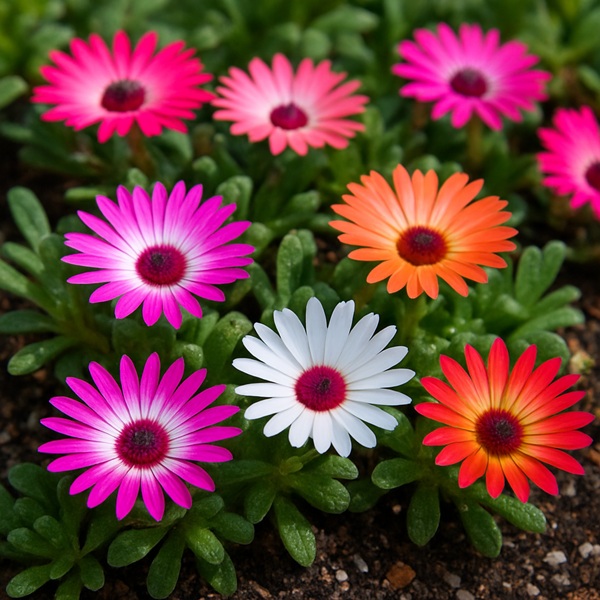
Dorotheanthus, also known as “midday flower” or “ice plant,” belongs to the Aizoaceae family and attracts gardeners with its bright flowers that shimmer in the sun, as well as its ability to form a dense green carpet. Visually, it resembles a miniature gerbera, but it is far more drought-tolerant, undemanding in terms of soil, and produces an extraordinary sparkling effect on its petals in bright light. In Ukraine, dorotheanthus is used to decorate rock gardens, borders, and flowerpots, especially in regions with long, sunny summers.
The most common species in ornamental gardening is Dorotheanthus bellidiformis — daisy-like dorotheanthus. It forms compact bushes up to 10–15 cm tall with fleshy green or slightly reddish leaves and bright flowers that open only in direct sunlight. The color range varies from pure white to deep purple, including orange, yellow, pink, and bicolored forms. Breeders have created numerous hybrids with different petal shapes — straight, needle-like, or rounded — and contrasting centers.
Among the most popular cultivar series are ‘Livingstone Daisy,’ ‘Magic Carpet,’ ‘Mezoo,’ and ‘Gelato.’ All of them are suitable for growing in Ukraine, though they differ in their care requirements. For example, ‘Mezoo’ is best suited for trailing cultivation in containers, while ‘Magic Carpet’ is ideal for open ground. Although dorotheanthus has tropical origins, it adapts very well to the Ukrainian climate, especially in the south and east, where summers are warm and sunny.
Planting dorotheanthus requires attention to several important conditions: temperature, light, and soil type. It is a heat-loving plant that is completely intolerant of frost, so it should not be planted in open ground before the second half of May, when the soil warms up to +16 to +18°C. In most cases, Ukrainian gardeners grow dorotheanthus from seedlings, sowing the seeds in March–April. The seeds are very small, so they are spread over the surface without covering them, only lightly pressing them into the moist substrate.
For germination, it is important to maintain a temperature of +20 to +24°C and provide good lighting. It is best to use a mini greenhouse or cover the containers with glass or film. Seedlings appear in 7–14 days. Because dense sowing can cause them to stretch, the seedlings are pricked out at the stage of two true leaves, leaving about 3 cm of space between plants. In open ground, the seedlings are planted 15–20 cm apart, forming a dense green carpet in a sunny location.
The soil should be light, well-drained, and neutral to slightly alkaline. In Ukraine, especially in regions with heavy or clay soils, it is best to prepare the beds in advance by adding sand, fine gravel, and compost. Excess moisture is the main enemy of dorotheanthus: even a few days in waterlogged substrate can cause root rot. For pot cultivation, it is recommended to use a universal substrate with added perlite and a mandatory drainage layer. Young plants tolerate transplanting well, while mature ones do not, so it is better to plant them in their permanent place right away.
Dorotheanthus is a typical plant of arid regions, so its watering regime fully follows a drought rhythm. It tolerates drying out much better than excess moisture. The right approach is infrequent but abundant watering, with the soil allowed to dry out between waterings. In open ground, it is watered no more than 1–2 times a week, depending on the weather. During hot July days, watering can be increased to 3 times a week if the soil dries well. In containers, the schedule depends on the pot size and evaporation conditions.
As for light, this is the main factor in the ornamental value of dorotheanthus. Its flowers open only in direct sunlight. On cloudy days, the plant looks less vivid. That is why planting it in shade, under tree canopies, or on the north side of buildings is not practical. In urban conditions, it can be grown on sunny balconies, loggias, and verandas. Indoors, dorotheanthus is usually grown as a seasonal plant — sown in spring and moved outdoors in summer.
The specifics of the Ukrainian climate require extra attention. Spring rains, especially in the west and north of the country, may cause young plants to rot. In such cases, it is advisable to install temporary covers or move containers to a protected place. With the right choice of lighting and proper moisture control, dorotheanthus will flower continuously from late May until October.
Although dorotheanthus is considered an undemanding and hardy plant, it becomes vulnerable to a number of diseases if care rules are violated. In most cases, the cause is excessive moisture, poor ventilation, or overly dense planting. It is very important not only to fight the symptoms, but also to determine the root cause of the problem.
Common problems:
Gray rot. Appears when high humidity is combined with cool temperatures. Brown spots with a characteristic gray coating develop on the leaves and stems. Solution: prune the affected parts, apply a fungicide, improve drainage, and reduce watering frequency.
Fusarium. A fungal infection of the root system that causes wilting without any obvious reason. It often appears in heavy soils or with overwatering. Prevention: plant in a light, well-drained substrate and apply biofungicides at planting.
Powdery mildew. Visually resembles a thin powdery coating on the leaves. It is more common during damp nights with sharp temperature fluctuations. Treatment: sulfur-based products or biological fungicides.
Pests. Aphids, whiteflies, and spider mites may appear in greenhouses or on balconies when temperatures are high and air circulation is poor. Insecticides or soapy water are used for control, along with preventive spraying.
Sometimes gardeners confuse the natural aging of leaves with signs of disease. If yellowing starts from the bottom, without spots, and the leaves die off gradually, this is a normal process. But if the leaves darken, curl, or develop wet patches, that is already a signal to take action.
Two methods of propagation work best for dorotheanthus: sowing seeds and cuttings. Both have their own advantages and characteristics.
Seed method.
This is the simplest and most common method. Seeds are sown in March–April, without covering them, only lightly pressing them into a moist substrate. The germination temperature should be +20 to +24°C, and a greenhouse effect promotes quick sprouting. About 2 weeks after the seedlings appear, they are pricked out. Under favorable conditions, flowering begins in just 2–2.5 months.
Advantages: fast growth, easily available material, high germination rate.
Disadvantage: all plants are annuals, so they must be sown every year.
Cuttings.
Shoots cut in summer, 6–8 cm long, root easily in a light substrate under cover. The rooting temperature should be around +20°C. These cuttings can be kept indoors through winter and replanted into the ground in spring. This method is convenient for preserving rare varieties or bushes with stable flowering.
Typical mistakes include using shoots that are too young or already flowering, overwatering, and lack of ventilation. The best time for cuttings is late summer.
Cuttings are also useful because they allow you to control the shape and development of the bush. Once rooted, they establish quickly and by the following summer reach full decorative form.
To ensure that dorotheanthus delights you with abundant flowering throughout the warm season, it is important to set up a seasonal care schedule. Here is a step-by-step yearly plan:
March–April:
– sow seeds in a greenhouse;
– ventilate daily and maintain humidity;
– prick out seedlings when 2 leaves appear;
– provide supplemental lighting if natural light is insufficient.
May:
– harden off the seedlings;
– plant them in open ground;
– feed with a universal fertilizer at half strength;
– monitor watering and drainage.
June–August:
– water regularly as needed;
– feed with phosphorus-potassium mixtures;
– remove faded buds to stimulate new ones;
– provide ventilation if growing in containers.
September–October:
– gradually reduce watering;
– prune weak shoots;
– take cuttings for winter storage if desired;
– move containers to protected places when the weather turns cold.
In the southern regions, dorotheanthus may sometimes continue flowering until mid-October. In the rest of Ukraine, it is better to finish the season in September and prepare the planting material for storage. Adjusting the seasonal strategy to your regional conditions is the key to long-lasting, stable, and impressive flowering of dorotheanthus in Ukrainian gardens.