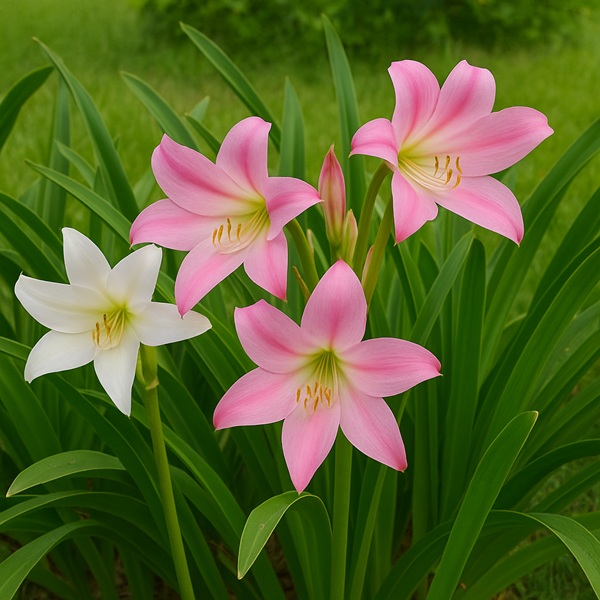
Crinum is a graceful bulbous perennial from the amaryllis family, admired for its size, fragrance, and longevity. In nature, there are more than 100 species of this plant, most of which grow in tropical and subtropical regions of Asia, Africa, Australia, and the Americas. Despite its exotic origin, many crinums adapt well to conditions in Ukraine, especially in the southern regions and in container cultivation. The plant is not only decorative but also remarkably hardy — with proper care, it can live for decades.
In appearance, crinum resembles something between a lily and an amaryllis. From its massive bulb, which can sometimes reach 20 cm in diameter, grow long strap-shaped leaves up to a meter in length. The flower stalk can reach 1.5 m and bears an inflorescence of 6–20 funnel-shaped or tubular flowers. The color ranges from white to pink and crimson, and the fragrance becomes stronger in the evening. As crinum ages, it only becomes more vigorous — after 3–4 years it forms a large clump, resistant to drought and capable of blooming twice a year.
The most common species for cultivation in Ukraine are:
Crinum asiaticum — an Asian crinum with narrow leaves and white tubular flowers;
Crinum powellii — a popular hybrid with pink flowers, capable of overwintering in a mild climate;
Crinum jagus — a heat-loving species with fragrant flowers, native to Africa;
Crinum moorei — pink-flowered, ideal for container growing.
Crinums are divided into terrestrial and aquatic types. The former grow well in soil or pots, while the latter thrive near bodies of water or partially submerged in water. Thanks to this diversity, crinums are highly valued by landscape designers: even a single specimen creates a striking focal point.
Planting crinum is not difficult, but it does require precision. First of all, you need to decide whether the plant will overwinter in open ground or be dug up. In the southern regions of Ukraine, such as Odesa, Mykolaiv, and Zakarpattia, crinums can be planted in open ground and covered for winter. In the northern and central regions, it is better to grow them in containers so they can be moved indoors.
Before planting, the bulbs should be inspected, cleaned of dry outer scales, and dried slightly. They are planted in spring, once the soil has warmed to +15°C. The location should be well lit and protected from standing water. The bulb is planted 15–20 cm deep, with the top remaining near the surface or slightly exposed. When planting in a container, good drainage is essential: expanded clay, gravel, or brick chips work well.
The soil mix should consist of turf soil, humus, and sand in a ratio of 2:1:1. After planting, water with warm water. For the first few days, shade the plant from direct sun while it adapts. If the plant is in a container, once warm weather arrives it is worth moving it outdoors — onto a terrace, veranda, or into the garden.
The spacing between plants in group plantings should be 30–40 cm. Crinum tends to spread strongly, so this is important. If planting is successful, leaf growth begins in 6–8 weeks, followed later by flower stalks. However, most species bloom only in the second year after rooting.
Crinum is a subtropical plant, so it loves light, warmth, and regular moisture. Without enough sunlight, the flower stalks become weak or fail to form at all. Indoors, it is best placed on a south- or southeast-facing window. In shade, the leaves stretch out, become pale, and flowering does not occur.
Watering should be abundant, but without water stagnation. During the active growing season, water 2–3 times a week, depending on how quickly the top layer of soil dries out. During budding, watering can be increased slightly, and after flowering it should be gradually reduced. In autumn, water once a week or less often; in winter, only minimally. Cold water is not suitable for crinums — use only settled water at room temperature.
Additional misting is acceptable on very hot days, but it is not essential. The plant does well in normal indoor humidity. What should be avoided are drafts and sudden temperature changes. The optimal summer temperature is +22 to +28°C, and in winter +12 to +16°C. This drop in temperature helps the plant enter its dormant phase, which is necessary for bud formation in the following season.
Despite its hardiness, crinum may suffer from diseases typical of bulbous plants, especially in conditions of overwatering or poor drainage. In the Ukrainian climate, where spring waterlogging and unstable temperatures are common, prevention should not be neglected.
The most common problems include:
Gray rot. It develops because of excess moisture and cool conditions. Brown spots with a gray coating appear on the leaves and spread quickly. The first steps are to remove the affected leaves, treat with a fungicide, and reduce watering.
Fusarium. This fungal disease affects the roots and the bulb. Signs include yellowing leaves, limp growth, and an unpleasant smell coming from the soil. Repotting with complete soil replacement and disinfection of the bulb is necessary.
Scale insects and spider mites. These appear when the plant is grown indoors in dry air. You can detect them by sticky residue or webbing. Spraying with insecticides such as Fitoverm, along with mechanical removal of pests, helps.
Common gardening mistakes include overfeeding with nitrogen, planting in soil that is too dense or too acidic, and heavy watering in cold weather. Even something as simple as misting on a cloudy day may trigger a fungal infection. It is important to inspect the root zone regularly, since that is where the first signs of problems usually appear.
Crinum can be propagated in two ways: by dividing offsets and by seed. Both methods have their advantages and disadvantages.
1. Dividing offsets is the simplest and most reliable method. A mature crinum produces “babies” — small bulbs that grow around the mother bulb. These are separated during spring repotting. Before planting, the cut surface is dried for 1–2 days, dusted with ash or charcoal, and then planted in a loose substrate.
The advantages of this method are quick rooting, preservation of the mother plant’s traits, and earlier flowering, often within a year or two. The main thing is not to divide bulbs that are too small or immature and have not yet formed roots.
2. The seed method is less common, but interesting for breeders. Seeds are sown immediately after collection, without burying them, on a moist surface. Seedlings appear in 2–4 weeks. During the first years, the plant develops slowly and blooms in the third or fourth year.
The advantages are the possibility of obtaining new forms and flower shades. The disadvantages are the long wait for decorative value and the plant’s high sensitivity at early stages. In Ukraine, division is used much more often because it is the more stable method.
For crinum not only to survive but to bloom reliably, it is important to take its seasonal development into account. Here are the main guidelines for each season:
Spring:
– the start of vegetation; first feeding with a mineral fertilizer;
– repotting and division of bulbs;
– more active watering;
– moving potted plants to a sunny place.
Summer:
– abundant watering, but without stagnant water;
– feeding once every two weeks;
– removing faded flower stalks to prolong blooming;
– placing the plant outdoors whenever possible.
Autumn:
– reducing watering;
– preparing for dormancy: stopping feeding and cutting off dry leaves;
– moving container plants to a cool place;
– covering outdoor plants with agrofabric or mulch.
Winter:
– full dormancy; watering is minimal or stopped completely;
– keeping the temperature at +8 to +12°C;
– no repotting or feeding is needed;
– it is important to prevent overwatering and drafts.
With the right care cycle, crinum can bloom every year, produce new bulbs, and continue decorating a garden or home for many years.