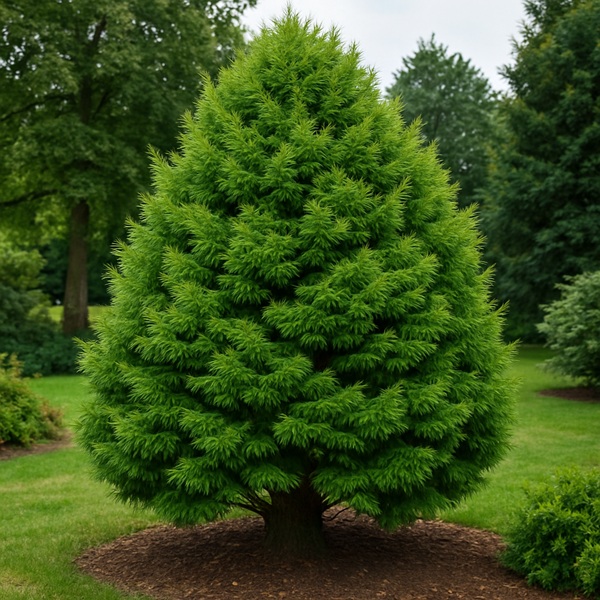
Cryptomeria is an evergreen coniferous tree native to East Asia, primarily Japan and China. In Japan, it is known as sugi and is considered the national tree. In its natural habitat, cryptomeria reaches 40–50 meters in height, forming a straight, powerful trunk and a symmetrical crown. In ornamental horticulture, especially in Europe, compact cultivars are more commonly used, suitable for home gardens, parks, and container growing. Its main aesthetic feature is its soft, fluffy needles with a delicate texture, which are bluish green in summer and turn bronze or reddish in winter.
Although botanically there is only one species — Cryptomeria japonica — dozens of garden forms have been bred within this species, among which the most popular are:
‘Elegans’ — a shrub-like form 2–4 m tall, with soft needles that turn red in winter;
‘Vilmoriniana’ — a dwarf spherical cultivar, ideal for rock gardens;
‘Globosa Nana’ — a dense globe up to 1 m in diameter, with decorative needles all year round;
‘Sekkan-sugi’ — an unusual form with golden-yellow young shoots.
Cryptomeria attracts landscape designers with its rich texture, soft lines, and changing color throughout the year. It combines beautifully with junipers, yews, rhododendrons, and ornamental grasses. Ukrainian conditions, especially in the southern and western regions, make it possible to cultivate it successfully in open ground with minimal winter protection. With every year, cryptomeria becomes more and more popular: it is increasingly planted in private gardens, botanical collections, and urban green spaces.
Planting cryptomeria requires care, especially under Ukraine’s climatic conditions, where winters can be unstable. The best time for planting is spring or early autumn, so the plant has enough time to establish itself well. A sunny or partially shaded place should be chosen, protected from strong wind. Cryptomeria does not tolerate sharp temperature fluctuations or dry air, so it is best planted near fences, walls, or next to deciduous trees.
The soil should be slightly acidic, loose, and well drained. To improve moisture retention and preserve acidity, it is advisable to add conifer litter, peat, or sawdust. The planting hole should be twice the size of the root ball. A drainage layer of pebbles or broken brick must be placed at the bottom. The soil mix for filling the hole consists of turf soil, humus, and sand in a ratio of 2:1:1. After planting, the plant is watered, and the root zone is mulched to preserve moisture and warmth.
Cryptomeria has a sensitive root system, so transplanting mature plants is desirable only in extreme cases. Young container-grown seedlings tolerate transplanting more easily — the main thing is not to disturb the root ball. It is best to choose plants with a closed root system, as they adapt more quickly to Ukrainian garden conditions. It is also worth trimming overly long branches before planting to reduce moisture loss and stimulate rooting.
Despite its visual similarity to other coniferous crops, cryptomeria has its own unique care requirements, especially in the first years after planting. The most important thing is to maintain stable, moderate moisture. The plant dislikes both drying out and overwatering. In summer, it should be watered once every 3–4 days; in cooler weather, 1–2 times a week. The water should be warm, soft, preferably rainwater or settled water.
Lighting greatly affects its appearance: in partial shade the needles darken and lose density, while in bright sun in the southern regions burns may appear. Ideal conditions are morning sun or light shading during the day. Indoors, it is important to choose a bright place without direct midday rays, and the container should be turned from time to time to ensure symmetrical growth.
Useful cultivation practices include regular mulching, especially in the first year after planting, loosening the soil after rain, and applying fertilizer. From spring until mid-August, cryptomeria is fed once a month with complex mineral fertilizers for conifers. In summer, foliar feeding with magnesium or iron chelates is beneficial — it stimulates vivid needle coloration. Starting in September, all feeding should stop so as not to encourage new growth before the cold weather arrives.
Cryptomeria is fairly resistant to diseases and pests, especially in open ground. But if the watering regime is disturbed, ventilation is poor, or the planting is too dense, typical conifer problems may appear. The most important thing is to notice the symptoms in time and prevent them from developing.
The main diseases include:
Fungal infections caused by overwatering or poor drainage. A sign is yellowing and needle drop, along with rotting in the root zone. The solution is to reduce watering, improve drainage, and replace the top layer of soil.
Fusarium — appears as brown spots on the needles and browning of the lower shoots. Treatment: apply a fungicide based on copper or triazoles, and thin the crown carefully to improve air circulation.
Mold near the root collar — a sign of stagnant water. In this case, remove the top layer of soil, allow the base to dry out, and stop watering until the plant fully recovers.
Among pests, aphids, scale insects, and spider mites may occasionally appear in open ground. Most often this happens when growing in pots or in greenhouses. Signs include sticky coating, shoot deformation, and fading needles. Treatment: broad-spectrum insecticides such as Aktara or Fitoverm, as well as preventive infusions of garlic, chamomile, or yarrow.
A separate problem is winter burn. During periods of sharp temperature changes and bright sun, the needles may dry out, change color, or curl. This most often happens in young seedlings. To avoid damage, it is recommended in February–March to place screens against the southern sun or cover the plant with agrofabric.
Under Ukraine’s climatic conditions, cryptomeria is best propagated vegetatively — that is, by cuttings or division. The seed method is more difficult and requires stratification, so it is used mainly in nurseries and botanical gardens.
Cuttings.
The best period is summer, from June to August. Semi-woody shoots 10–15 cm long are selected, and the lower needles are removed. The cutting is treated with a rooting stimulant, such as heteroauxin, planted in a moist peat-sand mix, and covered with film or glass. The temperature should be +20 to +24°C. Rooting takes 1.5–2 months. After that, the cuttings are transplanted into pots or onto a bed under cover.
Division of the bush is possible only for some dwarf forms that have several trunks. This is done during transplanting: one part of the plant is carefully separated with roots, excess needles are trimmed, and it is planted in a new place. After planting, the soil should be moistened regularly and overheating should be avoided.
Growing from seed is possible, but labor-intensive. Cryptomeria seeds require stratification for 2–3 months at a temperature of +2 to +5°C. Sowing is done in spring in a light, moist substrate. Seedlings emerge slowly, growth is prolonged, and it takes 3–5 years for the plant to reach a decorative appearance.
Recommendation: when choosing planting material, give preference to local seedlings that are already adapted to the conditions of your region. This ensures better establishment and greater resistance to stress.
To keep cryptomeria decorative and healthy, it is important to follow a yearly care cycle. Below is a seasonal scheme for a private garden or container growing.
Spring:
– remove winter cover;
– carry out sanitary pruning of damaged shoots;
– apply the first mineral fertilizer with nitrogen;
– water carefully, as the soil dries out;
– seedlings can be transplanted.
Summer:
– regular watering, especially in hot weather, and mulching around the trunk;
– feeding once every 3–4 weeks;
– cuttings can be taken;
– loosening the soil and controlling weeds;
– checking for pests.
Autumn:
– stop feeding;
– reduce watering;
– treat against fungal diseases;
– mulch the root zone;
– for container plants, move them to shelter or a veranda.
Winter:
– dormant period;
– young plants should be under nonwoven cover;
– protection from snow and sunburn;
– minimal care, only visual monitoring of condition.
By following this cycle, you will get not only a beautiful but also a long-lived conifer capable of decorating the garden for decades.