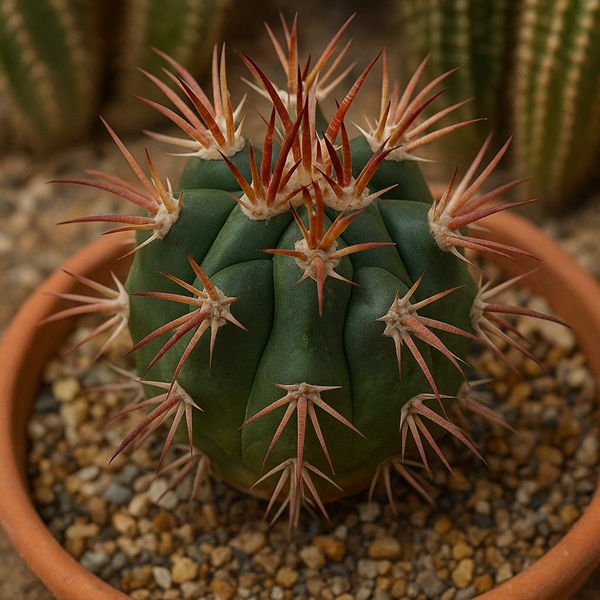
Ferocactus is a genus of cacti whose name comes from the Latin ferox — “fierce” or “wild.” It is an impressively accurate description of the plant’s appearance: powerful curved spines like claws, a thick stem, and a bright symmetrical form. In nature, ferocacti grow in the deserts of the southern United States, Mexico, and northern Central America. Among Ukrainian succulent enthusiasts, these cacti have become popular thanks to their decorative appeal, endurance, and relative ease of care.
The genus includes about 30 species, which differ in shape, size, flower color, and spine characteristics. The ones most often found in home collections are:
Ferocactus wislizeni — a large species with red flowers, reaching up to 60 cm in height;
Ferocactus latispinus — has broad, sickle-shaped curved spines and blooms with violet-pink flowers;
Ferocactus glaucescens — a compact species with a gray-green body and yellow flowers;
Ferocactus cylindraceus — an elongated stem shape and very long, hooked spines.
In nature, some species can reach 2–3 meters in height, forming true cactus “trees.” Indoors, including in Ukraine, plant growth is limited by the confined space of the pot, light intensity, and temperature conditions. Even so, even young specimens always look impressive thanks to their ribbed sculptural bodies and powerful spines. They decorate the interior while also serving as prized collector’s plants for experienced growers.
Planting a ferocactus is not just a matter of moving the plant into a new pot. It is a strategically important stage that determines how healthily and actively it will develop. In the Ukrainian climate, where humidity is often excessive and lighting unstable, it is especially important to create conditions that are as “desert-like” as possible.
Soil. The substrate should be mineral, airy, and almost free of organic matter. The optimal mix is 2 parts washed sand, 1 part turf soil, and 1 part fine gravel or crushed brick. Perlite or zeolite will help improve drainage. To prevent fungal diseases, it is recommended to add a little charcoal. Garden soil is not suitable — it is too heavy and retains moisture for too long.
Pot. Clay or ceramic containers are best — they breathe, do not overheat, and quickly remove excess water. The pot should exceed the plant’s diameter by 2–3 cm, and its depth should be at least two-thirds of the ferocactus’s height.
Placement. The best location is a south- or southeast-facing window, balcony, or loggia with bright light. In warm weather, the plant can be moved outdoors, provided it is protected from rain and not kept in shade. In winter, when natural light is insufficient, supplemental lighting is worth adding — a grow light is an excellent solution.
Repotting. Young ferocacti are repotted every year, mature ones every 3–4 years. After repotting, the plant should not be watered for 5–7 days to avoid root rot. The neck of the plant must not be buried — this is another potential risk zone.
Watering a ferocactus requires precision. It should not be done “out of habit,” as with ordinary houseplants. In summer, during active growth, ferocactus is watered once every 10–14 days, making sure the substrate has dried out completely. The water should be soft, settled, and at room temperature. Water must not be poured directly into the center of the plant — this is one of the main causes of rot.
In autumn, watering is gradually reduced, and with the onset of cold weather it is stopped completely. If the temperature drops to +10...+12°C, ferocactus should enter its dormant phase. This is essential for the formation of flower buds for the following season. Without a rest period, the plant will either not bloom at all or produce deformed growth.
As for air humidity, ferocactus does not need misting. On the contrary, it prefers dry air. That is why it is ideal for apartments with central heating. It is only important to avoid stagnant air and to ventilate the room from time to time.
An interesting fact: experienced cactus growers note that during sudden changes in atmospheric pressure or humidity, ferocacti may “creak” or “crackle” with their spines. This is not a sign of disease, but a reaction to changing climatic conditions — tiny shifts within the plant’s tissues. This sensitivity once again shows how closely the plant “monitors” the environment around it.
Ferocactus is considered a hardy plant, but if the key care conditions — light, watering, and soil — are disrupted, it quickly loses its decorative appeal or becomes ill. This plant is especially sensitive to excess moisture. In the Ukrainian climate, this is a common issue: damp springs and cool balconies can lead to rot even for experienced growers.
The greatest risk is root rot. It develops slowly: first the ferocactus loses firmness, then the base darkens, and the stem becomes soft. The longer you wait, the greater the chance of losing the plant. If you notice anything like this, act immediately: carefully remove the plant from the pot, cut away the affected roots, dust the cuts with charcoal, and repot it into fresh, completely dry substrate. After that, do not water it for at least a week.
Other possible problems include fungal infections such as fusarium and dry rot, which may appear as spots or cracks on the stem. If the damage is limited, pruning and fungicide treatment may help; if most of the body is affected, the plant is difficult to save. Prevention is the best solution here: sterile soil, drainage, and ventilation. And remember: with ferocactus, excessive care is more harmful than brief neglect.
It is also worth watching for pests. Aphids, spider mites, or root mealybugs may come in with the soil or with new plants. Once a month, it is a good idea to inspect not only the stem but also the root zone. If a pest is found: isolate the plant, treat it with an insecticide, and monitor neighboring plants.
Ferocactus is not the kind of cactus that readily produces offsets. Under home conditions, the most effective methods are two: seed propagation and, in rare cases, side shoots. Grafting is also used, but mainly among experienced collectors.
Sowing seeds is the most reliable option. Seeds are sown into a sterile substrate based on sand, perlite, and a minimal amount of peat. They are not buried, only lightly pressed into the moist surface. The container is covered with film or glass and kept at +24...+26°C. Seedlings usually appear within 7–20 days. During the first few weeks, it is important to avoid direct sunlight and keep them in soft, diffused light. After a few months, the seedlings are pricked out into separate pots.
This method requires patience: you will have to wait at least 4–5 years for flowering. But in return, you get a full, strong generation of plants adapted to your environment.
Side shoots, if they appear, can be separated in summer. The cut must be dried for several days, after which the shoot is rooted in dry sand. Watering is completely excluded for the first 2–3 weeks. This method is suitable for species such as Ferocactus glaucescens.
Grafting is used to save weakened plants, preserve rare varieties, or accelerate growth. Echinopsis is usually used as the rootstock. Grafting should be done with sterile tools, in a well-lit room, at a temperature no lower than +22°C. The method is effective, but it requires skill.
If you want your ferocactus to be more than just a spiny “spherical decoration,” but a fully healthy plant with a chance to bloom, adjust its care cycle to the seasons.
Spring. Awakening. Begin watering with a small amount of water once every 10–14 days. If repotting is planned, this is the right time. Spring is also when you should begin feeding with specialized low-nitrogen fertilizers.
Summer. The most active period. Ferocactus needs lots of sun, stable warmth, and moderate watering. It can be moved to a balcony, as long as it is protected from heavy rain and overheating of the roots. Fertilizer is applied once a month. If the cactus has been kept in shade for a long time, acclimate it to direct sun gradually.
Autumn. Start reducing watering. Avoid excess moisture. Fertilizer is no longer applied. If the plant has been outdoors, move it indoors before the cold arrives. Reduce the light exposure somewhat, but do not leave the plant in darkness.
Winter. Full rest period. The ideal temperature is +8...+12°C, with no watering. If the temperature is higher, watering is possible only once every 6–8 weeks — and only if the soil has dried out completely. Lighting should be natural or weak artificial light.
With this approach, your ferocactus will not only develop harmoniously, but may also form flower buds in spring — a rather rare but extremely striking event for this genus.